When US President Donald Trump touched down in Turkey’s capital Ankara for a critical NATO summit this week, Turkish President Recep Tayyip Erdogan rolled out the most extravagant red carpet possible — a welcome tailored specifically to the 80-year-old American leader’s well-documented love of grandeur and pageantry.
Diplomatic observers have long noted that world leaders hoping to win favor with the notoriously unpredictable Trump have found few tools more effective than hosting him with ceremonies and settings fit for a monarch. Erdogan, it turns out, executed this strategy perfectly, leaning into shared tendencies that have connected the two leaders for years: a mutual affinity for opulent presidential architecture and a top-down, authoritative governing style.
Erdogan went so far as to greet Trump personally on the tarmac after he exited his newly retrofitted Air Force One. On multiple occasions, the 72-year-old Turkish leader guided Trump by the arm as the pair walked off the plane. That aircraft itself offers a subtle backdrop to how world leaders have already shaped Trump’s views: the retrofitted jet was a controversial gift to the US from Qatar’s royal family in 2024, gifted after Trump publicly complained that the older presidential transport plane was unacceptably outdated and embarrassing.
After the airport greeting, Trump’s motorcade processed through central Ankara to the sprawling Bestepe Presidential Compound, popularly known as the “White Palace.” Mounted Turkish riders flanked the presidential limousine along nearly empty city streets, where a full honor guard in crisp red and blue uniforms waited to receive him. As the US national anthem *The Star-Spangled Banner* played, Trump stood at attention, and even attempted to deliver a short greeting in Turkish — a small gesture that fit the festive tone of the day. The ceremony concluded with a dramatic flyover by Turkish fighter jets, which left trails of red, white, and blue smoke trailing across the Ankara sky. Adding a theatrical historical flourish, two dozen soldiers clad in replica Ottoman-era armor, pointed helmets, and stylized false facial hair stood at attention outside the palace entrance.
Completed in 2014 at a total cost of roughly $615 million, the massive White Palace complex draws architectural inspiration from Turkey’s ancient Seljuk and Ottoman imperial histories. Critics have long slammed the project as a symbol of Erdogan’s alleged authoritarian excess, pointing to its huge price tag as evidence of his increasingly autocratic leanings. But for Trump, the opulent complex was the perfect setting to leave an impression: the palace features soaring atriums lined with rare onyx and polished green marble, a level of grandeur that aligns perfectly with Trump’s long-admired fascination with the lavish residences of foreign leaders.
As he pursues his second term in office, the former real estate billionaire has made no secret of his goal to reshape Washington D.C. into an imperial capital matching his personal vision. He has already demolished an entire wing of the White House to construct a $400 million grand ballroom, drawn up plans for a massive triumphal arch he has named the “Arc de Trump,” and launched a sweeping, multi-million dollar initiative to renovate the nation’s capital’s iconic monuments.
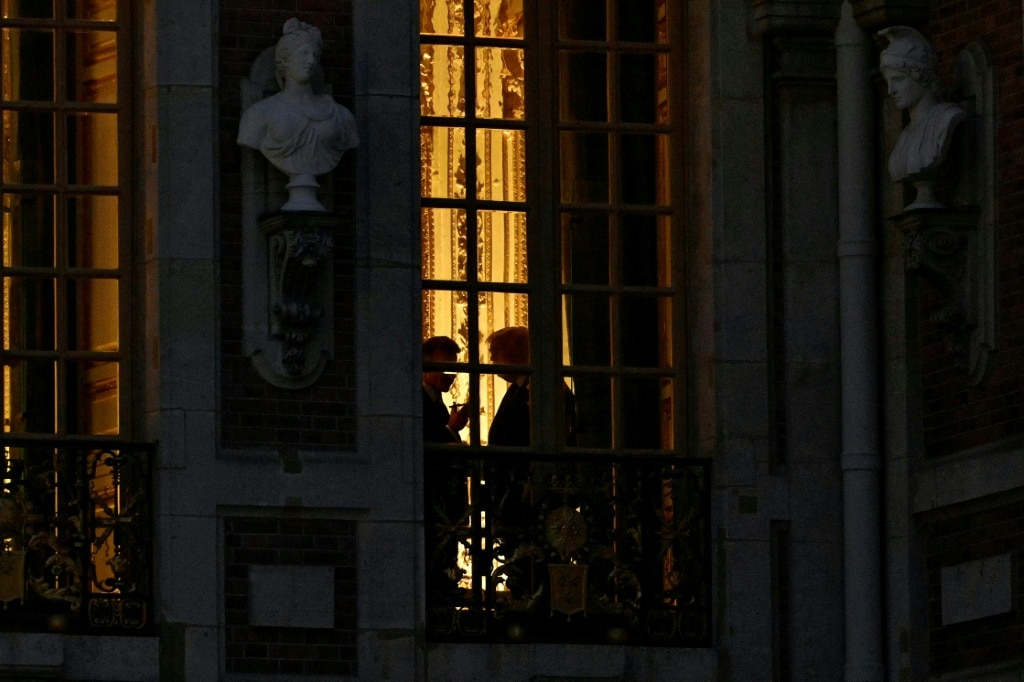
This strategically opulent welcome from Erdogan fits into a clear pattern that has emerged across Trump’s second term: foreign leaders have learned to leverage the US president’s well-known obsession with palatial splendor to win goodwill. Just last month, French President Emmanuel Macron hosted Trump for a private state dinner at the Palace of Versailles following a G7 summit, where Trump praised the former residence of King Louis XIV as “the real deal.” Earlier in 2025, Chinese President Xi Jinping welcomed Trump with a full ceremonial welcome at Beijing’s Great Hall of the People, followed by a visit to the Temple of Heaven and private tea at the exclusive Zhongnanhai leadership compound. In September 2025, Britain’s King Charles III hosted Trump for a full state visit at Windsor Castle, complete with a ceremonial flyover and extensive pageantry — and Trump was still talking about the castle earlier this week, incorrectly describing it as “the longest building I’ve ever seen.” During a May 2025 visit to the Middle East, Trump openly expressed envy for his Arab hosts’ accommodations, praising the marble in Qatar’s royal palace as “perfecto” and marveling at the scale of Saudi Arabia’s modern architectural projects.
In Turkey, one small personal gesture seemed to leave a particularly strong impression on Trump: he told reporters that Ankara’s airport had named a building after him, a tribute that left him “very happy.” The good mood came even as a US court recently blocked Trump’s own plan to add his name to Washington D.C.’s John F. Kennedy Performing Arts Center. After the arrival ceremony, Trump praised Erdogan to reporters, calling him “a great leader” and emphasizing that the relationship between the two leaders and their nations has been “very special.”