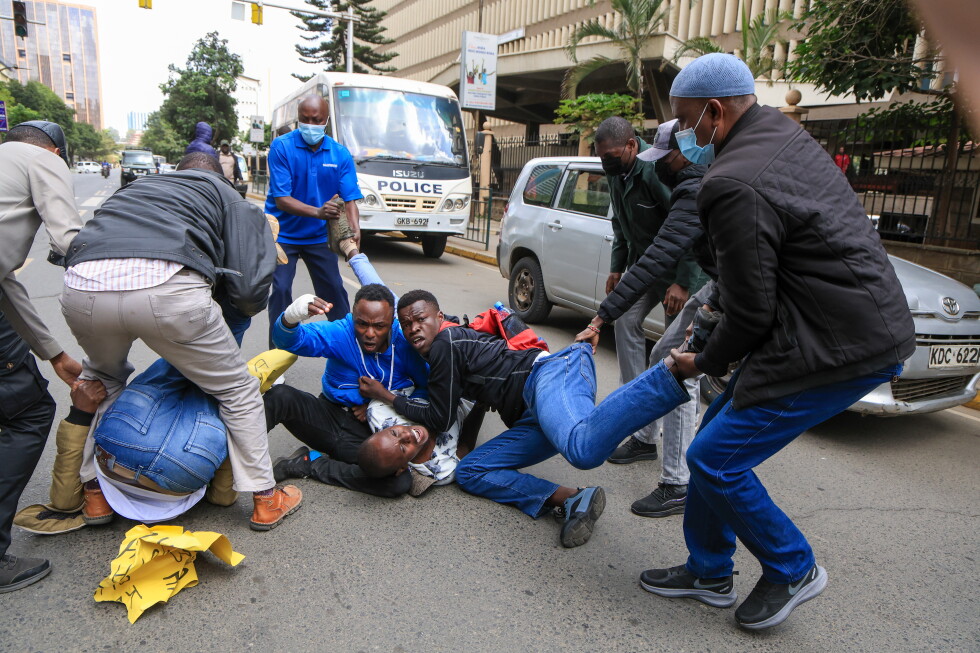
On Tuesday, a date carrying deep symbolic weight for both East African nations of Kenya and Tanzania, large-scale deployments of security forces successfully prevented planned opposition protests from going forward in both countries’ capitals.
July 7 holds distinct historical meaning for each neighbor. For Kenya, the date marks the 1990s pro-democracy movement that fought to establish multiparty rule, a landmark moment in the country’s democratic journey. For Tanzania, the date commemorates the 72nd founding anniversary of the organization that eventually became its current ruling party.
In Tanzania, the planned protests had two core demands: sweeping democratic reforms in the wake of a deeply contested October 2024 general election, and the immediate release of prominent opposition leader Tundu Lissu, who remains in custody on charges of treason that critics call politically motivated.
In Dar es Salaam, Tanzania’s bustling commercial hub, joint units of uniformed police and military personnel were positioned across key urban areas ahead of the scheduled protests. By the end of the day, no assembled protesters had been spotted in public spaces, and the city’s annual trade fair operated as scheduled under heavy armed guard.
Speaking to reporters ahead of the protest date on Monday evening, Tanzania’s Home Affairs Minister Patrobas Katambi made clear the government’s hardline stance. “Tanzania is not a country where any group can unilaterally dictate when and where protests will be held,” Katambi said, adding that state security forces were fully prepared to act against any action that threatened public order.
Political analysts note that the Tanzanian government has maintained an elevated state of alert ever since the disputed October election, when post-vote protests and a subsequent government crackdown left hundreds of people dead across the country.
Wade Green, a threat analyst at Aldebaran Threat Consultants, explained that for any protest movement to successfully challenge the current security posture, organizers would need to catch state forces off guard. “Right now, security forces are on extremely high alert across the country,” Green noted. “Unless opposition protesters are exceptionally well-organized and numerically overwhelming, they have no way to counter the lethal force that Tanzanian security forces deployed last year, and are fully prepared to use again.”
In Kenya’s capital Nairobi, the security response was equally robust. Police cordoned off the country’s parliamentary buildings with rolls of barbed wire, blocked access to major arterial roads, and took a small number of people into custody. Most businesses across the capital remained shuttered for the day as a result of the security buildup.
Senior Kenyan opposition politician James Orengo condemned the heavy police deployment, framing it as a deliberate campaign to intimidate ordinary citizens. “This is exactly what a police state looks like,” Orengo said. “Police are deployed en masse even when there is no unrest, no march, no active demonstration; roads are emptied of traffic, and even holding a simple press conference becomes nearly impossible. But we will not be deterred.”