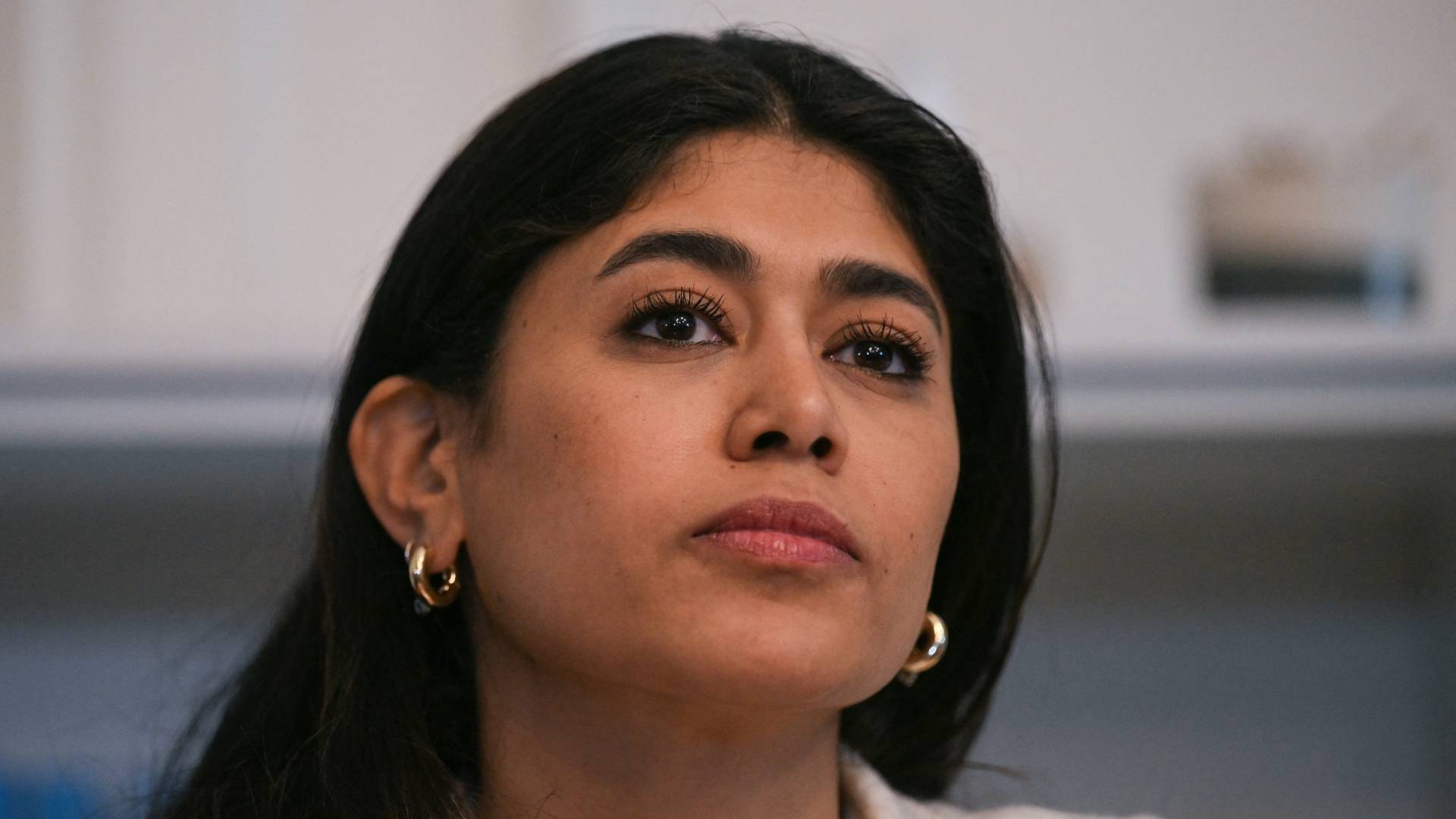
When French-Palestinian politician Rima Hassan made history in June 2024 as the first person of Palestinian heritage elected to the European Parliament from France, she did not anticipate the coordinated campaign of targeting that would quickly follow. Just months after taking office, the Left Group MEP, affiliated with France’s left-wing La France Insoumise (LFI) party, is set to stand trial on Tuesday on charges of “apology for terrorism” — a French criminal offense that penalizes speech deemed to endorse or glorify terrorist acts.
In an exclusive interview with Middle East Eye on the eve of her trial, Hassan framed the prosecution as nothing less than an organized effort to muzzle her for speaking out against Israel’s occupation of Palestinian territory and allegations of genocide. Her case is far from an isolated incident: over the past two years, 16 separate judicial proceedings have been launched against the outspoken advocate, 13 of which have already been thrown out for lack of merit.
The current charges stem from a post Hassan shared on the social platform X back in April 2025. The post featured a quote from Japanese militant Kozo Okamoto, convicted of involvement in the 1972 Lod Airport attack in Israel that left 26 people dead. It read: “Kozo Okamoto: I gave my youth to the Palestinian cause. As long as there is oppression, resistance will not only be a right, but a duty,” alongside images of the Japanese and Palestinian flags.
In a pre-trial statement, Hassan’s team clarified that the quote was intended to highlight a long-recognized principle of international law: the right of occupied peoples to resist foreign colonial rule. To avoid any misinterpretation of her words, Hassan deleted the post shortly after publishing it. The complaint that led to prosecution was filed by far-right National Rally MP Matthias Renault, France’s interior minister, the European Jewish Organization (OJE), and the League Against Racism and Anti-Semitism (Licra), with public prosecutors — who operate under the oversight of France’s executive branch — moving forward with the case.
Hassan alleges that the pressure she has faced extends far beyond routine legal proceedings, with what she describes as grossly disproportionate investigative tactics that violate her status as an elected representative. When she was taken into police custody in April, authorities violated her parliamentary immunity — a legal protection designed to shield MEPs from state interference and protect their freedom of speech — holding her for more than 13 hours. During questioning, she was subjected to invasive, irrelevant interrogation about her identity, ethnic origins, and religion.
“This way of proceeding is part of a political climate in which Palestinians, or people perceived as such, are too often regarded as suspects before they are regarded as citizens,” Hassan told MEE. “This reflex, fuelled by Islamophobia and anti-Palestinian racism, constructs the dangerous figure of the ‘enemy within’,” she added, echoing the label already applied to her by much of France’s established political class.
Through her legal team and independent French outlet Mediapart, Hassan has uncovered details of sweeping surveillance measures mobilized against her. Authorities ordered retroactive surveillance of her mobile phone starting at the beginning of the year, and requested full travel data from French rail operators SNCF and Thalys, airline Air France, and Europol to map every movement she made between January and early March. Hassan notes that such invasive tactics are typically reserved for investigations into the most serious organized crime, not alleged speech offenses.
Compounding the abuse, false claims that Hassan possessed illegal narcotics were leaked to the press during her detention, in a deliberate violation of investigation confidentiality. French investigative outlet Le Canard Enchainé reported that the leak was directly coordinated by Sacha Straub-Kahn, spokesperson for France’s Ministry of Justice. “The objective was clear: to divert the political debate, tarnish my reputation, and plant suspicion in public opinion,” Hassan said. After her release, she clarified that she only carried CBD for medical purposes, framing the leak as a coordinated disinformation operation designed to undermine her standing. “When rumor replaces facts, democracy itself is weakened,” she added.
Following Hassan’s complaint over the breach, Paris prosecutors opened an investigation into the leak, and France’s justice minister referred the matter to the General Inspectorate of Justice. Straub-Kahn has since filed a defamation suit in response to the allegations.
Hassan’s case is not an anomaly, but the most high-profile example of a broader crackdown on pro-Palestine speech in French politics, particularly targeting members of the left-wing LFI party. In 2024 alone, left-wing politician Anasse Kazib was summoned by police as part of an anti-terror probe over pro-Palestine tweets; LFI Member of Parliament Sebastian Delogu was suspended from the National Assembly for 15 days and had his pay cut in half for two months after waving a Palestinian flag during a session; and Mathilde Panot, LFI’s leader in the National Assembly, was summoned for questioning over the party’s October 7 statement on the Israel-Gaza war, with a probe into alleged “apology for terrorism” that was ultimately dismissed. Ahead of 2024 municipal elections, three LFI mayoral candidates who publicly supported Palestine were targeted in a smear campaign linked to an Israeli private intelligence firm.
Official data from France’s Ministry of Justice confirms the sharp escalation in crackdowns: the number of “apology for terrorism” prosecutions tripled between October 2023 and November 2024, compared to the nine months prior. Marc Trevidic, a former anti-terrorism investigating judge with nine years of experience in Paris, has publicly denounced what he calls a widespread “misuse of anti-terrorism legislation” by French magistrates. “We are witnessing a genuine abuse, a completely perverted use of the law,” Trevidic stated in a 2024 interview with TRT France.
For Hassan and her legal team, the trial exposes a dangerous inversion of accountability: “Those who denounce a genocide are being prosecuted, rather than those responsible of committing it,” the team argues. “This judicialisation of public debate seeks to make any criticism of the policies pursued by the Israeli government politically costly. It is a way of silencing a political voice rather than responding to it democratically,” Hassan said. “All these measures follow the same logic: creating a climate of intimidation in order to discourage civic engagement.”
Hassan has filed multiple legal challenges to the alleged investigative abuses, and is pushing for a full acquittal in her July 7 trial. Beyond her own case, she says she hopes the high-profile proceeding will spark a broader public reckoning with the crackdown on pro-Palestine speech in France. “The facts alleged against me do not justify this procedure,” she said, “but beyond my personal situation, I hope this trial will lead to a collective awakening.”