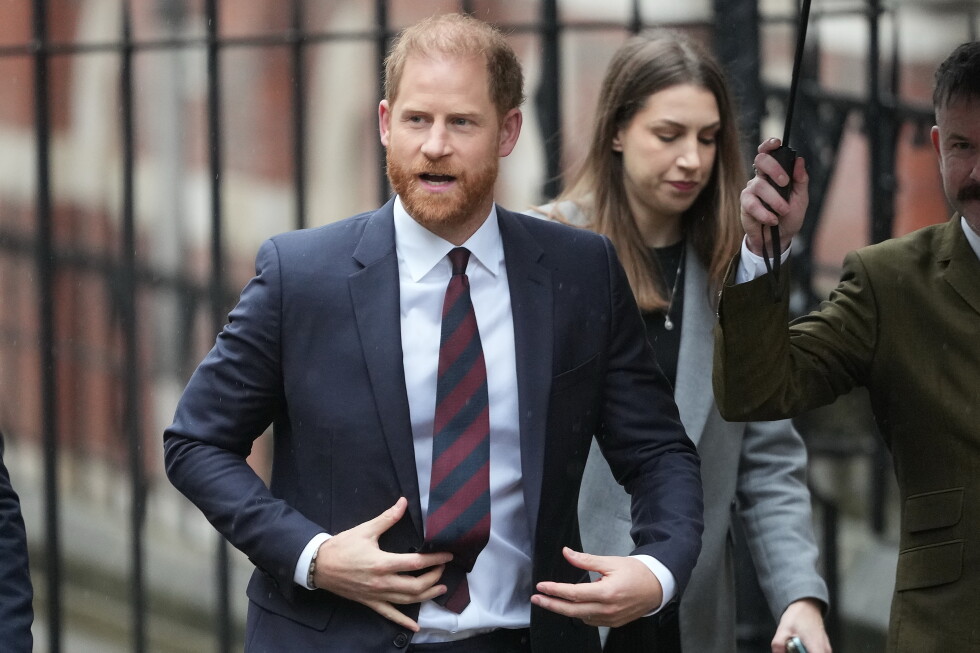
LONDON — After months of high-stakes testimony, explosive contradictions, and years of public conflict between the British royal family and the country’s tabloid press, Prince Harry’s long-running legal battle over privacy invasion is set to reach a pivotal turning point on Tuesday, as a London High Court justice hands down a ruling in his lawsuit against Associated Newspapers Ltd., publisher of the *Daily Mail* and *Mail on Sunday*. This verdict closes the third in a series of high-profile lawsuits Harry has brought against British news outlets over allegations of unlawful information gathering.
The case unites Prince Harry with six other high-profile claimants, including music icon Elton John, actors Elizabeth Hurley and Sadie Frost, anti-racism activist Doreen Lawrence, former lawmaker Simon Hughes, and David Furnish, in a pursuit of substantial compensatory damages. The 11-week legal proceeding has racked up an estimated £40 million ($53.5 million) in total legal costs, making it one of the most expensive celebrity privacy cases in recent British history.
The core allegation from claimants is that Associated Newspapers oversaw a systemic, years-long campaign of unlawful snooping, leveraging in-house journalists, freelance contributors, and private investigators to tap phones, intercept private voicemails, and obtain sensitive personal information through deceptive means. Hurley laid bare the human impact of the alleged intrusions in her testimony, accusing the outlet of planting listening devices outside her home and stealing confidential medical records. “It is like there is someone peeping into your life and into your home,” she told the court. “My private life had been violated by violent intruders — that there had been sinister thieves in my home all along and that I had been living with them completely unaware.”
For Prince Harry personally, the lawsuit is far more than a legal dispute. It is the culmination of a decades-long mission to reform what he has called a toxic British tabloid culture, a mission rooted in the 1997 death of his mother, Princess Diana, who was killed in a Paris car crash while being chased by paparazzi. He has repeatedly blamed relentless press harassment of his wife, Meghan, Duchess of Sussex, for pushing the couple to step back from senior royal duties and relocate to California in 2020. In emotional testimony earlier this year, a tearful Harry told the court, “They continue to come after me, they have made my wife’s life an absolute misery.” He added that persistent press intrusion left him “paranoid beyond belief,” damaged his personal relationships, and inflicted lasting harm on his mental health.
Associated Newspapers has forcefully denied all allegations, dismissing the claims as preposterous. Defense lawyers argue that the roughly 50 articles at the center of the case relied entirely on legitimate, lawfully obtained sources ranging from palace spokespeople and royal aides to friends and publicists who voluntarily shared information with reporters. Lead defense attorney Antony White told the court that the claimants’ case rests on unproven speculation and biased inferences, and that Harry was quick to assume unlawful activity where none existed. Unlike a previous 2023 phone hacking case against the *Daily Mirror* that resulted in a ruling against the publisher, dozens of journalists have testified in the *Daily Mail* case to defend their reporting, with many confirming they obtained information through official channels or on-the-record sources. Former *Mail on Sunday* editor Katie Nicholl told the court that Harry’s claims of a closed inner circle were unfounded, saying, “I had very good sources in the inner circle.”
A key sticking point in the trial has centered on the timeline of allegations, many of which date back to the 1990s — long after the six-year legal deadline for bringing such claims expired. Claimants argue they were unaware of the unlawful surveillance until private investigator Gavin Burrows came forward in 2021 to admit his role in the snooping campaign. Burrows, who once publicly apologized to Harry on a BBC documentary for targeting the prince as a teenager, made a stunning reversal during this trial, testifying that he never worked for Associated Newspapers. He claimed the original statement supporting the claimants was fabricated by the plaintiffs’ legal team and that his signature was forged. The defense has argued that Burrows’ reversal completely undermines the claimants’ case, while the prosecution insists a wealth of other evidence ties the publisher to unlawful activity.
Tuesday’s verdict coincides with a rare visit by Harry back to the UK, where he is in London to attend charity events. What has dominated headlines, however, is widespread speculation over whether Harry will be reunited with his father, King Charles III, who is currently undergoing treatment for an undisclosed cancer. The meeting would mark the first time Harry has seen his father in person since the king’s cancer diagnosis was announced, and would be the first visit from Harry’s children, Prince Archie and Princess Lilibet, to the UK in several years. The potential reunion remains unconfirmed, as Harry continues to negotiate security arrangements and accommodations; the British government has repeatedly refused Harry’s requests for taxpayer-funded security during his visits, a dispute that has already spawned multiple failed legal challenges from the prince.
This ruling adds another chapter to Harry’s unprecedented break with royal tradition: three years ago, he became the first senior British royal to testify in a civilian court in more than a century. He already notched two major victories in prior press privacy cases: in 2023, he won a default judgment against *Daily Mirror* publisher Reach plc, where a judge condemned the paper for “widespread and habitual” phone hacking. Just last year, Rupert Murdoch’s *The Sun* issued an unprecedented public apology for years of intrusion into Harry’s life and settled the lawsuit with a substantial damages payment.