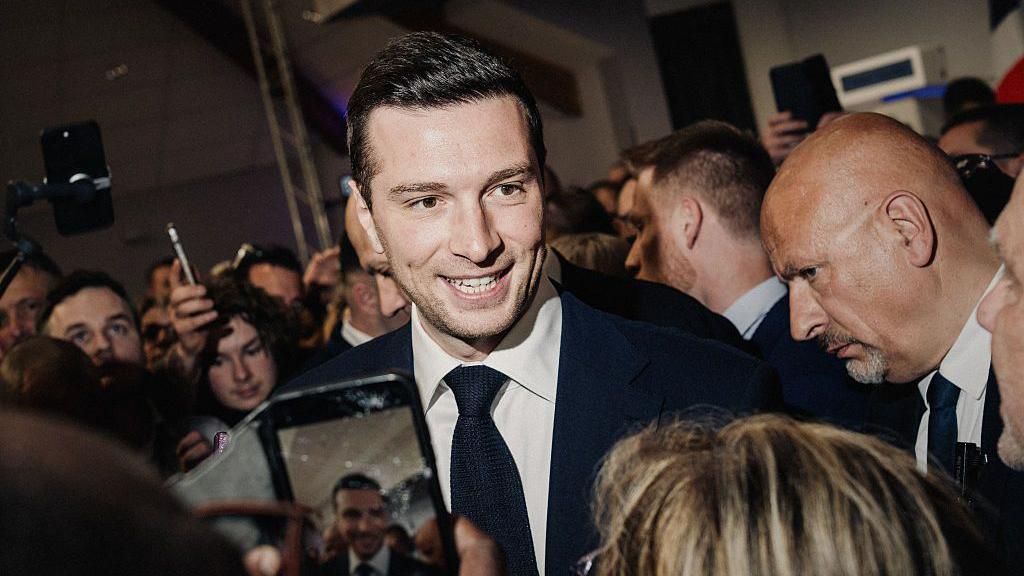
At 30 years old, Jordan Bardella, the current president of France’s far-right National Rally (RN), stands on the cusp of a historic political breakthrough: he could become the youngest head of state in modern French history, and the first hard-right leader to occupy the Elysee Palace, if a pending court ruling bars party figurehead Marine Le Pen from running in the 2027 presidential election. The upcoming Tuesday verdict on Le Pen’s appeal trial will decide whether she retains her ban from running for public office, opening the door for Bardella to step in as the RN’s nominee. With the party holding a commanding lead in national polls and Bardella posting strong 40% approval ratings, political observers now consider a presidential victory in 2027 a plausible outcome.
Bardella’s path to this moment began in the working-class Paris suburb of Seine-Saint-Denis, where he was raised by his Italian immigrant single mother, who often struggled to cover household expenses. While his father – also of Italian descent – owned a successful drinks distribution business in the more affluent town of Montmorency, a detail that softens the narrative of extreme working-class hardship Bardella often cites on the campaign trail, his background reflects a side of France far removed from the traditional elite that has long dominated the country’s politics. As a teen, Bardella even felt self-conscious about his non-traditional name, which stood out among the aristocratic, classic names common among the French political class.
Bardella joined the then-National Front (FN), the RN’s predecessor, at age 17 in 2012, after convincing his initially reluctant mother to approve the move. He dropped out of university to pursue politics full-time, climbing the party ranks at a meteoric pace: he became a local departmental secretary at 19, a regional councillor for the Paris region at 20, the RN’s national spokesperson in 2017, and one of the youngest Members of the European Parliament in 2019. By 27, he had been elected president of the RN, taking the reins of the party Le Pen had remade from a fringe extremist movement into a mainstream political force.
Bardella has long cited Le Pen as his core inspiration for joining the party, praising her unique courage, energy and political vision. That admiration quickly became mutual: Le Pen took the young rising star under her wing, elevating him to the party’s inner circle just years after he joined. In 2024, Bardella led the RN to a 33% first-place finish in snap parliamentary elections, falling just short of capturing the prime minister’s office when a center-left alliance secured a second-round victory. Despite that narrow loss, his popularity has remained robust ever since, matching Le Pen’s own steady 39% approval rating.
Political analysts and sociologists who study the RN attribute Bardella’s broad electoral appeal to his unique ability to connect with disparate voter groups. Described by sociologist Raphael Llorca as an “incredible blank canvas,” Bardella lets different voter segments project their own ideal candidate onto him. He retains old-school RN supporters by leaning into the party’s core anti-immigration and populist platform, while courting young voters through active social media outreach, where he boasts two million followers. He balances a glamorous public profile from his relationship with Italian socialite Princess Maria Carolina of Bourbon-TTwo Sicilies with constant references to his modest upbringing to connect with working-class voters. For business leaders, he promises to cut burdensome fiscal and regulatory rules; for Eurosceptics, he pledges to renegotiate France’s EU membership terms, while reassuring moderate voters he has no intention of leaving the bloc entirely.
Though he has carefully cultivated this adaptable public image, Bardella has rarely deviated from core RN policy, especially on the party’s signature issue of immigration. He has called for cutting social benefits for immigrants, ending birthright citizenship, and has promised that his first act as president would be to hold a national referendum on immigration to “take back control” of France’s borders. Critics have noted that the French constitution does not permit referendums on immigration, meaning the policy would require a lengthy constitutional amendment that would need broad parliamentary support to pass.
On European policy, Bardella has abandoned the RN’s old demand for a full French exit from the EU and the euro, but has described the bloc as “profoundly old-fashioned” and “obsolete.” He has pledged to cut France’s EU budget contribution by half – a total of €10 billion – and renegotiate the EU electricity market’s price-setting rules to lower consumer energy bills. On foreign policy, he has promised to withdraw France from NATO’s integrated military command after the end of the war in Ukraine, rejected Emmanuel Macron’s proposal to extend France’s nuclear deterrence to European allies as a potential “national betrayal”, and has built close ties with other European nationalist leaders including Italy’s Giorgia Meloni – who he calls a personal role model – and Poland’s PiS opposition, with the goal of building a large nationalist bloc in the European Parliament.
As the nation waits for Tuesday’s court ruling on Le Pen’s eligibility, Bardella has navigated a careful political balancing act, positioning himself as ready to assume the presidential nomination while vowing to stand aside if Le Pen is cleared to run. Speaking ahead of the verdict, he said he was “calm and ready to accept the consequences.” Whatever the ruling brings, the 30-year-old politician has already reshaped modern French politics, and a 2027 presidential victory would cement the most dramatic political shift in the country’s modern history.