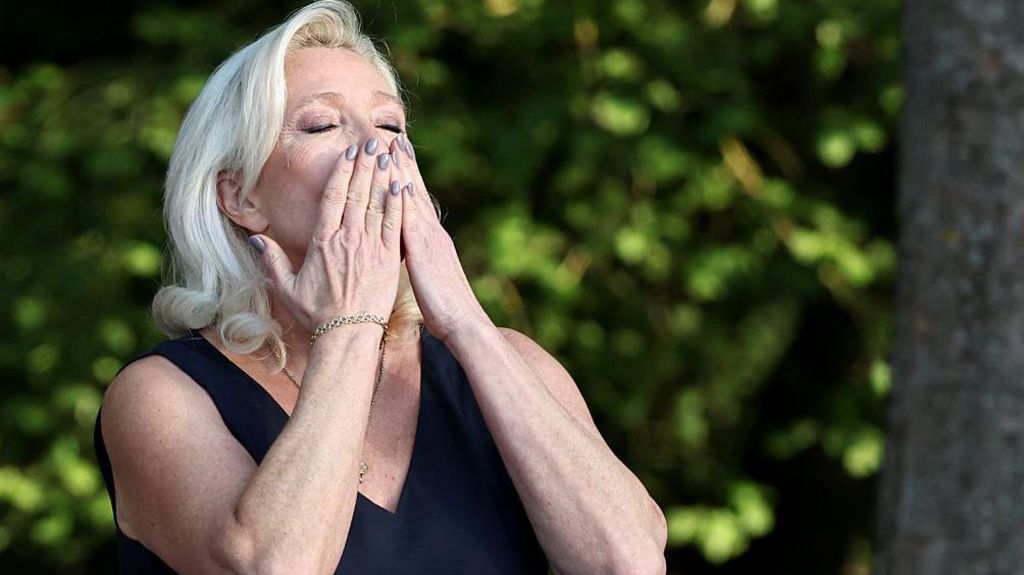
As France’s right-wing nationalist figurehead Marine Le Pen awaits a key verdict from a Paris appeals court this Tuesday, the future of her decades-long political career hangs in the balance. Should the court rule to bar her from running in the 2027 French presidential election, it would bring an abrupt close to a political journey that has reshaped the country’s far-right landscape for a generation.
In a gathering with supporters over the weekend in Liévin, located in the heart of her Pas-de-Calais constituency, the 57-year-old leader made clear her plan if the ruling goes against her: if barred from seeking the presidency, she will step back and throw her full support behind her hand-picked protégé, current National Rally head Jordan Bardella. Observers who attended the event noted that the moment carried the quiet air of a planned leadership transition, even as Le Pen and Bardella publicly presented a united front ahead of the verdict.
Le Pen’s path to this crossroads stretches back more than half a century, rooted in the legacy of her father Jean-Marie Le Pen, who founded the original National Front (FN), the predecessor to today’s National Rally, in the 1970s. Her first brush with the dangers of her family’s political life came at just 8 years old, when a bomb destroyed the Le Pens’ central Paris apartment in 1976. Though Marine and her two elder sisters escaped with only minor injuries, the attack was a formative “night of horror,” as she later described it, that cemented her awareness of her father’s place in French politics.
Eight years later, her family fractured when her mother left the household to live with her father’s biographer, later posing for *Playboy* magazine. All three sisters stood by their father, but it was the youngest, Marine, who would go on to inherit his political mantle. She once reflected in a 2004 television interview: “You’re born Le Pen’s daughter, you die Le Pen’s daughter. He’s the man of my life. He’s made me the woman I am.”
By the early 1990s, Le Pen had graduated from law school in Paris and launched her formal political career. Her family name led to boycotts from fellow legal professionals, pushing her to focus full-time on party work within the National Front. She rose steadily through the ranks: becoming vice-president of the party in 2003, winning a seat in the European Parliament in 2004, and finally taking the party’s top leadership from her father in 2011, nine years after he reached his own political peak by advancing to the 2002 presidential runoff against Jacques Chirac.
Once in charge, Le Pen set out on a deliberate mission to de-demonize the party her father built, working to distance it from the overt racism and antisemitism that had long defined the FN’s public image. She expelled Jean-Marie Le Pen from the party in 2015 to solidify this shift, a move that sparked a bitter family feud; after her father’s death last year, she acknowledged she would “never forgive myself for this decision, because I know it caused him immense pain.” She completed the rebrand in 2018, renaming the FN the National Rally, repositioning the once-fringe movement as a mainstream political contender while retaining its core anti-immigration platform focused on prioritizing French nationals for housing, jobs, and social benefits.
Le Pen’s own electoral record reflects the party’s growing popularity: she placed third in the 2012 presidential race, then advanced to the runoff twice, losing to incumbent Emmanuel Macron in both 2017 and 2022. With Macron constitutionally barred from seeking a third term in 2027, Le Pen currently leads early polling for the race, positioning 2027 as her strongest ever shot at the Élysée Palace.
But the legal conviction that led to this week’s appeal stems from a 2024 ruling that found Le Pen played a “central role” in a scheme that diverted €1.4 million (£1.2 million) in European Parliament public funds to pay unqualified National Rally party assistants. She has rejected the charges, but a disqualification from running would end her presidential bid before it formally begins.
Le Pen’s political career has also been marked by controversial ties to the Kremlin. Decades ago, when major French banks refused to lend to the far-right party due to its history of bigotry, the National Rally turned for financing to a Russian-Czech bank linked to the Kremlin — a deal struck the same year Vladimir Putin illegally annexed Crimea from Ukraine. Le Pen openly praised Putin for years, met him at the Kremlin ahead of the 2017 election, and infamously told the BBC on the eve of the 2022 full-scale invasion that she did not believe Russia would attack Ukraine, though she later voiced support for Ukrainian sovereignty. That handshake photo with Putin has repeatedly come back to undermine her credibility with centrist voters.
Outside of politics, Le Pen holds a professional certification in cat breeding, a hobby she has long said could be a post-political life. After suffering a regional election defeat in 2015, she told *Le Parisien* she could easily “stop everything, do something else — breed cats for example.” She earned her official breeding diploma five years later, once even earned a small side income from the venture, and was most recently spotted carrying a kitten in a pet carrier during a visit to the prime minister’s official residence in 2025. Yet for many observers, it is hard to imagine Le Pen stepping fully away from the political sphere she has inhabited since childhood.
As the country waits for the court’s ruling, one thing is clear: whatever the outcome, the next chapter of French right-wing politics will likely be led by a new generation, with Jordan Bardella waiting in the wings to carry forward the movement Le Pen built.