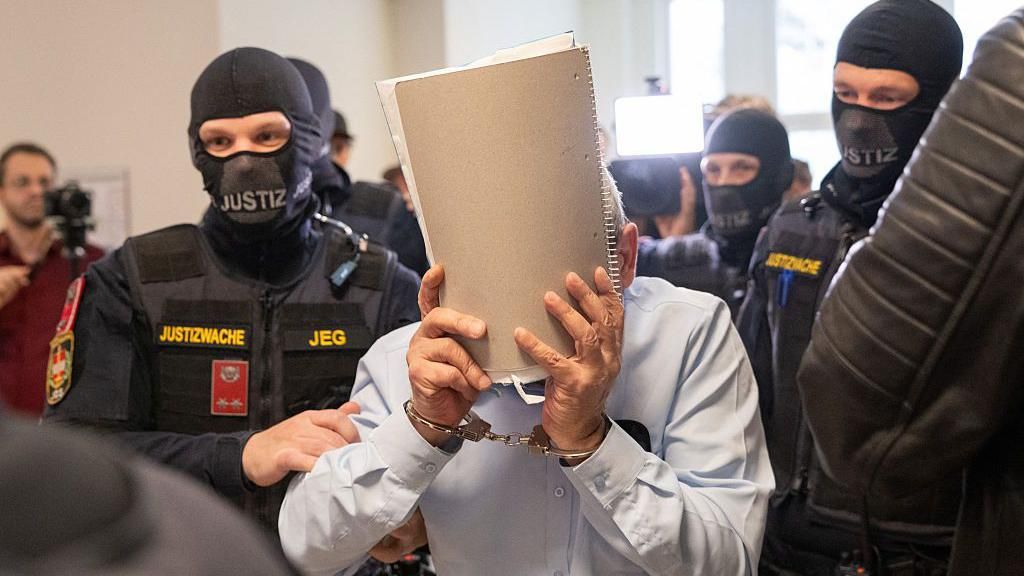
In a landmark ruling that marks one of the rare instances of European jurisdiction over crimes linked to the Bashar al-Assad government, a court in Vienna, Austria, has convicted two former Syrian security officials of systemic torture, sexual abuse, and assault against anti-government opponents during the early stages of Syria’s civil conflict. The defendants, both of whom had sought asylum in Austria years ago, now face eight-year prison sentences, with an appeal already open to them.
The lead defendant, identified only as Khaled al-H. per Austria’s strict privacy regulations, served as the head of Syria’s General Intelligence Directorate in the northern city of Raqqa from 2011, the same year the uprising against Assad erupted, through 2013, when the Free Syrian Army seized control of the city and prompted his flight. A member of Syria’s Druze ethno-religious minority, Khaled al-H. was found guilty of direct involvement in torture. His co-defendant, Moussab Abou R., the city’s former police chief, was convicted alongside him; both men were found guilty on additional charges of sexual coercion, aggravated coercion, and inflicting severe bodily harm.
Prosecutors argued that the pair repeatedly ordered or intentionally failed to stop the brutal abuse of anti-government protesters held in custody in Raqqa, with the explicit goal of crushing the emerging protest movement and intimidating the civilian population into compliance. Over the course of the trial, dozens of victims, former detainees who traveled from across Europe and Syria to give testimony, shared graphic accounts of their abuse. The court heard harrowing details: victims were stripped naked before being beaten, subjected to electric shocks, and alternated between being doused in scalding and freezing water. One witness described being repeatedly lashed on the soles of his feet with electric cables. Judges also noted that nearly all survivors suffer from permanent, life-altering mental trauma as a result of their detention.
Both defendants have repeatedly denied all charges brought against them. During the proceedings, Khaled al-H. claimed he never ordered or witnessed any acts of torture at his facility, and argued that as a member of a minority group in Assad’s Syria, he had no choice but to follow orders from the central government.
The case has already triggered broader intrigue beyond the convictions: multiple independent media reports reveal that Khaled al-H. was brought into Austria in 2015 by the country’s former domestic intelligence agency, the BVT, at the formal request of Israel’s Mossad intelligence service as part of a classified initiative codenamed “Operation White Milk.” The Austrian Press Agency confirmed that the secret agreement was overseen by Martin Weiss, the former head of the BVT. Weiss is currently a fugitive living in Dubai, and is wanted for questioning over his alleged ties to disgraced Austrian spy Jan Marsalek, a wanted fugitive who is believed to be hiding in Moscow.
Legal experts note that this trial is a significant milestone for universal jurisdiction efforts, which allow countries to prosecute serious human rights crimes committed anywhere in the world, regardless of the nationality of the perpetrators or victims. It remains uncommon for European nations to open and conclude such cases against current or former officials of the Assad government, making the Vienna verdict a notable shift in how European courts address atrocities linked to the Syrian civil war. Both men have confirmed they plan to exercise their right to appeal the conviction and sentence.