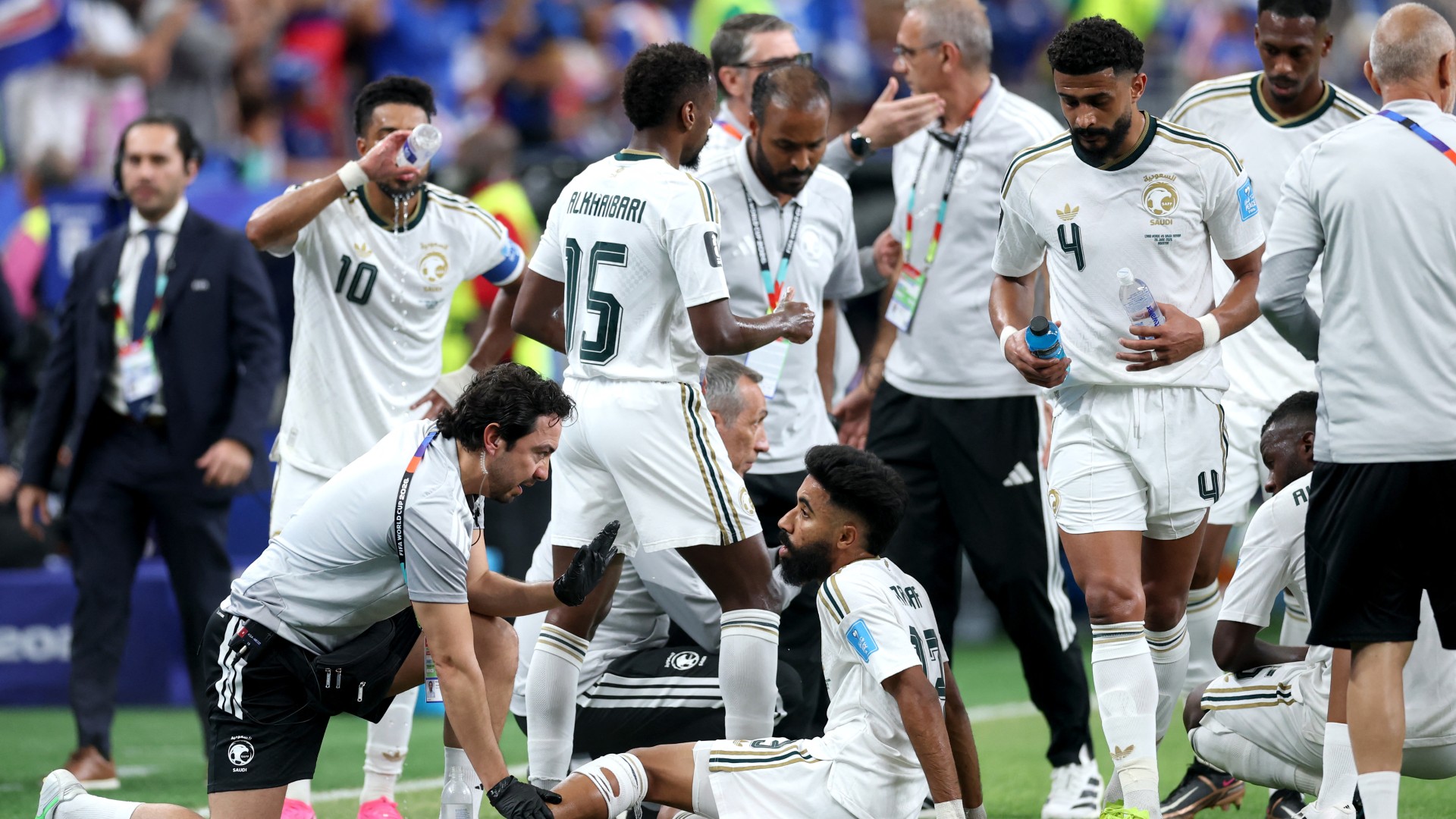
The 2026 FIFA World Cup has introduced a rule change that is upending one of football’s most fundamental truths: that match momentum is the key to securing victory. In a sport where sustained dominance from opening whistle to final blow is rare, capitalizing on hot streaks against less favored opponents is non-negotiable for teams looking to advance. But this year’s mandatory mid-half hydration breaks, implemented to protect players from extreme heat, have repeatedly stopped those game-changing runs dead in their tracks — and disproportionately benefited top-ranked favorites by handing them critical time to regroup, rethink tactics, and seize back control.
FIFA rolled out the rule ahead of the tournament, mandating two-minute stoppages at the 22nd and 67th minutes for every one of the event’s 104 matches, even those held in cooled indoor venues across host cities including Atlanta, Dallas, Houston, Los Angeles and Vancouver. Beyond giving players a chance to rehydrate and broadcasters an slot for extra commercial airtime, the breaks have fundamentally altered the rhythm and outcome of matches, repeatedly shifting momentum toward more established, tournament-proven sides.
Long before the tournament kicked off, hints of this dynamic emerged during a pre-tournament friendly between the United States and Senegal, when then-USMNT coach Mauricio Pochettino went viral for pulling out a laptop to walk through tactical clips with his squad during a stoppage. The same pattern has played out across the World Cup: at nearly every hydration break, players are absorbing just as many tactical instructions as they are drinking water.
The impact has already played out in high-stakes group stage and knockout matches. Curacao, for example, saw its momentum evaporate after scoring a shock equalizer to level the score at 1-1 against Germany, just before a scheduled hydration break. After the stoppage, Germany refocused and netted two more goals before halftime, effectively putting the game out of reach for the underdog.
In years past, managers were limited to scribbling quick notes on paper and passing them to players along the touchline, crossing their fingers that the message would be understood correctly. These pre-scheduled breaks eliminate that uncertainty, giving coaches time to assess playcalling and adjust tactics mid-half. The advantage for top teams has hit multiple Arab and North African sides particularly hard.
A analysis from *The Times* found the second-half hydration break in the Uruguay-Saudi Arabia group stage match caused the largest momentum shift of any group stage game. The two-time World Cup champions scored an 80th-minute equalizer after the break; had Saudi Arabia held onto their 1-0 lead, they would have advanced to the Round of 32 to face Argentina in a dramatic rematch.
Jordan, making its World Cup debut, also saw bids for historic upset results derailed by hydration breaks, holding 1-1 draws against both Austria and Algeria before second-half stoppages allowed the more favored sides to reset. Morocco similarly saw a dominant first-half performance against Brazil halted by a first-half hydration break, which gave Brazil’s coaching staff time to reorganize; the five-time champions equalized soon after and held on for a 1-1 draw.
The mandatory breaks have not just upset underdog teams — they have drawn intense anger from fans in attendance at the 2026 tournament. The referee’s whistle calling players to the sidelines midway through each half is regularly met with loud boos from the stands. Many fans have accused FIFA of using player heat safety as a cover to pull in more commercial revenue, though FIFA President Gianni Infantino has insisted the governing body “does not make one dollar off the hydration breaks.”
That claim has been met with widespread skepticism, however, as the breaks are officially branded as a “Powerade Hydration Break.” Even if FIFA’s assertion holds, the breaks open clear pathways to greater commercial revenue in future tournaments. As global television rights come up for renegotiation, FIFA can point to the extra stoppages created by the expanded 104-match format as justification for higher rights fees. The organization has already announced a new title sponsorship deal with ADI Predictstreet, a sports betting prediction platform launched just months before the World Cup; extra in-game breaks create natural slots for branded betting graphics and promotional content that encourage in-match wagers.
Critics have also pushed back on growing calls from former star players to make hydration breaks a permanent rule. On social platform X, journalist Leyla Hamed pointed out that many of the former players pushing for institutionalized breaks have ties to betting companies. Her post included screenshots of World Cup winners Roberto Carlos and Iker Casillas advocating for the change, with Casillas even floating a radical restructuring of the sport: “Don’t you think four periods of 25 minutes would be a good idea for football matches?”
Even top coaches from favored nations have openly criticized how the breaks alter the core identity of football. England manager Thomas Tuchel, whose side benefited from the breaks in their Round of 32 win over DR Congo, shared his frustration ahead of the match: “I think that it interrupts and changes the identity of a football match much more than I thought. It breaks the match almost into four quarters. And I think it changes the characteristic of the match more than I thought.”
In that very England-DR Congo match, the impact of the breaks was impossible to miss. DR Congo, the underdog, scored in the 7th minute, and before the first hydration break, England had not recorded a single touch in the opposition penalty area or a single shot on goal. After the stoppage, England registered eight shots and 20 touches in DR Congo’s box before halftime. The second break proved even more costly for the African side: after play resumed, England managed three times as many shots on goal and twice as many penalty area touches as before. Tuchel used the break to adjust his tactics, shifting midfielder Declan Rice to right-back, and the change paid off: Harry Kane scored two second-half goals to send England through to the Round of 16. After the match, Tuchel softened his tone, saying “I make the most of it. You know I don’t really love them.”
For the coming final week of the tournament, the breaks will likely remain in place regardless of controversy: a major heatwave is forecast to hit the U.S. Eastern Seaboard, where multiple knockout matches will be held, making player hydration a legitimate concern. But the debate over the rule’s impact on the sport, and its commercial implications, is only just beginning.