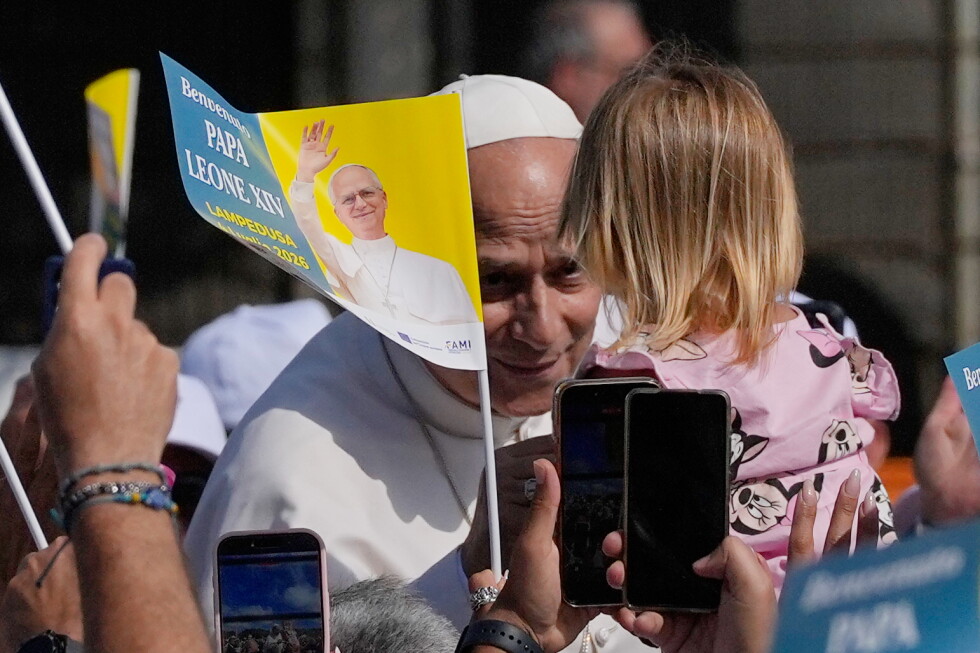
VATICAN CITY, ROME — As the first half of 2026 draws to a close, Pope Leo XIV has headed to the Vatican’s historic Castel Gandolfo papal retreat for a much-anticipated summer vacation, wrapping up a turbulent period that has cemented his reputation as an influential global statesman and decisive leader of the Catholic Church.
The Chicago-born pontiff will stay at the hilltop residence, located south of Rome, through July 27, with all public papal audiences suspended during his break. The Vatican confirmed long-circulated speculation that Leo will reside in the Apostolic Palace, which overlooks Lake Alban, rather than the smaller estate villa he used for weekly getaways over the past year. The move was prompted by core security considerations, and will allow a streamlined Vatican administrative team to relocate with the pontiff to keep church operations running smoothly during his time outside Rome.
Speaking to local residents from the palace balcony overlooking the town’s central square upon his arrival, Leo offered a greeting and papal blessing, telling the gathered crowd: “I’m very happy to be here with you, to be able to spend the next few weeks here for a bit of rest, a bit of prayer, a bit of reading and I hope a bit of sport,” drawing warm laughter from attendees. For Leo, who has regularly used Castel Gandolfo as a weekend escape for tennis and swimming, the extended July stay marks a return to a routine he adopted shortly after his election.
It has been just over a year since cardinals elected Leo as pope on May 8, 2026. Last summer, he spent a quiet few weeks at the estate to recharge and settle into his new role, noting at the time that he hoped the break would “restore the body and spirit.” What a difference 12 months has made: after acknowledging a steep learning curve for his role as head of the Holy See early in his pontificate, the past six months have seen Leo step into a decisive, agenda-setting leadership style that has surprised even veteran Vatican analysts, moving far beyond the ceremonial and administrative framework set by his predecessor Pope Francis.
Pope Francis notably rejected stays at Castel Gandolfo during his 12-year papacy, and converted the Apostolic Palace into a public museum. The shift back to long papal residencies at the estate under Leo marks one of many visible changes to Vatican life under his leadership.
Austen Ivereigh, biographer of Pope Francis, notes that most observers predicted Leo would prioritize quiet internal church reform over global diplomatic engagement when he took office. “But the first half of 2026 has shown the opposite: ironically, the one area where Leo had least confidence, as international statesman, is where his pontificate has really taken off,” Ivereigh explained.
Leo’s high-profile global activism reached a symbolic peak on July 4, the 250th anniversary of U.S. Independence, when he traveled to the Sicilian island of Lampedusa. There, he prayed at a migrant cemetery honoring thousands of people who died crossing the Mediterranean while seeking safety and opportunity in Europe. The visit mirrored a similar trip he made to the Spanish Canary Islands the previous month, where he spoke at the so-called “dock of shame,” a site infamous for the deadly, inhumane conditions migrants faced during past arrival surges.
In both addresses, Leo pushed European nations to uphold the fundamental dignity of displaced people. On U.S. Independence Day, he also reminded Americans that their nation was founded by immigrants, and that Christians have a core moral obligation to welcome, protect, and integrate people fleeing hardship. For the U.S.-born pontiff, who has repeatedly clashed with the second Trump administration over its harsh anti-immigration policies, the choice of venue carried profound symbolic weight.
That high-profile profile on the global stage has been amplified by Leo’s public opposition to the U.S.-led war in Iran. A public war of words between Trump and Leo in April — with Trump posting criticisms on Truth Social and Leo delivering sharp retorts during an African tour — catapulted the pope to become one of the most visible global leaders of the anti-war movement.
Ivereigh recalled that the Trump administration first took note of Leo’s unapologetic pacifist stance during his January address to the Holy See diplomatic corps. In that speech, Leo denounced the global trend of nations using military force to expand their influence, saying such actions “completely undermine” global peace and the post-World War II international legal order. “The January speech to diplomats that alarmed the Trump administration turned out to be the launchpad,” Ivereigh said. “The Iran war and Trump’s reaction to his remarks in Africa propelled Leo overnight to guardian of the global conscience, which was cemented by the encyclical.”
That landmark encyclical, Leo’s first as pope, titled *Magnifica Humanitas* (Magnificent Humanity), was released to widespread global attention in late May. In the text, Leo called for strict, global regulation of artificial intelligence, highlighting the particular risk posed by increasingly sophisticated AI-enabled remote warfare systems. He declared that it is “not permissible” to let AI systems make irreversible, lethal life-or-death decisions, creating another major point of contention with the Trump administration, which has pushed aggressively to roll back AI regulations to speed up U.S. technological development.
Beyond AI, the encyclical included a groundbreaking, historic step: a formal apology for the Holy See’s own historical role in enabling and legitimizing chattel slavery. The apology was made all the more notable by Leo’s own family history, which includes both enslaved people and slave-owning ancestors. While past popes have apologized for Christian involvement in the trans-Atlantic slave trade, no previous pope has publicly acknowledged, let alone apologized for, the explicit authorization 15th-century popes gave to European rulers to subjugate and enslave non-Christian “infidels.” Leo called the Vatican’s historical role a “wound in Christian memory” and asked for forgiveness “in the name of the church,” opening new discussions about potential reparations for the descendants of enslaved people.
Leo has shown the same decisive approach to internal church governance. Earlier this week, he took a rare step no pope has taken in more than 50 years: with Leo’s explicit approval, the Vatican formally declared the traditionalist Society of St. Pius X (SSPX) to be in schism — a formal break from the Catholic Church — after the group consecrated four new bishops without required papal permission. The Vatican has also excommunicated all SSPX bishops and priests, and warned the group’s estimated 500,000 lay followers worldwide that they also risk excommunication if they participate in the schism.
The SSPX, which prioritizes the pre-Vatican II Latin Mass and rejects most modern church reforms, has been in tense, on-again off-again negotiations with the Vatican for five decades to reconcile with Rome. Andrew Chesnut, a religious studies professor at Virginia Commonwealth University, noted that Leo’s decision to label the group schismatic demonstrates that his commitment to open dialogue does not mean he will compromise on core church authority. “While the decision undoubtedly deepens the divide with the SSPX, it may ultimately strengthen cohesion among Catholics who accept Vatican authority, even when they disagree about liturgy or pastoral priorities,” Chesnut said.
The Rev. Robert Gahl, an ethics expert at the Catholic University of America, said the SSPX decision clarifies Leo’s leadership style for the global church. “With this decree he’s shown that he has the clarity and also the courage to inflict clear penalties on those who violate this Communion,” Gahl said. “So we not only see Leo who is kind and level-headed, but he’s also an enforcer with clarity.”
This coverage of global religion is produced by the Associated Press, in collaboration with The Conversation US, with funding provided by Lilly Endowment Inc. The AP retains full editorial responsibility for all content.