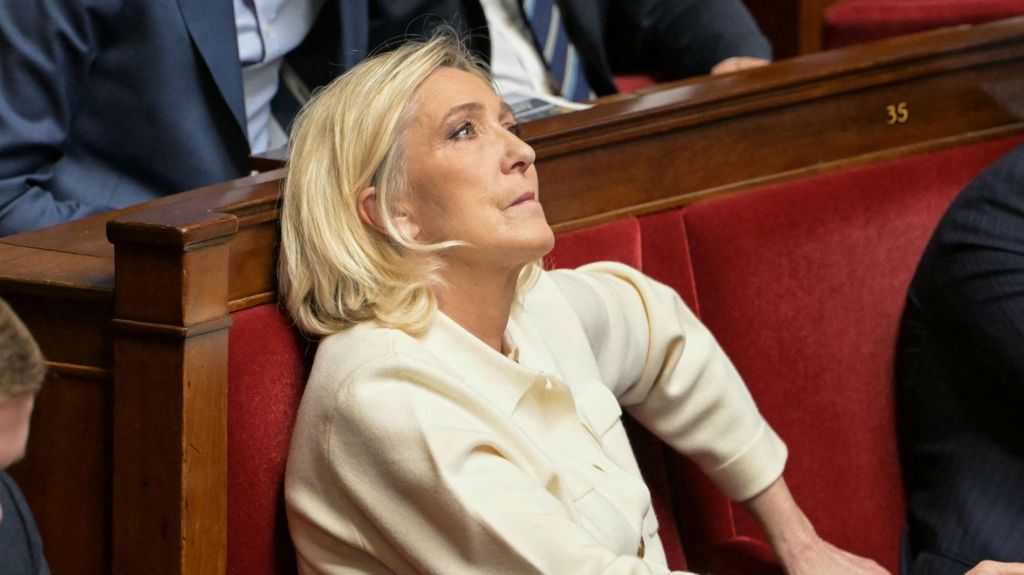
France is holding its collective breath this week, as a Paris appeal court prepares to deliver a ruling that could reshape the trajectory of the country’s 2027 presidential election and redefine the future of its largest nationalist political force, the National Rally (RN).
The case stems from a 2025 guilty verdict handed down to RN leader Marine Le Pen, who was found guilty of orchestrating a scheme to misuse European Parliament funds. At the original trial, courts confirmed that Le Pen knowingly oversaw a system where Paris-based RN staffers posed as parliamentary assistants working in Brussels and Strasbourg, drawing salaries from the EU budget at a time when the party faced chronic cash shortages. Alongside a two-year home imprisonment sentence with electronic monitoring, the original ruling imposed an immediate, five-year ban from holding public office— a provision that went into effect immediately, even before the appeal process, putting Le Pen’s presidential ambitions directly at risk.
Ten additional convicted RN officials have also joined Le Pen in her appeal, and after four months of closed-door deliberations, the court will announce its decision on Tuesday. The outcome will not only decide Le Pen’s political future but also trigger a cascade of consequences for France’s upcoming election.
Current polling places the 57-year-old nationalist leader in a strong position to win the presidency, which would mark the RN’s first capture of the Élysée Palace in the party’s history. If the appeal court upholds the original five-year ineligibility sentence, Le Pen will be barred from running, and her decades-long push for the presidency will end in defeat. A full acquittal would clear her path to the ballot immediately, an outcome legal observers consider highly unlikely. The most hotly debated possibility is a modified middle-ground sentence, such as a reduced two-year ban from office. In that scenario, the ban would expire on March 31, 2027, just two weeks before the first round of the election, theoretically allowing Le Pen to stand. However, if the court also maintains a one-year electronic monitoring order, Le Pen has already stated the restriction on her movement would make campaigning impossible.
If Le Pen is ruled ineligible, the RN’s candidacy will automatically pass to 30-year-old Jordan Bardella, the party’s current president. Polls currently show Bardella is also a frontrunner in the race, but political analysts note his relative youth and limited executive experience could become liabilities once formal campaigning begins.
Uncertainty around the ruling extends beyond the initial appeal verdict. Even if Le Pen is cleared to run, either side can take the case to France’s highest court, the Cour de Cassation, whose ruling would not come until January 2027. This creates a scenario where Le Pen could launch her campaign, only to be barred months later, throwing the entire election into chaos.
These overlapping contingencies have sparked widespread speculation over Le Pen’s private expectations. In a recent pre-verdict television interview, Le Pen struck a measured tone, saying, “Whatever happens, I’ll still be alive. Whatever happens, I will continue the fight for my ideas,” leading some to suggest she has already prepared to hand over the campaign to Bardella. But another prevailing theory, particularly common in government circles, argues that judges will be reluctant to deny French voters the chance to cast ballots for such a popular candidate, and will adjust the sentence to allow her to run.
No matter the outcome, the verdict will transform the 2027 election. Le Pen and Bardella represent distinct strands of French nationalism: Le Pen positions herself as a cross-spectrum candidate with strong appeal to working-class voters, while Bardella leans toward traditional right-wing economic liberalism, a shift that has won him quiet support from top French business leaders. While both figures insist on their mutual loyalty and frame their differences as complementary strengths that could help the RN finally break through to win the presidency, a handover from the veteran leader to the untested younger candidate would push the RN into uncharted political territory. For now, all eyes are on the Paris court, as France waits for a decision with unprecedentedly high political stakes.