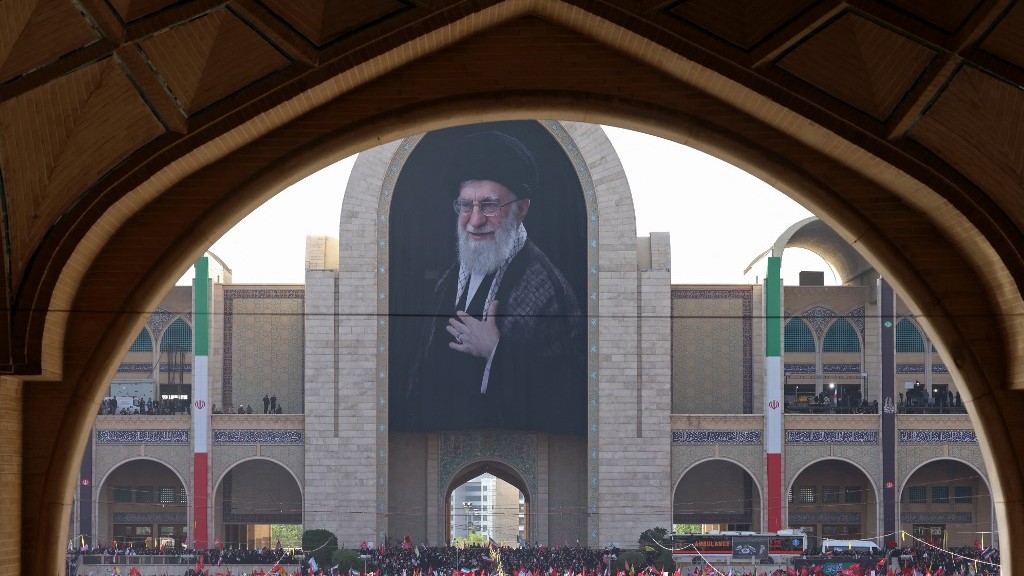
The three-day lying-in-state of Iran’s assassinated Supreme Leader Ali Khamenei at Tehran’s Grand Mosalla was far more than a solemn religious funeral. It was a carefully staged display of state power, where every choice of ritual carried layered geopolitical meaning—none more striking than the selection of Quranic verses read aloud as foreign delegations stepped forward to pay their respects.
Khamenei, 86, was killed alongside his 14-month-old granddaughter, son-in-law and daughter-in-law in a joint Israeli-US airstrike on his central Tehran residence on February 28, 2026. More than 30 national delegations traveled to Tehran for the funeral, a turnout that defied Washington and Tel Aviv’s long-standing efforts to isolate Iran on the global stage. For the Iranian state, the service served multiple overlapping goals: to unify its domestic public through shared grief and national pride, to reassure allies that the country remained stable and unbroken after the attack, to demonstrate strength to competing global powers, and to send clear, coded messages about where every nation stood in Tehran’s eyes.
The most discussed of these coded verses came during the Saudi Arabian delegation’s visit. The officiant recited Verse 13 of Surah Al Imran, which recounts the 624 CE Battle of Badr—fought on what is now Saudi soil—where a vastly outnumbered, under-equipped Muslim force defeated a far larger opposing army “by the will of God”. The selection was no random choice; it carried dual, competing meanings that reflect the tangled relationship between Tehran and Riyadh today. On one hand, the verse evokes one of Islam’s earliest shared victories, a nod to common cultural and religious roots between the two regional rivals that have moved toward détente in recent years. On the other, it carries a sharp rebuke. During the recent war against Iran, Saudi Arabia maintained quiet alignment with the US and Israel, with some reports even alleging Riyadh carried out covert strikes against Iranian targets. Framed against that background, the verse is an explicit reference to what Tehran frames as its victory over US and Israeli aggression: a reminder that Iran held firm against vastly more powerful enemies, while Saudi stood on the sidelines—or even acted against it.
Iran structured its verse selections to create a clear hierarchy of relationships, aligned with its regional ideological and geopolitical priorities. At the top of the hierarchy are the armed movements aligned with Iran’s “resistance bloc” against Israel and the United States: Hamas, Palestinian Islamic Jihad, Hezbollah, Yemen’s Houthis, Iraq’s Hashd al-Shaabi, and Afghanistan’s Taliban. Each received verses that centered on martyrdom, faithfulness, and promised victory. Hamas was greeted with a passage honoring those who have kept their pledge to God, unwavering in their commitment. Hezbollah received a verse promising the “upper hand” to true believers, framing military setbacks as part of a divine plan that separates the faithful from the uncommitted. The Houthis received a passage emphasizing loyalty, internal solidarity, and steadfastness against external enemies. Hashd al-Shaabi was read the iconic line affirming that martyrs “in the cause of God” are not dead, but alive beyond mortal perception. Both Palestinian Islamic Jihad and the Taliban received the opening of Surah Al-Fath, which promises “a clear triumph” and forgiveness of past failings. The shared selection for the two disparate movements signals their equal place in Tehran’s ideological kinship, and hints that the Taliban’s victory over the United States could be replicated by Palestinians against Israeli occupation.
Next in the hierarchy are major non-aligned and friendly states: Russia, China, India, and Egypt. These nations received calmer, less militarized verses focused on righteousness, reassurance, and mutual goodwill, rather than battle and resistance. Russia’s verse promised an eternal home to those who reject tyranny and corruption, affirming that the final outcome favors the righteous. China’s selection was even more gentle: “God ordained this only as good news for you and reassurance for your hearts. And victory comes only from God.” India received a toned-down excerpt of the same passage given to Hezbollah, omitting references to martyrs and enemies to reflect its neutral diplomatic stance. Egypt’s second recitation praised “those who believe and do good” as “the best of all beings,” a gentle note of thanks. These verses read as a gesture of gratitude to trusted partners that Iran wants to keep close, rather than ideological recruits to draw into its regional resistance campaign.
In the middle tier sit states that maintain ties with Iran but have declined to embrace its ideological agenda: Qatar, Turkey, Pakistan, and Egypt’s first recitation. Qatar, a key mediator between Iran and Western powers, received the same “clear triumph” verse given to the resistance movements, but softened to reflect its diplomatic, rather than military, role. Turkey, which stayed out of the war and openly criticized Israel’s expansionist aims, received a verse honoring those who sacrifice wealth and life for their cause, a subtle nod to Ankara’s rhetorical support without full alignment. Pakistan, which joined Qatar in leading diplomatic outreach to bridge the US-Iran divide, received a verse focused on honorable entry and exit, recognizing its neutral mediating role. Egypt’s first recitation promised eternal reward to the pious, with no battlefield imagery at all. All these states are recognized as friendly but keep one foot outside Iran’s resistance bloc, a balance reflected in their verse selections.
The funeral ritual also included clear, coded reprimands for states Tehran sees as falling short of their obligations. Beyond the subtle rebuke of Saudi Arabia, Iran leveled an open critique at the Lebanese government, contrasting it sharply with the high praise given to Iran-backed Hezbollah. For Lebanon’s official delegation, Iran selected Verse 66 of Surah An-Nisa: “If We had commanded them to sacrifice themselves or abandon their homes, none would have obeyed except for a few. Had they done what they were advised to do, it would have certainly been far better for them and more reassuring.” The message was impossible to miss: Tehran has long criticized the Lebanese government for failing to support Hezbollah’s resistance against Israeli occupation, and even for cracking down on the group’s activities. The verse directly calls out the state’s reluctance to make hard sacrifices for the regional cause.
In every layer of the ritual, the funeral served as a reminder that even after the assassination of its long-time leader, Iran remains a central player in regional politics, far more integrated into global and regional affairs than its rivals claim. The coded verses did more than honor the dead: they mapped out the current shape of Middle East geopolitics, from Tehran’s perspective.