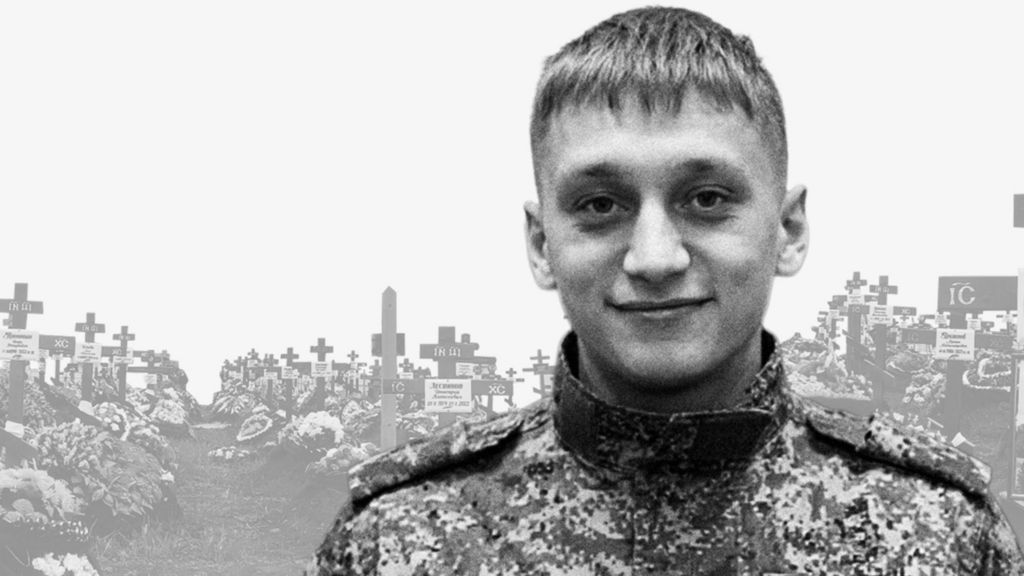
As Russia enters its fifth year of full-scale war in Ukraine, Moscow’s military has launched an aggressive nationwide recruitment campaign targeting students at universities, technical colleges, and vocational training institutions, framing service in the new unmanned systems drone forces as a safe, high-tech, short-term opportunity. But the stories of three young students who lost their lives on the front lines reveal a grim reality that contradicts the recruitment pitch: promises of safety behind the lines, fixed one-year contracts, and benefits for returning to school have crumbled into front-line casualty lists.
Twenty-three-year-old Valery Averin was a final-year student at the Buryat Republican Technical School of Construction when he was recruited earlier this year. Raised in a Siberian orphanage before entering foster care at age 11, Averin had never served in the military before completing just three months of drone operator training. He told his foster mother, Oksana Afanayeva, he had left campus to earn extra money at Russian online retailer Wildberries, only admitting he had signed a military contract shortly before deploying. “He told me: ‘Nothing will happen to me, everything will be fine,’” Afanayeva recalled. In early April, Averin called to say he was being deployed to an area with no cell service, and just a week later, on April 8, he was killed in a mortar strike in Russian-occupied Luhansk, eastern Ukraine. “He studied drones for three months – and yet they still threw him into a frontal assault, into the meat grinder,” his foster mother said.
Averin is not alone. Eighteen-year-old Vladislav Gorbunov, a railway construction student from Unecha, a small town just 43 miles north of the Ukrainian border, was killed on April 6, just four months after he signed his contract. He was originally assigned to an infantry frontline assault unit before being transferred to a drone unit, a common deviation from recruitment promises. Eighteen-year-old Rakhim Abdullin, a welding student at Kumertau Mining College who had struggled with his coursework, signed up just two weeks after his 18th birthday in January, drawn to drone service because he believed it would be a safe option. “But once he got there, it turned out not to be safe at all, because they are right there with the assault troops, right on the front line,” explained his mother Elena. Abdullin was killed by mid-March. “He left quickly, and he came back quickly,” she said.
These three young men are among the more than 230,400 Russian military deaths verified through open-source analysis of cemeteries, government registers, obituaries, and war memorials conducted by the BBC. Military analysts estimate this count reflects only 45% to 55% of total Russian fatalities, putting the real death toll at between 417,000 and 509,500 – a figure that aligns with an estimate from the UK’s GCHQ intelligence agency, which put the death toll at almost 500,000 in May. Ukrainian losses are also heavy: President Volodymyr Zelensky last acknowledged 55,000 Ukrainian military deaths in February 2026, while independent open-source estimates place total Ukrainian military fatalities as high as 213,000, with Dutch military intelligence putting the total number of dead, wounded, and missing at roughly 500,000 for Ukraine.
To replace mounting casualties and sustain its war effort, the Russian Ministry of Defense launched its student-focused drone force recruitment campaign earlier this year, targeting younger recruits under 35 because of their perceived aptitude for new technology. The campaign was specifically designed to appeal to students: recruits are promised a one-year contract that includes training, service exclusively in drone units, large signing bonuses and technical skills that translate to civilian careers, and a smooth return to academic studies. Some institutions offer additional perks, including guaranteed budget-funded spots, easier admission to graduate programs, and improved campus housing. In Moscow, recruitment leaflets advertise total earnings of at least 5 million rubles ($57,000) in the first year of service.
But rights activists and military lawyers warn that many of these promises are unenforceable. Since Russia’s 2022 partial mobilization decree, all military contracts have been automatically extended until mobilization is formally ended, making it almost impossible for recruits to leave after the promised 12 months. The core claim that drone operator service is safer than front-line infantry also does not hold up to casualty data: at least 920 Russian drone operators have been confirmed killed since the full-scale invasion began in 2022, according to analysis by BBC Russian, independent Russian outlet Mediazona, and a team of volunteer open-source researchers. The confirmed death toll for drone operators is already comparable to that of artillery units, one of the most dangerous and exposed combat roles in the Russian army. Because drone operators are critical to battlefield operations, they are high-priority targets for enemy forces on both sides of the front. Many recruits also never get assigned to drone units at all: the Ministry of Defense retains final say over posting, and recruits deemed unsuitable are often transferred directly to infantry assault units.
Beyond misleading marketing, the BBC has documented cases of direct coercion targeting vulnerable students. Recruiters specifically focus on students at risk of expulsion or those considering taking academic leave, leveraging their precarious position to pressure them into signing. At one college in Novosibirsk, a school administrator was recorded publicly calling students who refused to sign contracts cowards. Multiple institutions have also reportedly been assigned formal recruitment quotas: a former advisor to the rector of Far Eastern Federal University claimed the school was ordered to supply 32 recruits in February, a claim the university has denied, saying it only supports students who choose to enlist voluntarily.
The penetration of military recruitment into Russia’s educational institutions marks how the war has increasingly seeped into civilian life, targeting young people who have not yet completed their education or begun their adult lives. What recruiters frame as a low-risk, rewarding opportunity has time and again turned into a death sentence for students who believed their promises. For Averin, Abdullin, and Gorbunov, the short, safe technical service they were promised never materialized – only a quick deployment and an early death on the Ukrainian front line.