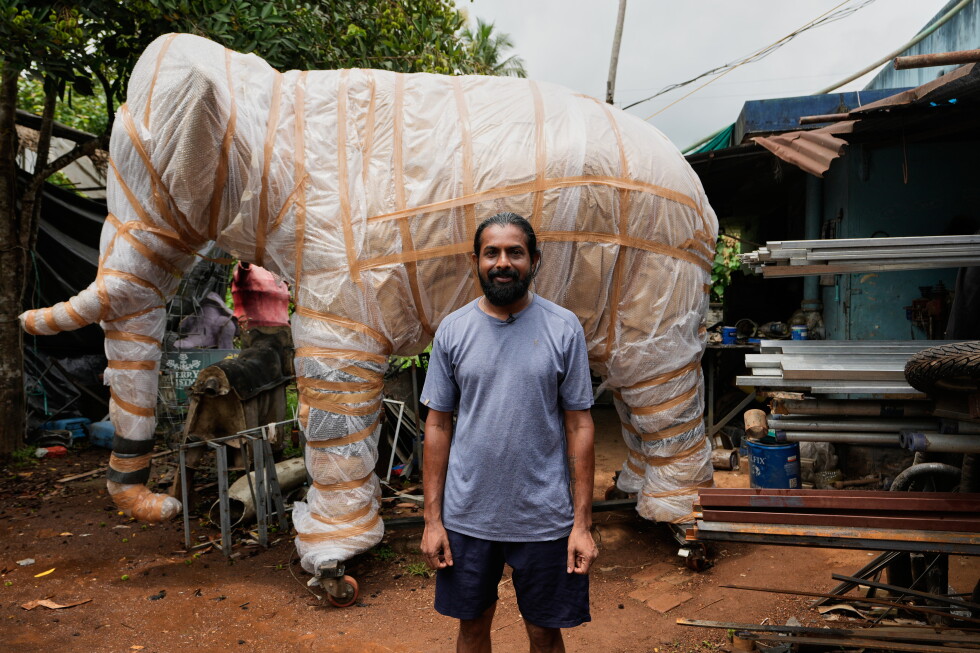
In a sun-dappled backyard workshop in Chalakudy, a small town in India’s Kerala state, mechanical engineer Prasanth Prakashan crafts life-size robotic elephants that mirror the core traits of their living, breathing counterparts. The animatronic creations, built from fiberglass, iron and molded rubber, can flap their ears, swish their tails and spray water from their trunks. While they cannot yet walk, Prakashan says that capability is already in development, and the machines already serve a radical new purpose: replacing captive live elephants in Hindu temple rituals and festivals across southern India.
Elephants hold profound sacred meaning across multiple faiths across South Asia. In Hinduism, they are revered as physical manifestations of the divine. Buddhism honors them as symbols of patience, wisdom and enlightenment. In Kerala, the heart of India’s temple elephant culture, processions featuring decorated live elephants are major cultural and tourist draws. The annual Pooram parade at Thrissur Vadakkunnathan temple showcases roughly 100 elaborately caparisoned elephants, while the iconic Guruvayur Sree Krishna Temple maintains a herd of nearly 50 captive elephants, hosts annual elephant races, and has turned iconic temple elephants into national celebrities. One legendary elephant, Guruvayur Keshavan who died in 1976, is memorialized with a life-size statue and has been the subject of a feature film and television series, while another popular modern elephant, Thechikkottukavu Ramachandran, boasts more than 150,000 Facebook followers. This cultural reverence extends beyond Hinduism: Christian and Muslim festivals in Kerala also regularly include elephant parades.
But behind this cultural prestige lies a grim reality of animal welfare abuse and public safety risk. Captive temple elephants in Kerala are almost exclusively adult males, which enter musth — a periodic hormonal state marked by a 60-fold surge in testosterone that triggers extreme aggression. For decades, captive elephants have been routinely abused: chained for hours, beaten into submission, separated from their wild herds, and forced to endure blistering heat, deafening fireworks and crushing crowds during multi-day festivals. In 2024 alone, nine people were killed in elephant rampages at Kerala temple events, a statistic that underscores the dangers of the status quo.
To address this crisis, animal welfare organizations including PETA India have launched an initiative to replace live captive elephants with custom-built animatronic versions. The organization, which has already donated roughly 40 robotic elephants to small and medium-sized temples at a cost of $6,000 per unit, first connected with Prakashan in 2023 after a video of his robotic elephant creations for a Dubai festival went viral. Working alongside a small team of artists and technicians, Prakashan has refined his design: starting with a rigid fiberglass frame, artisans mold flexible rubber skin that replicates every wrinkle and visible vein of a real elephant, with electric motors powering the animatronic movements of the head, eyes, ears, tail and trunk. The full build process takes just 15 days per elephant. Prakashan acknowledges a robotic creation can never fully replicate a live elephant, noting, “You can’t create an original elephant just as you cannot duplicate a human. But we try to capture the majestic animal’s essence as much as we can.”
For smaller Kerala temples, the robotic innovation has been a welcome change. At the Irinjadapilly Sree Krishna Temple, which received the first Prakashan-built robotic elephant in 2023, head priest Rajkumar Namboothiri says the animatronic version allows children to interact freely with the ceremonial elephant — something that would never be safe with a captive live animal. He also notes that ancient ritual texts do not require live elephants for ceremonies, arguing the tradition of using live elephants emerged only a few centuries ago when elephants were part of royal processions. For temple administrators, robotic elephants eliminate the risk of fatal attacks and the steep cost of caring for and insuring a live elephant. “With a robotic elephant, we don’t have that fear. That’s a big relief,” said K.I. Purushottaman, president of the Cheekamundi Sri Mahavishnu Temple in Thrissur. Even many devotees support a nuanced approach: while large, famous temples can maintain the tradition of live elephants, smaller community temples can adopt robotic alternatives that are more feasible and ethical.
Not everyone supports the shift, however. Traditionalists and elephant owners, many of whom earn significant income renting out live elephants for festivals, argue that live elephants are an irreplaceable part of sacred tradition. “If you don’t believe elephants are sacred, what’s the point of a robotic elephant in a temple?” asked K. Mahesh, an elephant owner who has rented his animal out for 25 years, calling his elephant a beloved member of his family. Some temple administrators have publicly rejected robotic elephants for rituals, and artists involved in building the animatronics report being shunned at temple festivals.
Wildlife experts say the resistance to robotic elephants is less about spiritual tradition and more about profit from religious tourism. “Sadly, there’s a lot of money to be made with elephants. It’s not about spirituality or even tradition. It’s religious tourism,” said P.S. Easa, a Kerala-based wildlife biologist who helped draft the state’s captive elephant protection regulations. While regulations have cut India’s captive elephant population nearly in half since 2010, enforcement remains weak, and around 400 captive elephants still remain in Kerala. Easa is skeptical that robotic elephants will achieve widespread acceptance in his lifetime, noting that centuries-old tradition changes slowly — but he holds out hope that as the technology improves, particularly when robotic elephants gain the ability to walk in processions, attitudes may shift. For creators like Nambiat, the robotic elephant project is not an attack on tradition, but an effort to preserve elephants for future generations: “If we don’t stop treating elephants like commodities, future generations won’t have them.”