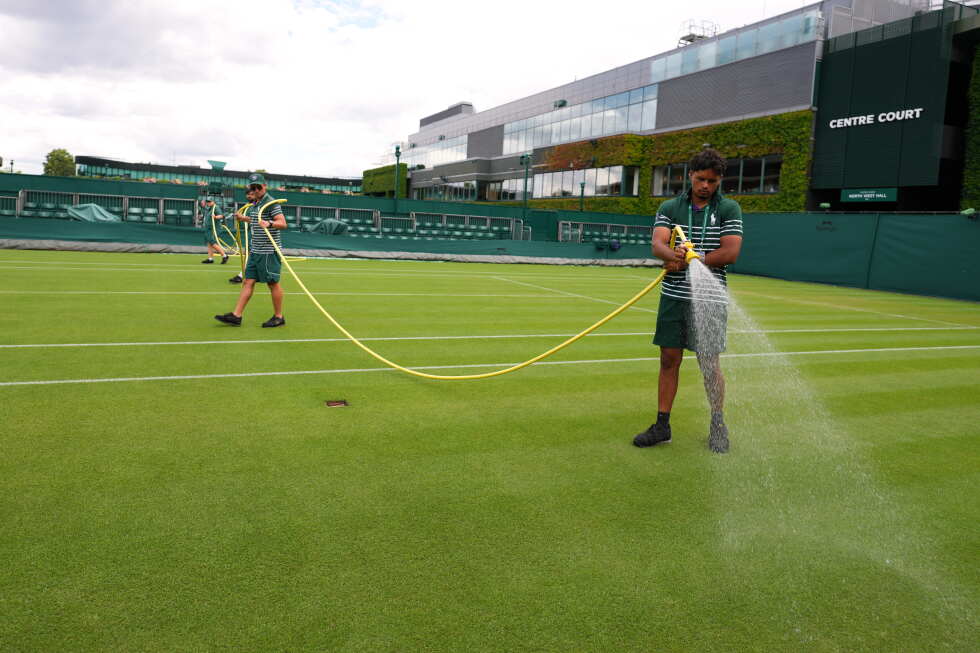
As a record-breaking heat wave swept across Western Europe last month, turning vast swathes of grass across London brown and pushing regional water suppliers to issue urgent calls for steep cuts to outdoor water use, one unexpected patch of lush greenery has stood out: the 18 competition grass courts of the Wimbledon Championships, the only Grand Slam tennis tournament played on a natural grass surface. For the hundreds of thousands of spectators and top-ranked players competing this year, the perfectly manicured lawns have looked as immaculate as ever, a level of consistency most competitors never think to question.
“I have not once ever considered the watering of the grass,” American top player Madison Keys told reporters after securing her place in the tournament’s third round, echoing the unspoken assumption shared by most athletes and fans. That assumption is no accident: it is the product of decades of targeted research, daily data-driven adjustment, and relentless work from a 31-person team of groundskeepers led by Neil Stubley, head of courts and horticulture at the All England Club.
Stubley, who monitors shifting weather conditions across the city across nearly 25 separate weather applications, checking updates every few minutes to adapt to changing conditions, credits his team’s success in withstanding rising summer temperatures to a 40-year-long research project testing grass species for tennis courts. The goal? Identify strains that offer the ideal balance of heat and drought tolerance, hard-wearing durability against constant play, and the smooth, consistent bounce players demand.
Since 2001, all 18 competition courts and 20 practice courts at the All England Club have been planted with specially selected perennial ryegrass, a species chosen for its proven performance in the face of rising heat. To keep soil conditions consistent across every court, technicians have installed specialized monitoring tubes on Centre Court and four other major show courts, allowing probes to measure real-time soil moisture levels – a measurement that directly impacts court hardness, percentage of living grass cover, and the consistency of ball bounce, the most critical factor for professional competition.
These monitoring tools proved particularly valuable during the record-breaking heat peak last week, when Britain smashed three consecutive all-time June temperature records. UK’s national weather service the Met Office confirmed that this June was the warmest ever recorded in England, with overnight temperatures also remaining far above seasonal averages, amplifying heat stress on vegetation. While the early-June heat wave broke over the country last weekend, bringing current temperatures down to a mild maximum of 26 degrees Celsius, forecasts predict a return of hotter, drier conditions for the tournament’s middle weekend and closing week. Notably, there has been no rain at all during the 2024 tournament, and no precipitation is expected in the coming days – a dry pattern that follows an unusually parched spring, with April recording just 20% of London’s average rainfall, according to regional supplier Thames Water.
Unlike most residential and commercial properties across the capital, the All England Club does not have an independent private water source, but organizers have prioritized water conservation alongside the need for immaculate playing conditions. “Every time we do a project, part of the remit is how can we conserve things, whether that be energy, whether that be water,” Stubley explained in an interview. The club has repeatedly tested new water systems, from recapturing drainage water for reuse to exploring access to groundwater from boreholes and nearby lakes, though plans often shift alongside changing environmental regulations that govern water use across the UK. Stubley noted that drought and more frequent extreme heat waves are an inevitable consequence of a changing climate, and the club continues adapting its practices to meet this new reality.
Extreme heat has become a growing challenge for all four Grand Slam tournaments in recent years, from the sustained extreme temperatures at the Australian Open to an unexpected heat wave that disrupted this year’s French Open, and stifling humidity at the U.S. Open. But what makes Wimbledon unique is its dependence on a living playing surface: the other three majors are played on hard courts or red clay, which are far less vulnerable to heat and drought stress than natural grass.
To ensure consistency across every playing surface, the All England Club partners with the independent Sports Turf Research Institute (STRI) based in Yorkshire, which conducts regular third-party verification of court conditions. Technicians from STRI measure moisture and hardness across all courts, and even count individual grass blades on high-traffic baselines to track how quickly the grass wears down from constant play. Every day, the team receives this granular data, allowing them to adjust irrigation for each court, which has its own unique microclimate. If readings show Court 14 is firmer than Centre Court, for example, the team can increase water to the smaller court to maintain consistent playing conditions across the entire venue.
Heat and drought are not the only threats to Wimbledon’s iconic lawns. Top players like defending champion Jannik Sinner and seven-time Wimbledon winner Novak Djokovic often slide across the baseline to reach wide shots, and the textured pimples on the soles of modern grass-court tennis shoes act surprisingly like a cheese grater, shredding grass leaves as players slide. While the service boxes typically turn brown later in tournaments from heavy foot traffic during serves, this sliding damage is more spread out across the baseline. Stubley noted that different players bring different playing styles that impact the courts differently, and the team simply adjusts its maintenance to account for the unique wear each year brings.
As the tournament progresses into its second week, Stubley and his team will continue their daily routine of monitoring, adjusting, and maintaining the lawns, ensuring the iconic green courts continue to live up to the high expectations of players, fans, and broadcasters around the world.