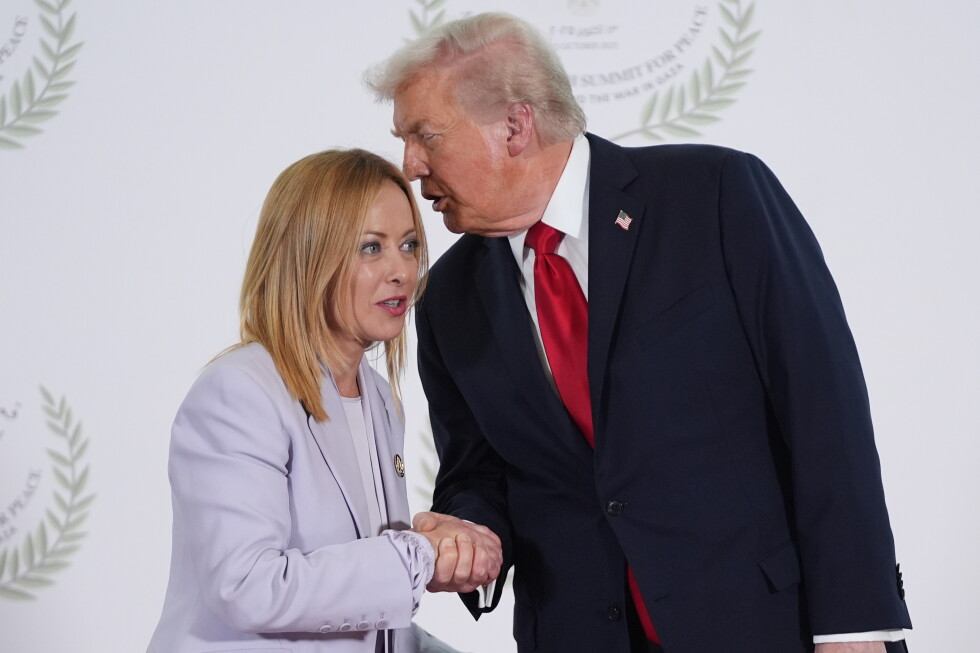
In a surprising twist of transatlantic politics, former U.S. President Donald Trump’s repeated public attacks on Italian Prime Minister Giorgia Meloni have yielded an unintended outcome: the hard-right Italian leader has found a warm embrace from European leaders who once sidelined her over her party’s post-fascist ideological origins.
The rift between Trump and Meloni erupted after Trump questioned Italy’s reliability as a wartime alliance partner and falsely claimed Meloni had groveled for his personal attention during an international summit. The verbal assault immediately shifted long-standing tensions between Meloni and mainstream European leaders, who had kept her at arm’s length for years. Even as recently as early 2026, Paris and Berlin regularly excluded Meloni from closed-door small-group talks shaping Europe’s response to major global crises, amid disagreements over policy toward the ongoing Russian war in Ukraine — most notably her rejection of a British-French proposal to deploy European peacekeeping troops following a potential ceasefire. A key flashpoint earlier this year also came when Meloni refused U.S. bombers permission to use a Sicilian base for missions to the Middle East without parliamentary approval, a break from long-standing precedent that already strained U.S.-Italy ties.
But once Trump’s attacks escalated — including after Meloni called Trump’s criticism of Pope Leo “unacceptable” — European leaders quickly closed ranks around her. Many of the continent’s top leaders have themselves been targets of Trump’s biting public barbs, creating common ground. At a late June summit in Berlin, Meloni was formally included in talks alongside the leaders of Germany, France, Britain and Poland, marking her full entry into Europe’s core policy coordination circle. A day later, she held her first bilateral post-pandemic summit with French President Emmanuel Macron in southern France, cementing the new dynamic.
This shift extends far beyond Meloni and Italy, offering the latest clear example of how Trump’s consistently divisive approach to European politics is pushing the continent to deepen collective integration at a moment of unprecedented global strain. Facing concurrent crises — the ongoing war in Ukraine, escalating conflict in Iran, a ballooning trade imbalance with China, and persistent security threats from Russia — European mainstream leaders are increasingly prioritizing bloc-wide coordination on defense, trade tariffs, and foreign policy. This unity undermines Trump’s long-held strategy of negotiating with individual European nations bilaterally to split the continent, leaving him with far less leverage to advance his policy goals, according to analysts.
“Most of the mainstream leaders realize that Europe is getting squeezed between China and America, and so, if not now, then when?” said Sudha David-Wilp, vice president at the German Marshall Fund. “They need to act as a bloc in order to maintain Europe’s place in the world.”
Even Europe’s once pro-Trump nationalist political parties are recalibrating their stances, as Trump’s trade policies and the escalation of the Iran war grow deeply unpopular with domestic voters. In France, far-right leader Jordan Bardella — who once praised Trump’s nationalism as a “wind of freedom” — now lambastes U.S. actions as “foreign interference” and describes Trump as “erratic” and “extremely unsteady.” In Germany, far-right Alternative for Germany co-leader Tino Chrupalla, who once viewed Trump as a leader who would avoid new conflicts, said in March he was “extremely disappointed” by Trump’s military campaign against Iran.
These shifting political dynamics are playing out across the entire European continent, beyond the borders of the European Union. When Trump openly threatened to seize Greenland from Denmark, widespread protests broke out in both Nuuk and Copenhagen, with leaders across the Danish political spectrum condemning the move as a violation of European sovereignty that risks destabilizing the already strained NATO alliance. In Albania, a luxury real estate development linked to Trump’s family business has become a flashpoint for national political controversy, spurring large-scale protests in June. The political danger of close alignment with Trump was most clearly demonstrated in Hungary, where long-time Trump ally Prime Minister Viktor Orbán was voted out of office in April, despite open backing from Trump and prominent MAGA movement figures. A political analysis from risk consultancy Maplecroft concluded that widespread negative public perception of the Trump administration likely weighed heavily on Orbán’s electoral defeat.
For Meloni personally, the shift requires a careful balancing act. While she remains ideologically aligned with Trump on core issues including immigration and domestic security, she has long diverged from him on policy toward Ukraine, and her unwavering support for Kyiv has already helped repair trust with European allies. During her public spat with Trump last month, Meloni acknowledged that her personal friendship with him carries significant domestic political cost. In her response to Trump’s false claim that she “begged” for a photo with him at the G7 summit, she wrote on social media: “As for my popularity, being your friend has certainly not helped it, nor does it depend on my relationship with you.”
Data backs up that assessment: a recent Pew Research Center survey found that Trump is deeply unpopular across Italy, with 83% of Italians saying they have no confidence in Trump’s ability to handle international affairs correctly. His handling of issues ranging from the Iran war to transatlantic tariffs to U.S. immigration policy received overwhelmingly low approval from Italian respondents.
With Italian national elections scheduled no later than 2027, and potentially called as early as spring 2027, Meloni faces growing domestic pressure from fallout over the unpopular Iran war and her past ties to Trump. Lorenzo Castellani, a political analyst and professor at Rome’s LUISS University, noted that European voters often hold their own leaders accountable for actions of an American president that are outside their control. “At a certain point, when voters see the price of gasoline rising because of a war perceived as distant, they ask Meloni for the bill, not Trump,” he said.
This new push for European unity will face its first major public test next week, when NATO leaders gather for a long-scheduled summit in Turkey.