MEXICO CITY – At Mexico City’s Benito Juárez International Airport, a 39-year-old man clad head-to-toe in vivid orange gear carefully loads 12 cardboard boxes onto a luggage cart. He is no ordinary passenger, and these boxes hold far more than personal belongings: inside are dozens of body bags, preparation for a grim, life-saving mission to one of the worst natural disasters Venezuela has faced in modern history.
That man is Germán Bello, a volunteer with Brigada Internacional de Rescate Topos Azteca, Mexico’s most celebrated civilian search-and-rescue nonprofit. Born from the rubble of the catastrophic 1985 Mexico City earthquake that killed thousands, the independent organization has built a global reputation for rapid deployment to disaster zones across the world, answering calls no matter the risk.
Nearly a full week has passed since two powerful earthquakes tore through Venezuela’s Caribbean coastline, leaving a trail of death and destruction. By Wednesday, official government reports put the confirmed death toll above 2,200, with more than 11,000 people injured across the hardest-hit region of La Guaira. As rescue teams from around the world continue to comb through the wreckage of collapsed apartment blocks and family homes, the slim window to find trapped survivors is rapidly closing, and the operation has increasingly shifted toward recovery of the deceased.
Bello, an electrical engineer who owns a small auto repair shop, declines to say when he will return to Mexico. Along with standard rescue equipment, he carries the body bags to handle the grim aftermath of the quakes. Within the brigade, he goes by the nickname “La Secre” – short for secretary – as he serves as the close second-in-command to the group’s founder, 80-year-old veteran rescuer Héctor “El Chino” Méndez, who is already on the ground in La Guaira leading search efforts for any remaining survivors. Méndez first cut his teeth in disaster response organizing spontaneous civilian rescue efforts after the 1985 Mexico City quake, and has led Topos missions across six continents for nearly 40 years.
“The hardest part is telling someone that their loved one has died,” Bello shared ahead of his departure, a sentiment that underscores the emotional weight of the work rescuers take on.
For Topos volunteers, emotional discipline is non-negotiable. In a disaster zone, a single lapse in focus can mean the difference between life and death, both for trapped victims and the rescuers themselves. Merry Valencia, a 14-year veteran of the brigade, recited the group’s core code of conduct to explain the mindset: “There is no hunger, no heat, no sleep. There is no fear.”
Once teams arrive on site and assess the structural stability of collapsed buildings, they split into small groups assigned to different sections of the debris field. They crawl through narrow gaps and empty spaces beneath pancaked concrete floors – a dangerous work style that earned the group their name “Topos”, Spanish for moles. To detect signs of life, they rely on thermal imaging cameras, sensitive listening devices, and years of honed instinct. Working with simple tools like shovels and hand hammers, they remove rubble inch by inch, taking extreme care to avoid triggering secondary collapses that could bury anyone still trapped.
One of the group’s most iconic contributions to global search-and-rescue practice is the silence protocol, a technique first developed during the 1985 Mexico City earthquake that is now used by rescue teams worldwide. As a Mexican Army rescuer demonstrated while searching a collapsed La Guaira building Saturday, after announcing the team’s presence and asking any trapped people to make noise, the rescuer raises a clenched fist. The signal spreads instantly across the entire search area: every rescuer, soldier, volunteer and journalist stops talking immediately. For several seconds, the only sound is the wind over the rubble. Rescuers then wait, holding their breath, listening for any sign of life through microphones, pressed against concrete, or scanning with cameras for the faintest movement or tap.
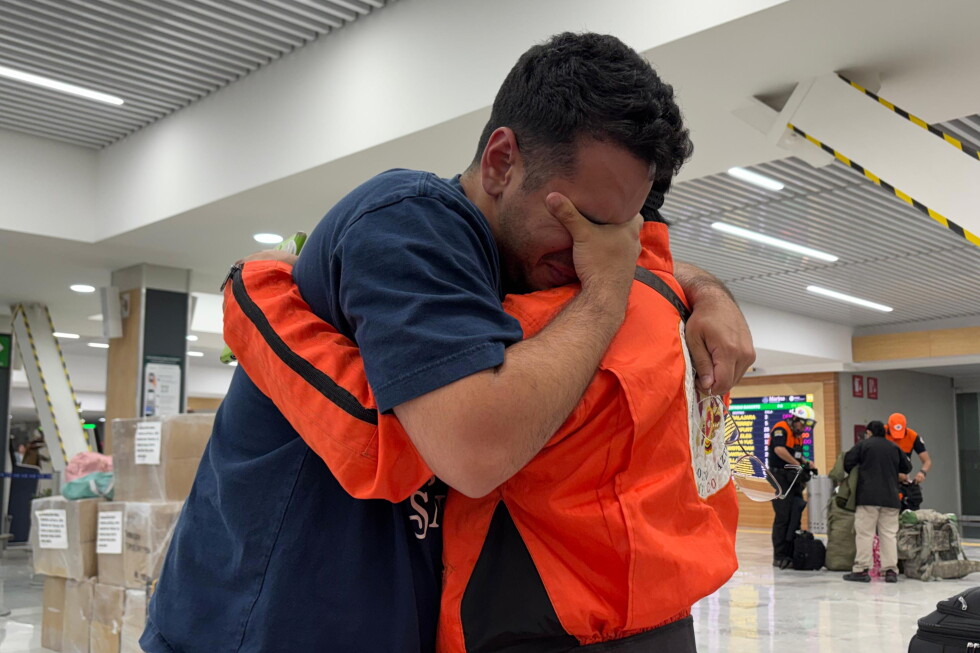
Back at the Mexico City airport, the human cost of the disaster came into sharp focus as Bello prepared to leave. A young Venezuelan engineer living in Mexico, Diego Bejarano, recognized Bello’s gear and approached to ask if he was part of the rescue mission. When Bello confirmed he was heading to the disaster zone where Bejarano’s entire family lives in Caracas, Bejarano broke down in tears.
Bello pulled him into a tight hug, a small moment of connection that he says fuels his years of volunteer work. After Bejarano left, Bello wiped tears from his own eyes and explained what keeps him returning to disaster zones again and again: “That’s my reward. Being able to give someone a little hope.”