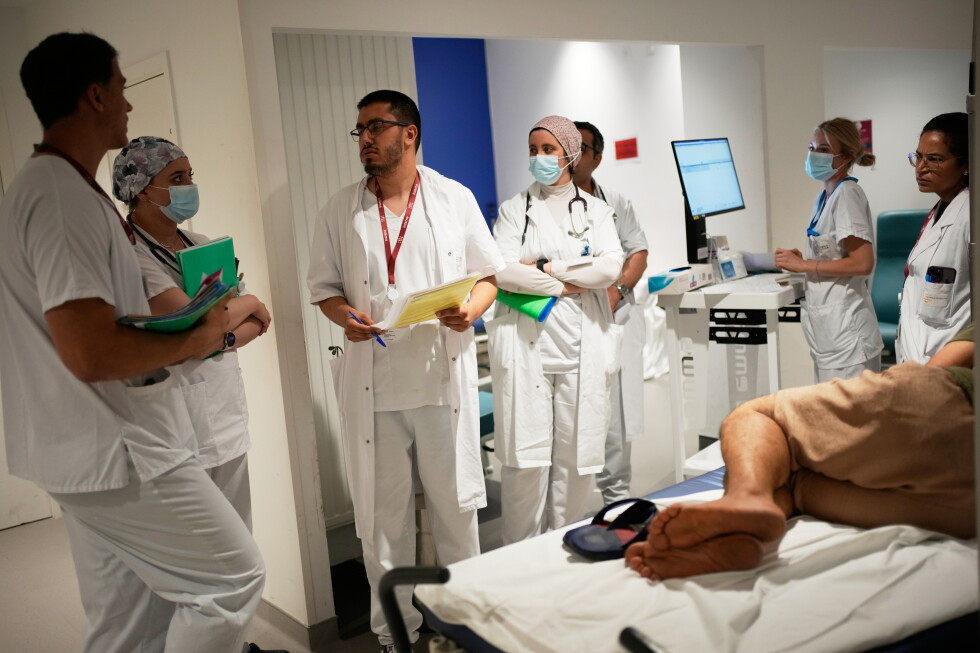
When a historic, temperature-shattering heat wave swept across Western Europe earlier this summer, it pushed French healthcare facilities to their breaking point — exposing critical gaps in preparedness that medical providers and government leaders are now rushing to fix as climate change makes extreme summer heat a permanent new public health reality. \n\nAt Paris-Saclay Hospital, located just outside the French capital, emergency medical teams faced a staggering, unanticipated shortage of one life-saving resource last week: large volumes of ice. With patients flooding in suffering from dangerous overheating, medics needed to immediately lower core body temperatures via cold water immersion to prevent fatal heat complications. But the facility had no on-site ice machine, forcing staff to scramble for last-minute solutions. A local fast-food chain stepped in to donate its entire stock of ice, while care teams purchased additional supplies from nearby grocery stores. Today, the hospital has placed an order for its own dedicated ice machine, a piece of equipment the emergency department now counts as a critical priority for the next heat event. \n\nThe historic heat wave, which initially battered France, the United Kingdom and neighboring nations before shifting eastward across the European continent, left a growing death toll in its wake. Now, as forecasters warn another heat surge could hit France as early as next week, healthcare leaders say the chaotic, exhausting ordeal of the past week has made clear that heat wave response is the new normal for the medical sector — analogous to the annual preparation for winter flu season. \n\n“We thought we were ready. We were not actually,” shared Cédric Lussiez, director of the Paris-Saclay public hospital system, in an interview. For seven straight days, the hospital operated around the clock, improvising new protocols and solutions on the fly to match the surging demand for heat-related care. “We already learned some lessons,” Lussiez added. \n\nAcross France, national efforts to close preparedness gaps are accelerating rapidly. Shortly after the peak of last week’s record heat, French Prime Minister Sébastien Lecornu announced a 100-million-euro ($114-million) investment starting this summer to install cooling systems in hospitals and upgrade heat-resilient infrastructure across healthcare wards. During a crisis planning meeting Monday, Lecornu confirmed the national government is purchasing 30,000 new air conditioning units for health facilities, with the first shipments set to arrive by the end of this week. “It’s an absolute priority for us that, if the heat wave returns, the hospital situation be a lot less strained,” he said. \n\nGlobal health officials have underscored that the 2026 heat wave is not an isolated anomaly, but a preview of what summers will look like as the planet warms. The World Health Organization labeled the event a “dress rehearsal” for future, more severe summer heat events this week, noting that Europe is warming more than twice as fast as the global average. “Heat waves are no longer one-off freak events,” the organization stated. “Every summer we fail to prepare for them is a summer we pay for in lives.” \n\nFor frontline medical teams at Paris-Saclay, the human cost of that unpreparedness was on full display. Dr. Nicolas Gonzales, head of the hospital’s emergency department, reported that heat-related patient arrivals surged starting June 20, with a seven-day continuous wave of critical cases that felt like “a big mountain” bearing down on staff. “In winter, we know we’ll have influenza epidemics and probably COVID as well. And now, in the summer, we’re going to have the climate crisis,” he said. \n\nThe first heat-related critical case Gonzales treated was a 50-year-old man who slipped suddenly into a coma at home with a core temperature of 40 degrees Celsius (104 Fahrenheit), going from seemingly healthy to unconscious in minutes. After that first case, a flood of patients followed: cases of heat-induced heart attacks, severe dehydration, kidney failure, and other life-threatening conditions across every age group, from young children to isolated elderly residents. “Heat is a physical assault. It is a physical assault on the body,” Gonzales explained. “And when the body can no longer adapt — or, unfortunately, is no longer able to fight off that assault — you don’t feel it coming, and the heart can stop beating.” \n\nWhile the main Paris-Saclay Hospital building is new and equipped with full central air conditioning, three older facilities in Lussiez’s hospital network lacked adequate cooling systems, and were pushed to the breaking point during the heat peak. Temperatures on the top, most sun-exposed floor of one psychiatric unit hit 33 degrees Celsius (91 Fahrenheit), while medical teams had to improvise cooling for temperature-sensitive medications using electric fans and loose ice blocks. Student nurses were reassigned to help with frequent patient hydration checks to prevent worsening heat complications. \n\nIn response to the gaps exposed by the heat wave, Lussiez’s team is already rolling out urgent upgrades: the psychiatric unit will get a dedicated cool patient room on each floor, the elderly care department will be relocated to the cooled main hospital building, and a host of other renovations are moving forward at an accelerated pace. “We’ll be in a better situation next week than we were last week,” Lussiez said, a small note of cautious optimism as the region braces for the next potential heat surge.
Hospitals in Europe are gearing up for the next heat wave armed with lessons from this one