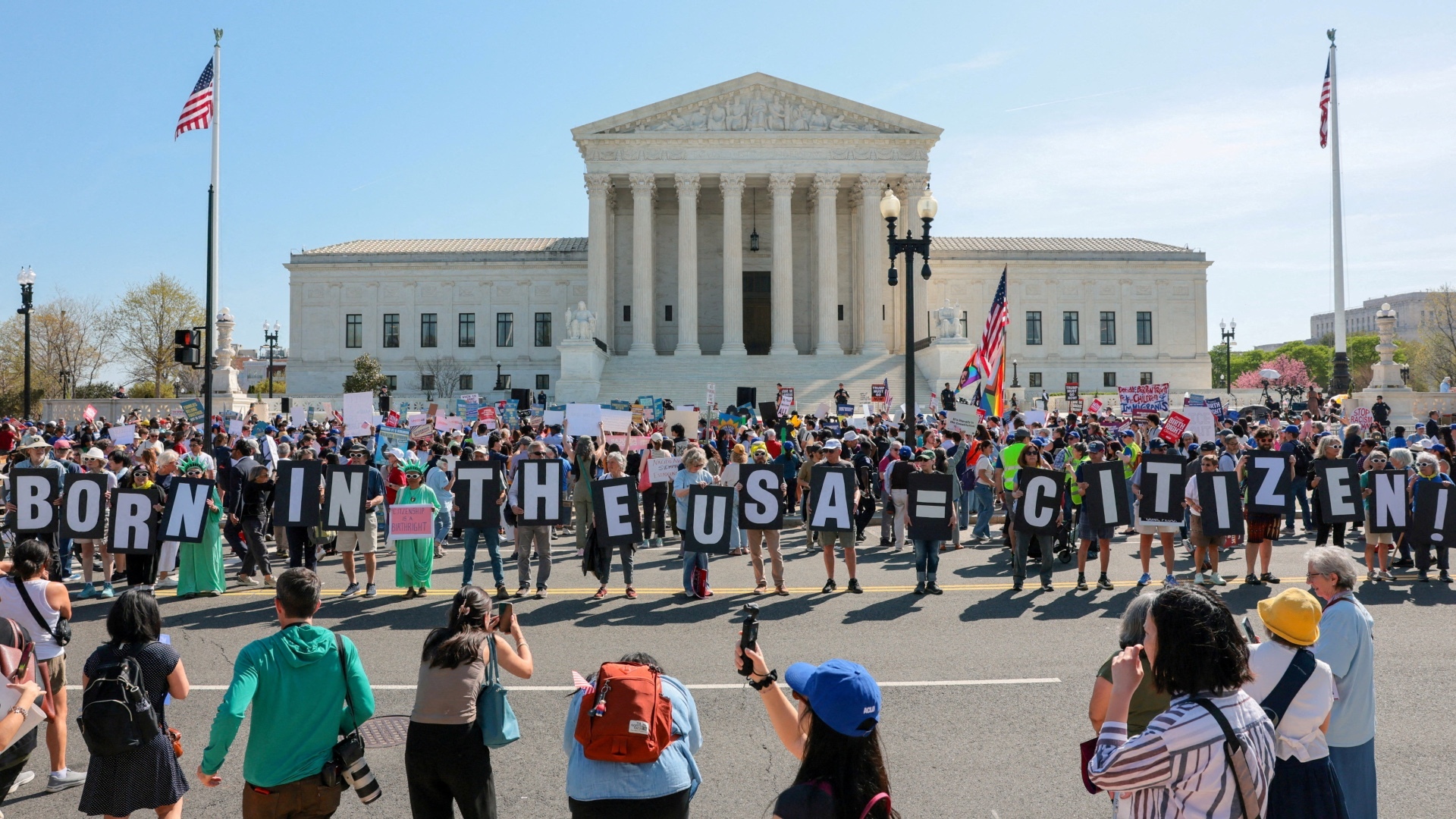
On Tuesday, the conservative-leaning U.S. Supreme Court — shaped by three appointments from former President Donald Trump — delivered a long-awaited ruling that preserved birthright citizenship as the nation’s binding law, in a narrow 5-4 decision that split the bench. Even dissenting Justice Brett Kavanaugh acknowledged that longstanding federal statute would have sustained the principle of birthright citizenship regardless of the court’s ruling on the constitutional question.
Writing for the five-justice majority, Chief Justice John Roberts emphasized the foundational role of citizenship in American democratic life. “Citizenship, then and now, was the right to have rights — to freely participate in our political community. The Framers of the Fourteenth Amendment extended that promise to ‘every free-born person in this land’,” Roberts wrote. “We keep that promise today.”
Rooted in the 1868 post-Civil War ratification of the Fourteenth Amendment to the U.S. Constitution, birthright citizenship mandates that nearly all children born within U.S. territory automatically gain American citizenship, with only narrow exceptions for children of foreign diplomats on official duty and active-duty foreign military personnel. The principle was adopted to redress the nation’s legacy of chattel slavery, which previously classified enslaved people as just three-fifths of a person for legal and political purposes and denied them full citizenship rights.
The case reached the Supreme Court after the Trump administration took the unprecedented step last year of moving to eliminate birthright citizenship, targeting children born to undocumented immigrants and people engaging in what the administration calls “birth tourism.”
Current demographic data puts the estimated undocumented population in the U.S. between 12 and 14 million, according to the Immigration Research Initiative. While no official federal data tracks birth tourism, 2020 estimates from the Center for Immigration Studies put the annual number of children born to birth tourists in the U.S. between 20,000 and 26,000, a small fraction of the 3.6 million annual births in a nation of 349 million people.
The Trump administration has positioned itself as the most hardline anti-immigrant administration in modern U.S. history. Over its current term, it has revoked more than 100,000 visas, deported roughly half a million immigrants, and detained roughly 70,000 more in overcrowded immigration facilities that have faced widespread condemnation for poor hygiene, insufficient access to food, and unsafe living conditions. It has effectively ended the national asylum program and canceled temporary protected status (TPS) — which allows people from unsafe countries to remain in the U.S. — for Afghans, Syrians, and Haitians.
Immigrant and human rights advocacy groups celebrated the Supreme Court’s ruling, but warned that the decision does not end the threat to immigrant protections for the remainder of Trump’s three-year term.
“While we welcome this decision, our work is far from over. We will continue to stand with our communities to ensure that every person’s constitutional rights are respected and that no administration can undermine the protections guaranteed by the Fourteenth Amendment,” Fernando Garcia, executive director of the Border Network for Human Rights, said in a public statement. “Today’s ruling reminds us that the Constitution belongs to all of us, and it is strongest when it protects everyone equally.”
Shawn VanDiver, president of #AfghanEvac, an organization supporting Afghan evacuees, noted that the question of whether birthright citizenship should stand should never have been in doubt. “For thousands of Afghan families rebuilding their lives in America, this ruling provides important certainty. Whether their parents are Special Immigrant Visa holders or applicants, refugees, asylees, humanitarian parolees, Temporary Protected Status holders, or navigating other immigration pathways, children born in the United States remain protected by the Constitution,” he said.
Jenin Younes, president of the American Arab Anti-Discrimination Committee, reaffirmed that birthright citizenship is a binding constitutional guarantee, not a discretionary privilege that can be revoked by executive order.
Shortly after the ruling was announced, with his executive effort to end birthright citizenship blocked, Trump took to his social media platform Truth Social to announce he would now push Congress to pass legislation eliminating birthright citizenship, arguing a full constitutional amendment is unnecessary.
“No long and unwieldy Constitutional Amendment is necessary! Congress should start TODAY to work on ending expensive and unfair to our Country, Birthright Citizenship. They will have my Complete and Total Support!” Trump wrote on the platform.
The White House has repeatedly framed birthright citizenship as a rule intended only for the children of enslaved people, not for people it claims are “trying to scam the system and come into the country.”
Hassan M Ahmed, managing partner of The HMA Law Firm based outside Washington, D.C., called the ruling a clear rebuke of the administration’s position. “The most conservative and, frankly, anti-immigrant Supreme Court just told Trump ‘don’t mess with birthright citizenship’. I think it’s safe for now,” Ahmed told Middle East Eye. He added that he does not expect the push for legislation to gain meaningful support among most members of Congress.
Unlike most of the world, which grants citizenship primarily by descent rather than birthplace, birthright citizenship remains deeply intertwined with American national identity and historical reckoning with slavery. Across the Americas, the principle of birthright citizenship is a widely established norm, and Ahmed called the U.S. version “sacrosanct” for its role in closing a dark chapter of the nation’s legal history.