Against the snow-capped backdrop of the Himalayan mountains, the iconic shikara wooden boats glide gracefully across Srinagar’s Dal Lake each morning, a postcard-perfect image that has drawn tourists to Indian-controlled Kashmir for generations. But behind this picturesque facade, one of South Asia’s most celebrated natural landmarks is quietly dying — and it is far from alone. A toxic combination of unregulated pollution, unplanned residential and agricultural encroachment, invasive vegetation, and climate-driven warming is pushing Dal Lake and hundreds of Kashmir’s other natural lakes toward irreversible collapse, with devastating consequences for local ecosystems, livelihoods, and the region’s core tourism economy.
Official government data underscores the scale of the crisis. A 2025 Indian government analysis found that since 1967, 315 of Kashmir’s 697 recorded natural lakes have vanished entirely, while another 203 have shrunk dramatically in surface area. Dozens of water bodies once mapped as full-year lakes have been reduced to shallow seasonal marshes, and many have been completely paved over or converted to farmland to accommodate the region’s growing population.
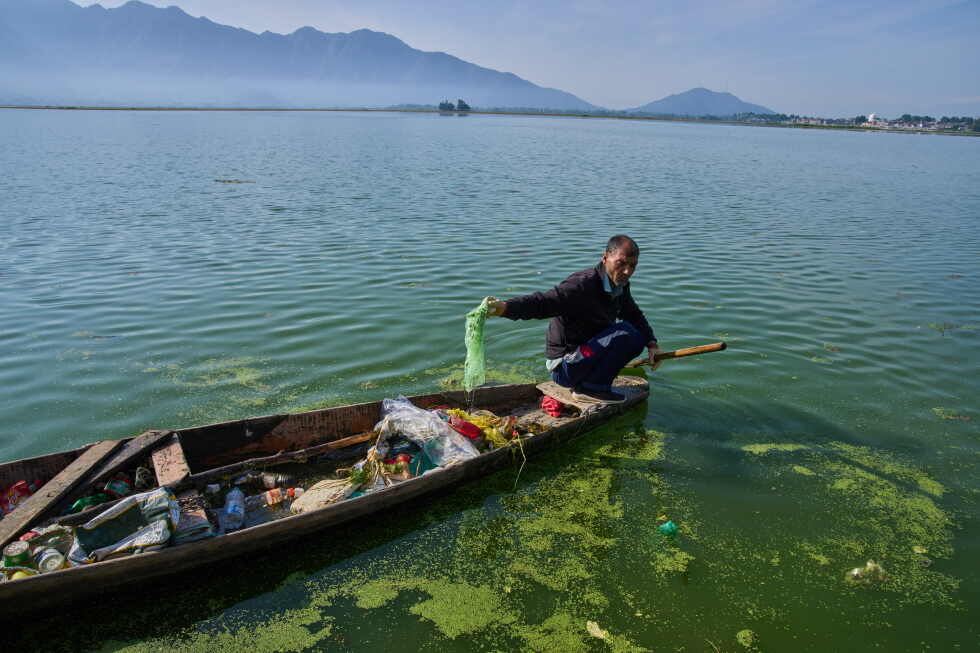
Dal Lake, which anchors Srinagar’s tourism sector and has long been the cultural heart of Kashmir, is among the fortunate few: it receives consistent, funded restoration attention from local authorities, a luxury most other Kashmir lakes do not get. Even so, the work of keeping the lake clear of choking invasive weeds and accumulated waste is a grueling, seemingly futile battle for the frontline workers tasked with its protection.
“We are afraid to touch the water with bare hands,” explained Ghulam Rasool, a weed cleaner employed by the local Lake Conservation and Management Authority (LCMA), during an on-site interview in May 2026. “Whenever we need to clean something by hand, we wear gloves, because without them our hands quickly develop painful allergies. Sometimes it feels impossible to keep up. Sewage drains flow directly into the lake, and water streams coming down from the mountains bring all kinds of waste — diapers, plastic bottles, every sort of garbage you can imagine.”
Every day, dozens of cleaners like Rasool work alongside heavy excavators to pull tons of weeds and solid waste from Dal Lake’s waters, with mounds of cleared debris visible along the lake’s shoreline. The root of the invasive weed problem, LCMA officials explain, lies in the untreated human waste that still flows into the lake. While more than 75% of Srinagar’s population is connected to a municipal sewage treatment system, thousands of unregulated homes built along the lake’s banks remain unconnected, flushing nitrogen- and phosphorus-rich waste directly into the water that fuels explosive invasive weed growth.
Encroachment by residential construction and agricultural land has also chipped away at Dal Lake’s boundaries for decades. Where open water once stretched, small farm plots and illegal structures connected by rickety wooden footbridges are now commonplace, with cattle grazing openly on reclaimed land that was once part of the lake. The same pattern plays out across nearly every major lake in the region, including Wular Lake, Kashmir’s largest freshwater body located 40 miles northwest of Srinagar.
Climate change has supercharged this slow decline, scientists warn. The Himalayan region is warming at a rate faster than the global average, amplified by the region’s high elevation. This rapid warming has triggered earlier spring snowmelt, reduced overall winter snowfall, and brought more frequent extreme rainfall events, all of which disrupt the steady flow of water that feeds Kashmir’s lakes. Glacial melt has also increased the volume of sediment carried downstream into lakes, filling them in faster and reducing their overall depth over time.
“While glacial melt can deliver a short-term increase in water flow, over the long term it erodes the natural water storage system that sustains rivers and lakes through dry summer months,” noted Sher Muhammad, a glaciologist with the International Centre for Integrated Mountain Development, based in Kathmandu. Irrfan Rashid, an environmental scientist at the University of Kashmir, added that climate change has upended nearly every core sector of Kashmir’s economy. “It has impacted hydropower generation, tourism, and even our high-value apple and saffron farms, all hit by erratic extreme weather in recent years,” he said.
For fishing communities that have relied on Kashmir’s lakes for centuries, the damage is already catastrophic. At Wular Lake, which historically acted as a natural flood buffer for the Jhelum River, 45-year-old fisherman Abdul Rasheed says his daily income has plummeted from roughly 1,000 rupees ($11) per day just a decade ago to just 100 to 200 rupees ($1 to $2) per full night of fishing. The lake has grown so shallow that navigating fishing boats through dense patches of invasive vegetation is nearly impossible, and decades of encroachment have reduced its total surface area by 45% since 1907, according to a 2007 analysis by conservation group Wetlands International. The same report warned that Wular’s degradation increases flood risk across the entire Kashmir Valley, because the lake can no longer absorb excess overflow from the Jhelum during monsoon season.
“Now even a skilled fisherman comes home with no more than 1 kilogram of fish, when a novice could catch 4 kilograms when I was young,” said 55-year-old veteran Wular fisher Bashir Ahmed. Most local fishers, he added, doubt future generations will be able to make a living from the lake at all.
Local authorities acknowledge that the crisis demands far more funding and coordinated action than what is currently allocated, but say they are working with existing resources to slow degradation. The LCMA, established in 1997, brings together civil engineers, ecologists, forest officials, and law enforcement to address encroachment and pollution, but systemic change requires broader policy action and public buy-in to save Kashmir’s iconic lakes.
This reporting was supported by private foundation funding for AP’s climate and environmental coverage, with the AP retaining full editorial control over all content.