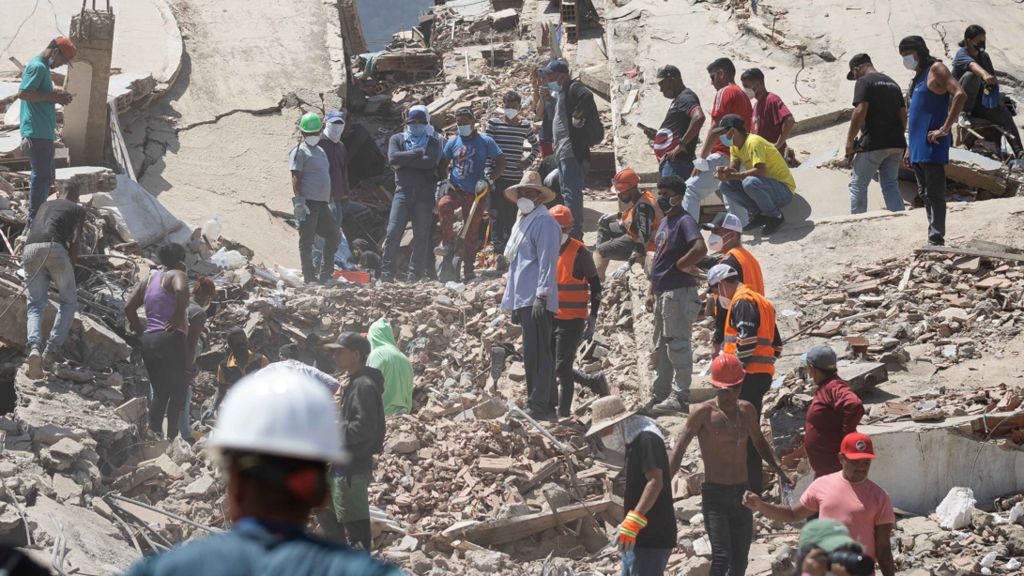
A week after two powerful back-to-back earthquakes devastated Venezuela’s northern coastal region, hopes of pulling more survivors from collapsed buildings are rapidly fading, as survivors and local volunteers lead most search operations amid widespread criticism of the Venezuelan government’s slow, under-resourced disaster response.
On August 26, a magnitude 7.2 quake and a 7.5 quake hit just 39 seconds apart in the state of La Guaira, located just outside the capital Caracas. The violent twin tremors triggered the collapse of nearly 800 structures, killed more than 1,700 people, and left tens of thousands unaccounted for. Interim President Delcy Rodríguez has called the disaster the “most brutal natural catastrophe” in Venezuela’s modern history. On Monday morning, a 4.6 magnitude aftershock rattled already frayed nerves across La Guaira and Caracas, though no additional damage was reported.
In La Guaira, one of the worst-hit port cities, reporters from the BBC observed local residents digging through rubble with only basic hand tools—crowbars, mallets, and pickaxes—hunting for trapped loved ones and neighbors. While uniformed Venezuelan police and military personnel were visible on streets near disaster zones, they were not spotted working to clear rubble or extract survivors. Heavy earth-moving equipment has only arrived sporadically, in most cases reaching collapse sites days after residents began digging, when it was already too late to save trapped people.
Many survivors have already shifted their goals from rescue to recovering remains to give family members a proper burial. Thirty-nine-year-old Carolyn Zerpa, who has been searching for her father and brother by hand, told reporters that pickaxes are barely enough to move heavy debris. “You can’t really do much with just a pickaxe,” she explained. Thirty-two-year-old electrician Ruben Rojas, who has worked through the rubble with only gloves and a hard hat, said even official civil protection teams lack the tools required for large-scale rescue. “The government doesn’t give it. They are just like us, working with their hands,” Rojas said.
Local frustration over the delayed response has been amplified by Venezuela’s ongoing severe economic crisis, which has stretched government resources thin for years. Zuly Marín, a 15-year La Guaira resident who lost her niece and brother-in-law in the disaster, said the slow arrival of rescue teams and heavy equipment directly cost lives. “I think that if they had come sooner, many people could have been saved,” she said. In El Junquito, a mountainous community west of Caracas, residents told Reuters that almost no public officials have reached the area, and local farmers and residents have been the only ones distributing basic food and supplies to displaced families. Thirty-three-year-old resident Keily Ibarra said the community is still waiting for official support to clear debris, inspect damaged structures, and aid impacted families.
Despite the fading odds of finding more survivors, there has been one small recent miracle: on Monday, a joint team of rescue workers from Venezuela, Mexico, and El Salvador pulled 21-year-old Aaron Levi Cantillo Vargas alive from rubble after he had been trapped for more than 100 hours. Salvadoran President Nayib Bukele confirmed the rescue in an announcement, adding that Cantillo is now receiving specialized medical care, and that rescuers will “continue working with the hope of being able to save more lives.”
The Venezuelan government has taken some formal steps in response to the disaster: Rodríguez announced a special government commission to assess full damage across affected regions, chaired by her brother, National Assembly President Jorge Rodríguez. The commission plans to use a color-coded system to classify the safety of damaged buildings and determine when residents can return to their homes, while temporary displacement camps are being set up in the meantime. But the slow on-the-ground response has left most rescue work to local volunteers and international disaster teams, which have mobilized quickly to support the effort.
Multiple countries have pledged substantial new international aid in recent days. The United States has doubled its previous commitment to disaster relief, announcing it will provide more than $300 million to fund emergency medical care, food assistance, clean water and sanitation, temporary shelter, and logistical support. A U.S. Navy frigate, the USS Fort Lauderdale, is currently stationed off the coast of La Guaira, and its crew and Marines are using landing craft to deliver supplies directly to hard-hit coastal areas. The Netherlands plans to send a cargo vessel carrying emergency supplies, while China has pledged nearly $15 million in disaster assistance for Venezuela.