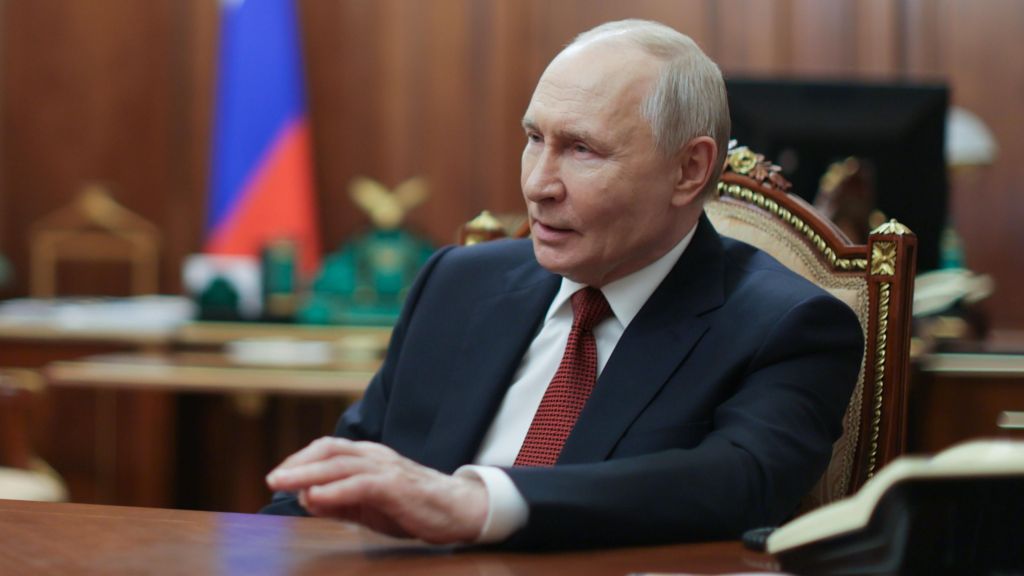
For months, the tangible effects of Ukraine’s long-range missile and drone attacks on Russian energy infrastructure stretching from central Moscow to the Black Sea coast have been impossible to ignore. Motorists have faced long lines at filling stations, mandatory fuel rationing has rolled out across dozens of regions, key oil refineries have been knocked offline by strikes, and in Russian-annexed Crimea, civilian drivers have been barred from purchasing fuel entirely to prioritize military convoys. Until now, however, Russian President Vladimir Putin had never publicly addressed the scope of the crisis. That changed over the weekend, when Putin met with top government officials and leading Russian oil industry executives to discuss the growing fuel shortage, marking an unprecedented moment of candor from the Kremlin leader.
In opening remarks to the gathering, Putin conceded that ongoing disruptions have created hardship for both ordinary drivers and commercial operators across the country. “You’re well aware that problems persist for both motorists and businesses,” he told attendees. “Unfortunately, there are still queues at petrol stations, and finding the right grade of petrol isn’t always easy.” He also highlighted the acute risks the shortage poses to Russia’s agricultural sector, noting that the success of the annual domestic harvest is directly tied to consistent, reliable fuel access for harvesting equipment.
According to independent Russian media outlet Mediazona, fuel purchase restrictions are currently in effect across 56 of Russia’s 85 regions, a scale of disruption that left Putin with little choice but to address the issue publicly. In a subsequent interview with Russian state television, he went even further, directly linking the fuel crisis to Ukrainian attacks on energy infrastructure. Ukraine’s strikes are “obviously creating problems,” Putin admitted, confirming: “We are currently seeing a certain shortage, but it’s not critical.”
The Russian leader outlined immediate steps his administration would take to mitigate the crisis, including ramping up production of air defense systems to better protect critical energy facilities across the country and accelerating repair work at refineries that have been damaged or destroyed by Ukrainian strikes. He acknowledged that the situation in Crimea is particularly strained, admitting the occupied peninsula only holds “a few days’ supply” of fuel stockpiles, but added he remained “confident” additional supplies would be transported to the region quickly.
Experts note that Putin’s level of openness about the impact of Ukrainian strikes on civilian life is highly unusual for the Kremlin, which has worked aggressively to downplay the domestic costs of its full-scale invasion of Ukraine since 2022. The public acknowledgement of hardship in Crimea carries extra symbolic weight, as the peninsula has been a core strategic and ideological priority for the Kremlin since its illegal annexation in 2014. Moscow has since turned Crimea into a major regional military hub, using it as a staging ground for much of its southern front offensive in the 2022 invasion.
Putin also framed his decision to speak openly about the fuel crisis as a counter to what he framed as a Ukrainian information offensive. He claimed that Kyiv is deliberately targeting energy infrastructure to sow division among Russian civilians, erode public support for the invasion, and pressure the Kremlin to enter peace negotiations. “We won’t give them that chance,” he said, adding that Ukrainian long-range strikes have had “absolutely no impact on the situation at the front line.”
That assessment is flatly rejected by Ukrainian authorities, who say their deep strikes into Russian territory serve two core military goals: they bring the reality of the war home to ordinary Russians who have largely been insulated from its effects, and they force Russia’s military command to reallocate critical air defense and troop resources away from frontline positions in eastern and southern Ukraine to protect infrastructure deep inside Russia.
In recent months, Kyiv has ramped up the frequency and scope of its deep strikes, hitting targets as far inland as St. Petersburg and central Moscow, while significantly increasing pressure on Russian military and energy assets in Crimea. Ukrainian officials have grown increasingly confident that their long-range strike campaign is shifting the momentum of the war in Kyiv’s favor.
Despite the growing domestic disruptions, Kremlin spokesman Dmitry Peskov reaffirmed on Monday that Moscow’s core war aims remain unchanged. Russia continues to demand that Ukrainian forces withdraw from the four southeastern Ukrainian regions Donetsk, Luhansk, Zaporizhzhia and Kherson, which Moscow illegally claimed to annex in 2022 – a claim that Kyiv and the vast majority of the international community reject entirely. “Our position is well known,” Peskov said.
In his state television interview, Putin also addressed recent reports that Kyiv has proposed a pause in hostilities to open negotiations, a suggestion Putin dismissed as a cynical ploy for Kyiv to buy time to rebuild its depleted forces and reequip its military for further offensive operations. Putin claimed that any proposal for talks comes only because Russia’s own deep strikes into Ukrainian territory are far more powerful and destructive than Kyiv’s attacks. He claimed Ukraine’s army is “catastrophically” depleted, and that Kyiv’s energy strike campaign is a desperate attempt to distract from losses on the front. “Saving the Kyiv regime is not part of our plans,” he added.