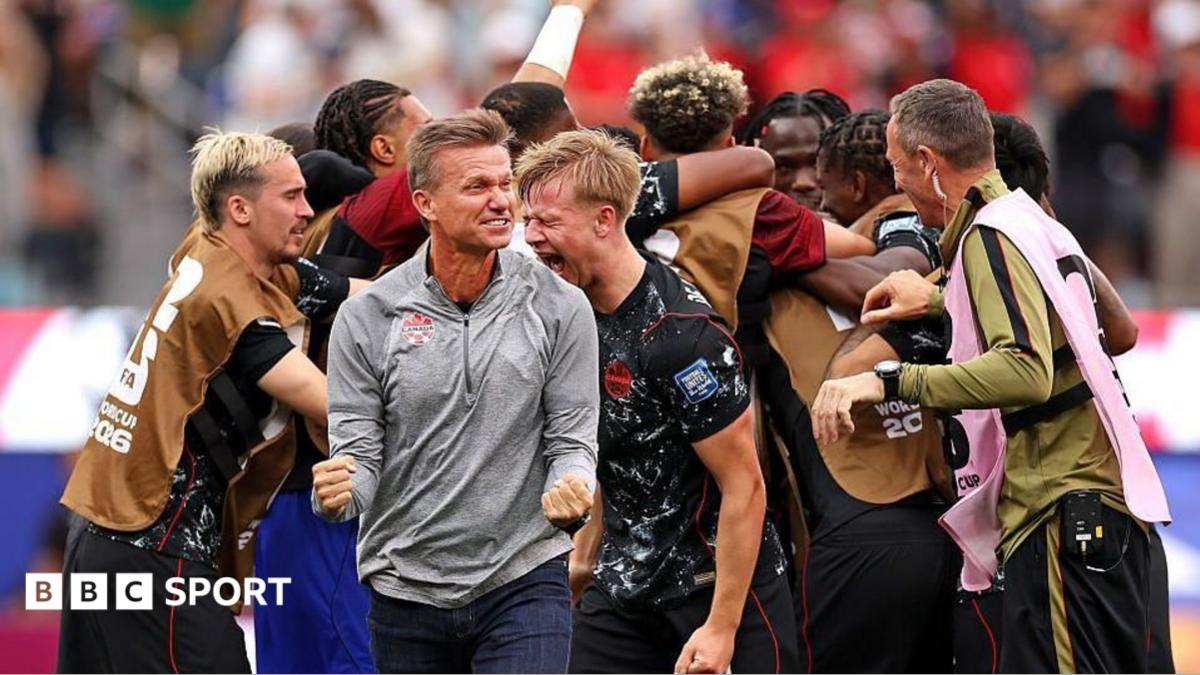
As the final whistle echoed across Los Angeles Stadium on Sunday, a new chapter of Canadian football was officially written. A last-gasp winner from midfielder Stephen Eustaquio secured a 1-0 knockout victory over South Africa, sending the co-host nation through to the Round of 16 at the 2026 FIFA World Cup for the first time in its history. Immediately after the full-time whistle, head coach Jesse Marsch pulled his entire squad and coaching staff into a tight, jubilant huddle, addressing his players as nothing less than “Canadian heroes.” \n\n”The future of the sport in this country is huge because of you,” Marsch told the group, words that carried far more weight than the coach’s famously impassioned rhetoric. For a nation long defined by ice hockey as its national sporting obsession, this breakthrough run has already shifted the cultural conversation around the game. Long referred to as “soccer” in Canadian public life, fans now openly embrace the global term “football” — a small linguistic shift that signals a far larger cultural change. \n\nWhen Marsch took charge of the Canadian national team two years ago, his goal of turning Canada into a recognized football nation sounded like a distant dream. As one of three North American co-hosts for this 2026 tournament, Canada spent much of the pre-World Cup buildup overshadowed: Mexico took the spotlight for the opening match, the United States claimed attention for hosting the final, and Canada was widely dismissed as the forgotten co-host. But the squad and its growing fanbase built momentum steadily, quietly cultivating domestic passion ahead of the tournament. \n\nThat growing enthusiasm has not gone unnoticed by the team’s star captain, Alphonso Davies, a veteran of packed stadiums playing for European giants Bayern Munich in the Champions League. Even Davies was overwhelmed by the shift in domestic support ahead of the tournament. Ahead of Sunday’s knockout clash, he recalled crying after watching thousands of Canadian fans pack viewing events in Toronto, clad in the national red and white, for the team’s opening draw against Bosnia-Herzegovina. \n\n”It was surreal because I’ve never seen so many Canadians at a football match before,” Davies said. “It brought tears to my eyes.” \n\nCanada’s historic run has already defied every pre-tournament expectation. Before this 2026 World Cup, the nation held a winless record across six previous World Cup matches, never picking up so much as a single point or victory. That drought ended in their opening fixture, with a hard-fought draw against Bosnia-Herzegovina that secured Canada’s first ever World Cup point. The team followed that breakthrough with a stunning 6-0 rout of Qatar, the tournament’s defending champions, to lock in their knockout stage spot — the first ever for Canada. \n\nA final group stage defeat to Switzerland forced the knockout match against South Africa to be played on American soil, marking the first time in World Cup history that a host nation has played a knockout match outside its own borders. That did nothing to dampen Canadian support, however: thousands of fans crossed the border to pack the stands, turning Los Angeles into a de facto home ground with chants and cheers that drowned out South Africa’s supporters. \n\nFor most of the 90 minutes, South Africa set out to grind out a result and force the game to penalties, putting Canada under persistent pressure to find a breakthrough. The Canadian side stayed composed, though, and it was Eustaquio who delivered the moment of magic in stoppage time, slotting home the winner to spark wild celebrations. \n\nMarsch later defended his decision to gather the entire squad for a full-time huddle on the pitch, a move some critics dismissed as performative. For Marsch, the moment was about pausing to celebrate the historic milestone together, amid the chaos of post-match media requests that pull players and staff in dozens of directions. \n\n”All I care about is our team and what we do together,” Marsch said. “I wanted to be able to voice to them how important a moment this will prove to be for the sport in the country. It is a shame we couldn’t do it in Vancouver, in front of our fans, but nevertheless I think you saw the character of the team, the quality of the team, the mentality of the team and the togetherness of the team.” \n\nUp next, Canada faces a stiff test in the Round of 16, with a clash against either Morocco — ranked 6th in the world — or the Netherlands, ranked 7th. But fans and players alike agree that regardless of the result of that upcoming match, the landscape of Canadian football has already changed forever. \n\nLong-time fan Harry, who attended matches in the 1990s when Canadian fans were often the minority at even home fixtures, marvelled at the turnout of supporters for the South Africa match. “It is incredible to see how many fans have come down into the USA to watch us, hopefully that energy can help improve us back home,” he said. \n\nFellow supporter Sean added that while large urban centers like Toronto have long held a dedicated soccer following, the hope now is that this World Cup run will expand interest across smaller cities and provinces, where ice hockey has long reigned supreme. \n\nWhile advancing past the Round of 16 will be no easy feat for Canada, the team has already surpassed every expectation placed on it heading into the tournament, making a upset far from unthinkable. Marsch echoed that confident mindset ahead of the next clash, framing the match as a free opportunity to test the team against global giants. \n\n”Given Morocco’s last six years they are a modern giant and given the success of the Dutch team for what feels like centuries that is a traditional giant,” Marsch said. “I feel like it is a free hit and we will go after it and do whatever we can to get a win.”