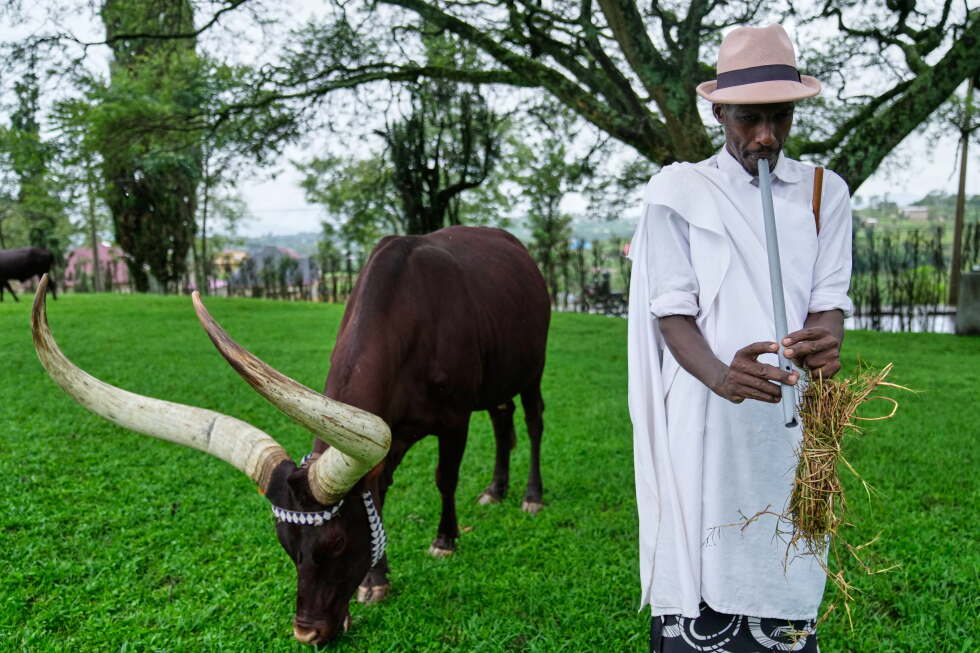
In the rolling grasslands of Nyanza, Rwanda, a gentle daily routine unfolds that reflects the country’s deep-rooted royal history: caretakers serenade sacred cows with traditional flute melodies and recite lyrical poetry honoring their grace. These are the Inyambo, a distinctive lineage of royal cattle that have evolved from symbols of monarchy power to treasured anchors of Rwandan national identity.
With iconic crescent-shaped horns and a rich deep brown coat long associated with nobility, Inyambo cows descend from the famous Ankole cattle of East Africa, a breed also found in neighboring Uganda and Burundi. For centuries, they occupied a unique place in Rwandan royal courts: unlike common cattle raised for milk or beef, Inyambo were kept exclusively as status symbols, representing immense wealth, prestige, and sovereign power for ruling monarchs. “They’re not for milk, they’re not for meat. They were just used as decorations around the palaces,” explains Bigira Junior, curator of the King’s Palace Museum in Nyanza, where a herd of Inyambo grazes today.
Though Rwanda’s monarchy was abolished decades ago, the reverence for Inyambo has endured and adapted to modern times. Even President Paul Kagame keeps Inyambo cows, and has continued the ancient tradition of gifting the cattle to foreign heads of state—a practice local outlet *The New Times* has dubbed “Inyambo diplomacy.” As Rwanda ramps up investment in cultural tourism to draw international visitors, the Inyambo herd at the King’s Palace Museum has become the site’s star attraction, drawing crowds eager to learn about the country’s pre-colonial history.
The care given to these animals reflects their elevated cultural status. Before public presentations or traditional ceremonies, caretakers call each cow by name and sing verses celebrating their unique beauty, a practice believed to keep the animals calm. One traditional refrain goes: “You have beautiful horns. Move your head so that we can see your beautiful neck and body. You are the most beautiful cow among others.” After reciting poetry, caretakers gently brush each cow’s coat, a hands-on practice that reflects the community’s connection to the breed. “Remember, they are to be loved and cherished, and you can’t love something from afar. You have to get close to it,” Junior notes.
Across much of East Africa, cattle have long carried profound social and economic weight: a larger herd, especially one with rare, distinctive breeds, signals greater respect and standing for its owner. This tradition extends across borders: in 2004, South African President Cyril Ramaphosa purchased a prized group of Ankole cattle from Ugandan President Yoweri Museveni, underscoring the breed’s cross-regional cultural significance. Today, Inyambo serve as shared cultural ambassadors for both Rwanda and Uganda, tying together shared regional heritage.
In Rwandan traditional culture, the influence of Inyambo extends beyond the pasture. The iconic shape of their curved horns has inspired the country’s beloved traditional women’s dance, where performers extend their arms in graceful arcs to mimic the cows’ silhouette. “The dance is more or less a way to portray the beauty of the royal cows,” Junior explains.
Formal conservation efforts for the Inyambo breed launched in the early 2010s, when the herd was reintroduced to grounds surrounding the King’s Palace Museum as part of a national heritage initiative. Today, the exact global population of Inyambo remains unknown, so caretakers run dedicated breeding programs to protect the breed’s most distinctive traits: their signature long crescent horns and the deep brown coat that has symbolized royalty, maturity, and stability for centuries.
For younger Rwandan generations visiting the museum, encountering Inyambo is more than a tourist experience—it is an introduction to their country’s history and shared identity. Museum educators work to instill this appreciation in young visitors, tasking them with carrying the tradition forward. “We educate them to take this information to others and keep the culture alive,” Junior says. As Rwanda builds its future, the gentle, sacred Inyambo cows remain a living link to the royal traditions that shape the nation’s identity today.