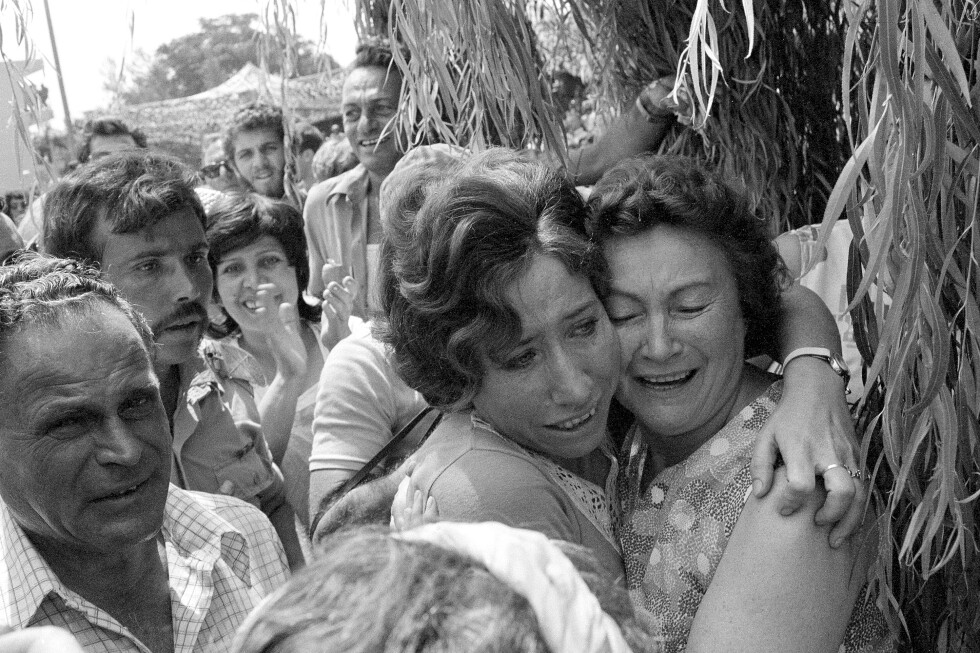
JERUSALEM — On Friday, Israel made public a vast collection of long-classified government documents that lay bare the internal deliberations and high-stakes decision-making behind one of the most legendary operations in Israeli military history: the 1976 Entebbe hostage rescue mission, whose 50th anniversary will be marked on July 3. The declassification comes at a deeply resonant moment for Israel, which is still navigating the fallout from the October 7, 2023, attack by Hamas-led militants that killed approximately 1,200 people and abducted 251 hostages to the Gaza Strip, casting a new shadow over decades of Israeli policy on hostage crises.
The operation itself remains a defining feat of military daring: On June 27, 1976, militants from the Popular Front for the Liberation of Palestine and West Germany’s Revolutionäre Zellen hijacked an Air France flight traveling from Tel Aviv to Paris, diverting it to Entebbe Airport in Uganda, where they received backing from then-Ugandan dictator Idi Amin’s government. The hijackers held 106 passengers, the vast majority of whom were Israeli or Jewish, threatening to execute them unless dozens of imprisoned militants were released by multiple countries. In a mission that took under an hour to complete, 29 Israeli commandos flew more than 2,500 miles over hostile territory to storm the airport, rescuing all but three hostages killed in crossfire. All seven hijackers and roughly 45 Ugandan soldiers were killed in the operation, and only one Israeli commando died: Yonatan Netanyahu, older brother of current Israeli Prime Minister Benjamin Netanyahu. The operation’s low casualty count and audacious scope cemented its place as a foundational myth of Israeli military prowess.
Longstanding popular narrative has framed Entebbe as a turning point where Israel rejected negotiation with hostage-takers in favor of a bold military strike. The newly released files from the Israel State Archives upend that simplified telling, revealing that Israeli leaders under then-Prime Minister Yitzhak Rabin pursued a deliberate two-pronged strategy, only greenlighting the raid when diplomatic efforts showed no signs of progress. For the first six days of the crisis, Rabin’s ad hoc national crisis team took a hard line, refusing any negotiations with the hijackers. But as the militants’ execution deadline drew near and pressure mounted from the hostages’ families, the cabinet shifted position, opening the door to conditional talks.
“The zero hour is approaching … We believe that a supreme effort must be made and break the ultimatum,” Rabin’s crisis team wrote in one newly released memo, which authorized negotiations on portions of the hijackers’ demands. While pushing forward France-brokered talks with Amin’s government, Israeli military planners simultaneously worked in secret: they built full-scale mockups of the Entebbe terminal to practice the raid, mapped flight routes through African airspace controlled by hostile states, and prepared transport planes for the overnight strike.
Only when negotiations stalled did leaders give the final order for the mission. Even before the release of these files, much was already known about the broad outlines of the Entebbe operation, but the new documents provide granular, unprecedented insight into the weight of the choices facing the Israeli cabinet. For decades, Israel has maintained a formal policy of occasionally exchanging imprisoned Palestinian detainees for hostages held by militant groups, a practice that has drawn repeated criticism from those who argue it incentivizes future kidnappings. The Entebbe documents confirm Rabin’s administration was willing to test diplomacy before turning to force, contradicting the popular framing of the operation as an outright rejection of negotiation.
The operation drew international condemnation at the time from Idi Amin and the Organization of African Unity, the predecessor to the modern African Union, which argued the raid violated Ugandan national sovereignty at a time when diplomatic efforts were still ongoing. For Israel, the mission stood as a rare high-profile victory after the trauma of the 1972 Munich Olympics massacre, where all nine Israeli hostages were killed during a failed German-led rescue attempt. Even in the immediate aftermath of the operation’s success, however, Rabin warned against overstating its impact on the long-term fight against terrorism, a prescient observation that carries new weight today amid the ongoing Gaza hostage crisis.
“Let us not deceive ourselves,” Rabin wrote in one personal memo included in the declassified files. “It was an extraordinary operation and achievement. However, the problem is not over. Terrorism continues to operate. What other problems terrorism will pose to us and what lessons we must learn from this matter, it is too early to say. We have finished one battle, but the war continues.”