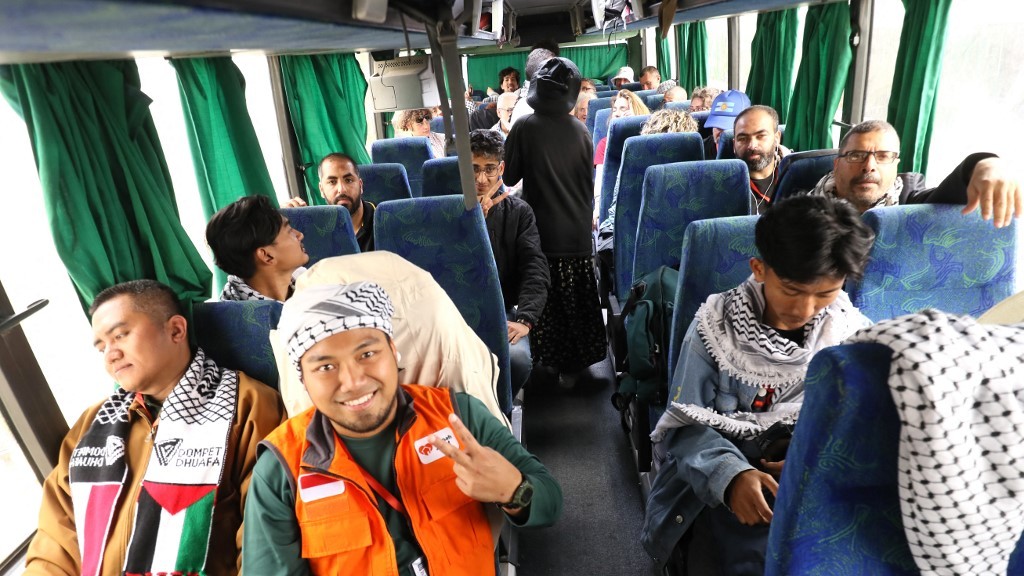
After 30 days of captivity in Libyan territory controlled by forces loyal to controversial Libyan strongman Khalifa Haftar, 10 international activists from a Gaza-bound humanitarian convoy have been released, official and advocacy group sources confirmed this week.
The detained activists, who hold citizenship from Spain, Poland, the United States, Argentina, Uruguay, Portugal, Tunisia and Italy, were part of the Global Sumud Convoy, a land-based humanitarian initiative aimed at breaking the years-long Israeli blockade of the Gaza Strip and delivering critical aid and services to the strip’s 2 million residents. The convoy, which was first organized by North African activists before growing to include international participants, carried seven ambulances, 10 aid trucks, 20 mobile homes, and a cohort of medical workers, engineers, educators and independent legal observers. Its organizers sought to follow in the footsteps of earlier sea-based flotillas that attempted to deliver aid to Gaza by challenging the Israeli naval blockade.
The convoy was halted by Haftar’s Libyan Arab Armed Forces (LAAF) in late May near the coastal city of Sirte, as it attempted to travel east across Libya toward the Egyptian border, from where it planned to enter Gaza. While most of the convoy’s members were deported immediately after the stop, the 10 activists were taken into secret detention in a remote Libyan desert location. In response to their arbitrary detention, the activists launched a hunger strike between June 1 and at least June 4 to protest their confinement and the authorities’ refusal to grant them access to legal counsel and contact with their families.
Under a recent ruling from the Benghazi Court of Appeal, eastern Libya’s foreign ministry announced this Wednesday that all detained convoy members would be deported from the country. Footage shared on the Global Sumud Flotilla official Instagram account showed six of the freed activists arriving safely at Istanbul’s airport on Wednesday, where they were greeted by waiting friends and fellow activists. It remains unclear when the remaining four activists will complete their deportation process.
Long-simmering human rights concerns have surrounded the LAAF, which has been repeatedly accused by global monitoring groups of systemic war crimes and widespread human rights abuses across the territory it controls in eastern Libya. Amnesty International has documented that the force and its allied armed groups systematically crack down on freedom of expression and peaceful association, deliberately targeting anyone perceived as a critic or opponent of Haftar’s administration.
“Libyans, as well as refugees and migrants, detained by LAAF, which exercises government-like functions in areas under its control, risk torture and other ill-treatment, as well as prolonged detention amid flagrant due process violations,” explained Sara Hashash, Amnesty International’s deputy director for the Middle East and North Africa. Before the activists’ release, the organization confirmed the group faced charges of unlawful unauthorized assembly, which carried a potential penalty of up to six months of prison time and an additional fine.
In the wake of the detention, Haftar’s eastern Libyan administration implemented a new travel restriction: all non-Libyan and non-Egyptian nationals are now barred from traveling onward to Egypt through eastern Libyan territory.
The incident has also sparked internal debate within activist circles over the planning of the convoy. Some observers and participants have argued that the initiative was flawed from its early stages, pointing to a lack of contingency planning for confrontations with LAAF forces. Felipe, a 29-year-old Chilean-Palestinian activist with experience in previous Gaza-bound aid flotillas, told Middle East Eye that the group bore partial responsibility for the outcome of their journey. After a two-week waiting period in Tripoli, Felipe noted that it became clear the convoy had no backup plan if it was blocked from crossing eastern Libya, and that the group spent nine idle days waiting in the desert without any clear next steps. “If we were not able to go through east Libya, we should not have kept pressuring them because we were going to shift the narrative from Israel to Libya,” he said.
Libya has remained fractured along political and geographic lines since the 2011 NATO-backed overthrow and killing of longtime authoritarian ruler Muammar Gaddafi. Today, Haftar’s administration controls eastern Libya with military and political backing from Egypt and the United Arab Emirates, while the United Nations-backed Government of National Unity holds authority over western Libya from its capital in Tripoli, with support from Turkey. The 5+5 security zone near Sirte where the convoy was halted was established under the October 2020 national ceasefire agreement, and remains a contested flashpoint between the two rival administrations.