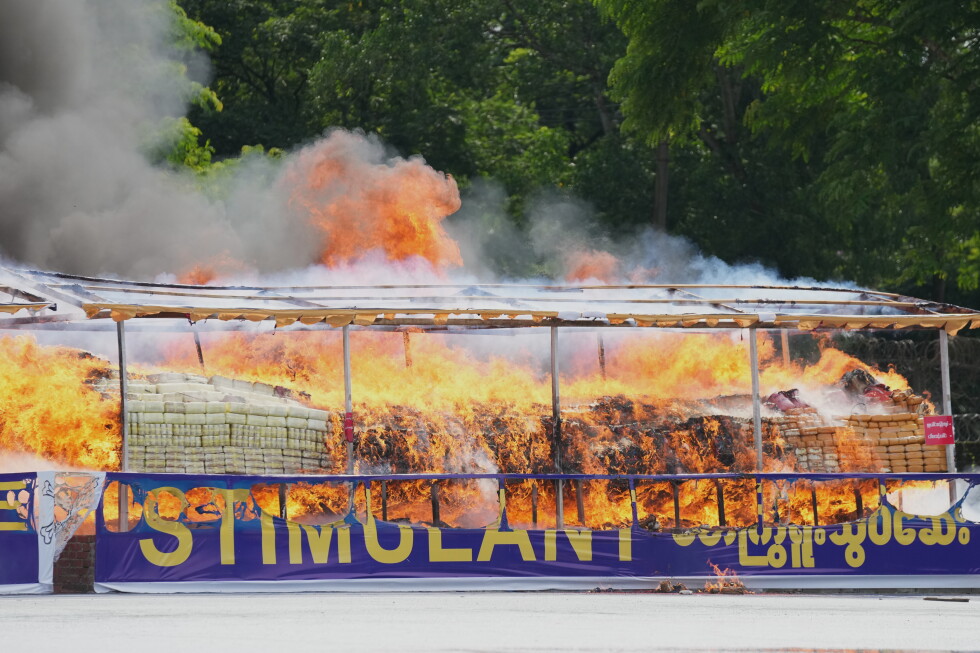
YANGON, Myanmar – On Friday, towering plumes of black smoke rose over the outskirts of Myanmar’s most populous city as authorities incinerated more than 50 tons of seized illicit narcotics to mark the United Nations’ International Day Against Drug Abuse and Illicit Trafficking. The destroyed drugs, which included heroin, opium, ketamine, methamphetamine, marijuana and crystal meth, carried a combined street value of roughly $600 million across all destruction events held nationwide. Of that total, $321 million worth of 31 distinct types of narcotics were burned at the Yangon site alone, according to Police Lieutenant Colonel Aung Myat Soe of Yangon’s Anti-Narcotics Police Force. Speaking to reporters at the bus station compound on Yangon’s edge where the burning took place, Aung Myat Soe noted that the 2024 total street value of destroyed drugs is more than double the amount destroyed in 2023. Parallel drug destruction ceremonies were also hosted in Mandalay and Taunggyi, the capital of eastern Myanmar’s Shan State – regions located much closer to the country’s major drug production hubs.
Myanmar has long grappled with large-scale illicit drug production, a crisis deeply tied to decades of political instability and economic uncertainty rooted in ongoing armed conflict across the country. For generations, the nation has ranked among the world’s top producers of heroin and methamphetamine, and it remains a primary supplier of illegal narcotics to markets across East and Southeast Asia, even after repeated government crackdown attempts.
Drug production has accelerated sharply since the 2021 military coup that ousted the democratically elected government led by Aung San Suu Kyi, experts confirm. The coup plunged the country into a widespread civil war that pits the military-run State Administration Council against pro-democracy opposition forces and a coalition of ethnic armed organizations, most of which control large swathes of territory outside central government rule. In early 2024, the military government announced that it had carried out the largest illicit drug seizure in Myanmar’s recorded history, confiscating vast amounts of narcotics and drug manufacturing equipment from 12 production sites during raids across northern Shan State.
The military government asserts that ethnic militias operating in contested border regions rely on the illegal drug trade to fund their insurgencies against state forces, and have little incentive to join national peace negotiations because of the massive profits the trade generates. While the military’s claim holds true for many armed groups, it is not universal: some anti-government factions have also carried out their own anti-narcotics operations. The Ta’ang National Liberation Army (TNLA), an ethnic armed group that seized large sections of northern Shan State during early civil war offensives before agreeing to a ceasefire with the military in October 2023, announced Thursday it would destroy approximately $5.5 million worth of seized narcotics in areas under its control. The 2024 general election held earlier this year, which the military won by a landslide, was widely dismissed by international observers as neither free nor fair, given that all major opposition groups were barred from participating and widespread voter intimidation was reported.