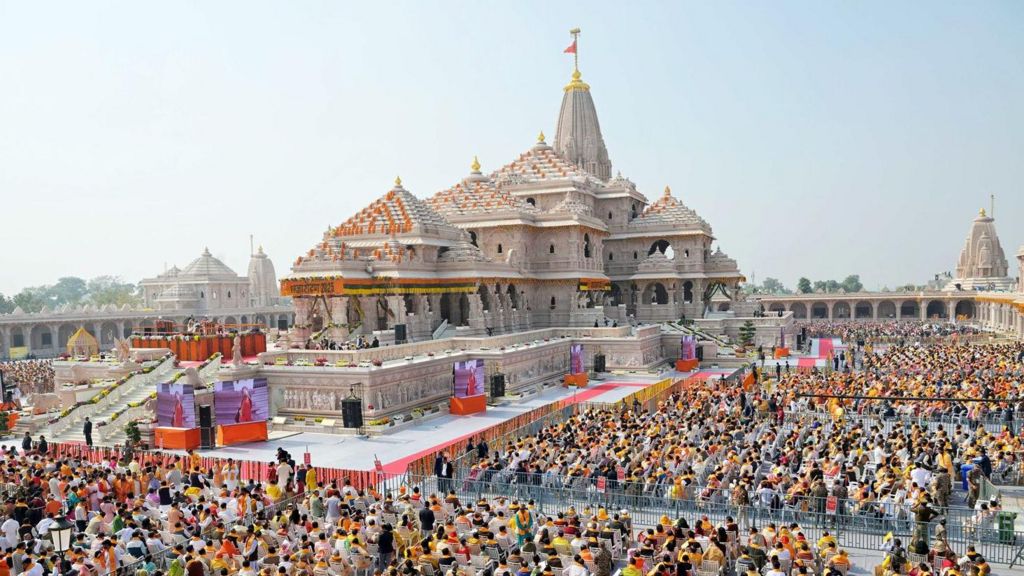
Two and a half years after Indian Prime Minister Narendra Modi inaugurated the sprawling Ram Temple in Ayodhya, one of Hinduism’s most sacred sites, the shrine has become the center of a bitter public controversy over claims that tens of millions of rupees in devotee donations have been misappropriated.
The temple’s location carries decades of charged religious and political history. The new structure, built across 2.7 acres in the flashpoint northern Uttar Pradesh city, replaced the 16th-century Babri Masjid mosque, which was torn down by Hindu nationalist mobs in 1992. That demolition triggered countrywide religious riots that left nearly 2,000 people dead. Following a years-long legal battle, India’s Supreme Court granted the disputed site to Hindu petitioners in 2019, clearing the way for construction of the Ram temple. Since its formal opening in January 2024, the three-story temple complex — which includes six smaller shrines — has cemented its place as one of India’s most visited pilgrimage destinations, drawing an estimated 50 million annual visitors, with between 70,000 and 80,000 devotees arriving on ordinary weekdays, and crowds swelling to three times that size on weekends and major religious festivals.
The current controversy stems from claims of mishandling of cash, jewelry, gold, and silver that devotees leave as offerings in roughly 35 donation boxes scattered across the temple grounds. Managed by the independent Shri Ram Janmabhoomi Teerth Kshetra Trust, the temple reported an annual income of 3.27 billion rupees (approximately $35 million) for the 2024-2025 fiscal year, making it one of India’s highest-earning religious sites. The first allegations of misconduct came from Mahipal Singh, a former supervisor of the trust’s accounting team who has emerged as the whistleblower in the case. Singh has publicly stated he was removed from his position after raising internal concerns about the handling of cash offerings and precious gifts. When contacted by BBC Hindi, Singh declined to comment further, citing death threats and overwhelming pressure, saying, “I have received death threats. I am under immense pressure and stress. I am not in a position to say anything. Whatever I have said in public so far, please accept it as my word.” A former local legislator has gone on to claim more than 70 million rupees (around $740,000) in donations have gone missing.
Trust officials have forcefully denied all allegations of wrongdoing. In a public video statement posted to Facebook, the trust’s general secretary Champat Rai explained that all donation counting processes, conducted in a dedicated counting room with participation from trust trustees, workers, and assigned employees from the State Bank of India, are subject to regular internal audits. “This work continues for several days. This is what is happening nowadays. No-one has noticed any discrepancy yet,” Rai said.
The long-running religious dispute over the Ayodhya site has fundamentally shaped modern Indian politics. The campaign to reclaim the land for a Ram temple was a central rallying cry for the ruling Bharatiya Janata Party (BJP) that fueled the party’s rise to national power in the 1990s, and construction of the temple was a core election promise that helped Modi secure a third term in 2024 general elections. That political history has turned the embezzlement claims into a major national political issue. Opposition parties have openly called on Modi and the BJP, which holds power both nationally and in Uttar Pradesh, to answer for the allegations. Samajwadi Party leader and former Uttar Pradesh Chief Minister Akhilesh Yadav first brought the claims to widespread public attention on June 7, demanding transparency and a formal investigation. His party’s Ayodhya Member of Parliament Awadhesh Prasad has gone further, calling for trust members to be suspended during any investigation and for an inquiry overseen by the courts. Even some local BJP leaders have joined calls for a full probe into donation management practices.
Longtime Ayodhya residents have expressed widespread shock and disappointment over the claims. Vijay Lakshmi, a local resident, told BBC Hindi: “The offerings are meant for the temple’s upkeep and for the welfare of pilgrims. It’s not meant for people to take home.” Another local, Santosh Puri, called the allegations “a fatal blow to our religion.” While some locals said they found it hard to believe long-time trust associates would engage in misconduct, many described the claims as a stain on the temple and the government, demanding urgent action to prevent future abuses.
In response to growing public and political pressure, the Uttar Pradesh state government formed a three-member Special Investigation Team (SIT) to probe the allegations. The SIT submitted an interim report to the government this week and requested additional time to complete its full inquiry, with no official findings released to the public to date. Uttar Pradesh Chief Minister Yogi Adityanath has called on anyone with evidence to share it with investigators, saying the inquiry will uncover the full facts and urging devotees to avoid pre-judging the outcome. “People who had waited centuries for the construction of the Ram temple can wait a few more days for the SIT to complete its work,” Adityanath said.
Despite the state-led investigation, there is growing public and legal pressure to transfer the probe to India’s federal Central Bureau of Investigation (CBI) under court supervision. Multiple petitions have already been filed in the Allahabad High Court and the Supreme Court of India requesting a formal criminal complaint and judicial oversight of the investigation. A prominent senior Indian Supreme Court lawyer has even written directly to the prime minister, chief minister, and chief justice of India urging a CBI probe to restore public faith. “These were not ordinary commercial receipts, but sacred offerings,” the lawyer wrote. “Any diversion or embezzlement of funds constitutes a profound betrayal of the faith reposed by millions of devotees in one of the most sacred institutions of Hindu faith.” As the inquiry proceeds, the controversy continues to test public trust in one of India’s most politically and religiously significant institutions.