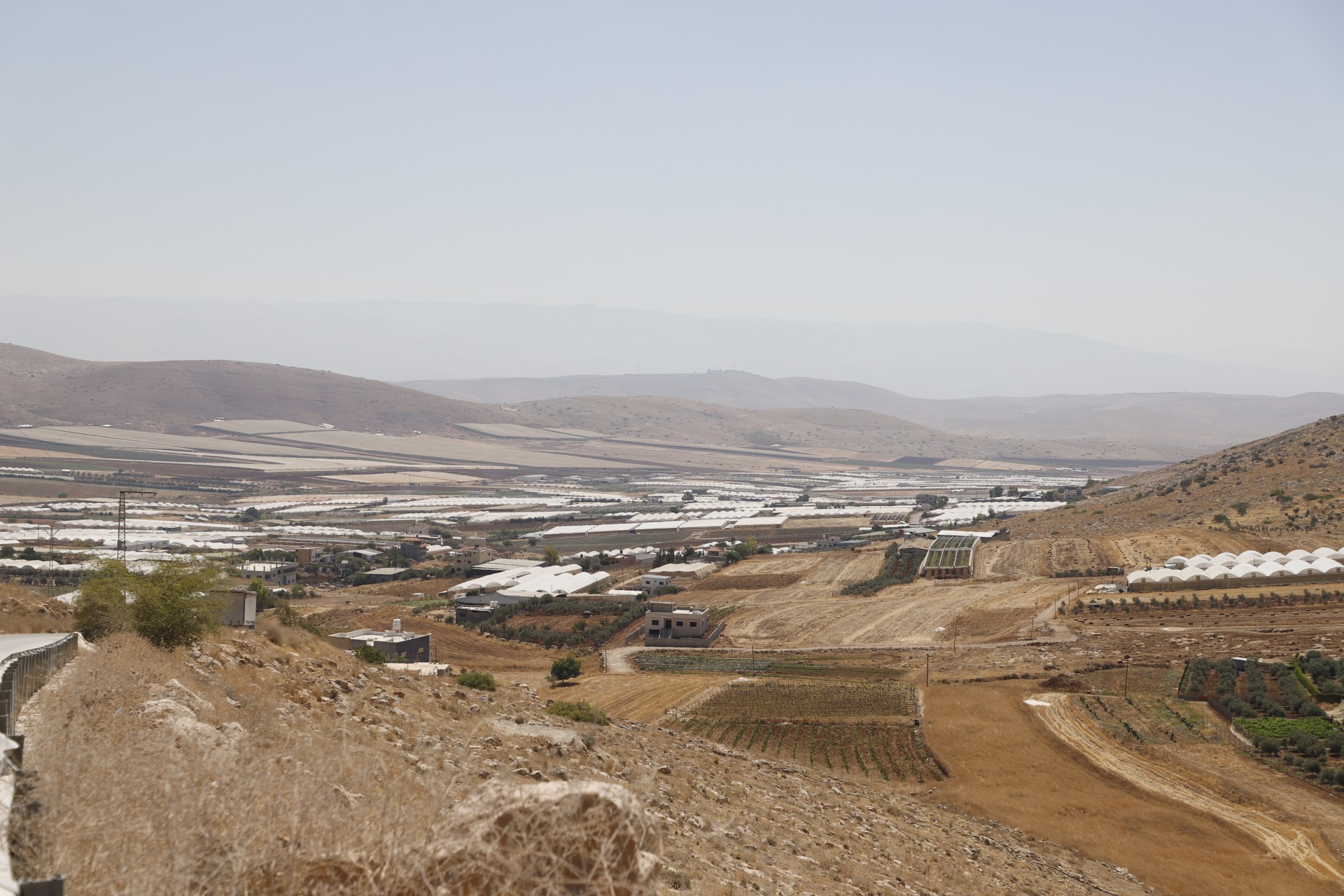
The rolling fertile fields of the Buqe’aa Plain, long known as the breadbasket of Palestine, have become ground zero for a sweeping Israeli land seizure initiative that is upending the lives of hundreds of Palestinian farming and herding families in the northern Jordan Valley. For Khairallah Bani Odeh, a lifelong Palestinian herder and farmer who once worked his family’s lands in the village of Atouf, displacement has turned his new home in Tammoun, south of Tubas, into nothing short of an open-air prison.
Months after being forced to abandon his ancestral lands, Bani Odeh is one of dozens of families pushed out by a confluence of escalating settler violence, deliberate water access cuts, and the ongoing construction of Israel’s “Crimson Thread” infrastructure project. The ambitious initiative calls for a 22-kilometer, 50-meter-wide separation wall and adjacent military road to be carved through eastern Tubas, cutting off Palestinian communities from vast swathes of their most productive agricultural and grazing land.
For generations, Bani Odeh and his neighbors sustained themselves through sheepherding and small-scale agriculture, their livelihoods tied directly to access to the Buqe’aa Plain’s fertile soil and local water networks. But from the moment construction crews moved in earlier this year, that foundation collapsed. According to Bani Odeh, Israeli settlers used bulldozers to destroy main water lines that fed hundreds of hectares of farmland across the plain, killing growing crops and cutting off critical water supplies for livestock. Without access to water, he was forced to buy expensive water from neighboring villages, walking miles to haul what he could for his herd. When settlers burned his standing barley crop, life in Atouf became untenable, forcing his family to relocate.
Three months after leaving, Bani Odeh says he still feels trapped. He struggles to find new grazing land for his remaining livestock, and he counts every day until he can return to his ancestral home. His experience is far from unique. Across Atouf and surrounding communities, thousands of residents are facing catastrophic losses of land, water, and livelihoods as the Crimson Thread project progresses.
Local estimates show more than 20,000 dunams (2,000 hectares) of agricultural land are already suffering severe drought and damage as a result of destroyed water infrastructure. For communities that rely almost entirely on livestock farming, shrinking pastureland and limited water access are pushing production costs sharply higher and forcing farmers to cull their herds, eroding their primary source of income.
Anis Bisharat, a local vegetable farmer who once tended thriving plots of melons, okra, cucumbers, and zucchini, has watched his entire season wither after the water cuts. With irrigation no longer possible, his crops have suffered irreversible damage, and the project has also closed the traditional access road to the plain, forcing him to travel twice the distance and pay double the fuel costs to reach what little of his land he can still access.
Muhammad Gharaibeh, another long-time farmer in the region, says the project is part of a far broader plan to seize more than 70,000 dunams of Palestinian land, facilitated by a settler outpost built on a hill overlooking the plain that has enabled repeated targeting of local agricultural activity. “This plain is the breadbasket of Palestine, and most of the fruits and vegetables distributed in the West Bank come from here,” Gharaibeh explained. With water lines cut, more than 40,000 dunams of standing crops are now without irrigation. With the scorching Palestinian summer just beginning, Gharaibeh says the entire growing season is at risk of total loss. “My crops have been without water for two weeks, and this is just the beginning,” he lamented.
Preliminary data from the Atouf Village Council confirms the scale of the crisis: 24,000 dunams of land belonging to roughly 300 local farmers are currently facing drought and damage from ongoing bulldozing operations. That affected area makes up roughly a quarter of the entire 96,000-dunam Buqe’aa Plain.
Details of the Crimson Thread project first emerged publicly in November last year, when Israeli newspaper Haaretz reported that the barrier and military road would stretch across Palestinian territory from Ein Shibli in the central Jordan Valley to the Tayasir military checkpoint. Shortly after the report, Israeli authorities issued formal military seizure orders for 1,042 dunams of Palestinian land along the planned route. Since the start of 2024, construction crews have operated continuously to advance the project, which researchers and local residents say will ultimately cut off thousands of additional dunams from Palestinian access entirely.
The humanitarian and political fallout of the project is rooted in long-standing Israeli restrictions on Palestinian presence in the Jordan Valley, which makes up roughly 30 percent of the occupied West Bank. A recent April report from Israeli human rights organization B’Tselem found that the Jordan Valley has some of the strictest limits on Palestinian access and residency in the entire occupied territory. As of April, the group reported that more than 4,100 Palestinians across 62 communities in Areas B and C have already been displaced by a combination of Israeli state restrictions and settler violence. Currently, 53.4 percent of the Jordan Valley is classified as Israeli “state land,” 45.7 percent is designated as military firing and training zones, and roughly 20 percent is set aside as nature reserves — designations that all but bar Palestinian access and use.
Mu’taz Bisharat, a leading expert on Israeli settlements in the West Bank, told Middle East Eye that the Crimson Thread project represents a dramatic tightening of Israeli control over the Jordan Valley, and a direct threat to the continued existence of Palestinian communities in the region. Bisharat noted that the deliberate destruction of water infrastructure is an intentional attack on the foundation of Palestinian life in the area, leaving little option for families but displacement. “Today, 70 percent of the land in this area has been lost due to the compounded crimes committed by the Israeli occupation against the Palestinian people, the Palestinian presence, and Palestinian agriculture. Nothing remains for the Palestinian citizen,” he said.
Bisharat added that the new barrier and road are intended to redraw de facto boundaries in the Jordan Valley, cutting the region off from the rest of the occupied West Bank in a quiet, ongoing process of annexation that continues out of the global media spotlight. “The annexation process is taking place on the ground in full view of the entire world,” he said. “It has been halted in the media, but it hasn’t stopped on the ground.”