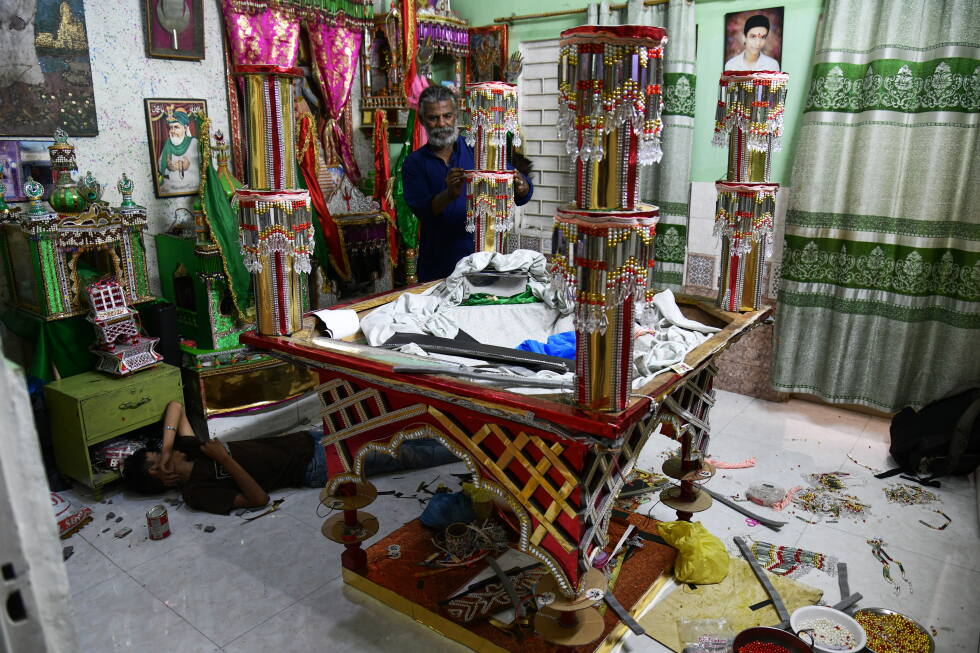
In the bustling coastal metropolis of Karachi, Pakistan, a remarkable interfaith tradition unfolds each year during the Islamic holy month of Muharram. For Raju Rathore, a lifelong Karachi resident whose parents resettled from India’s Gujarat region following the 1947 Partition of India, his Hindu faith and deep devotion to Imam Hussein coexist seamlessly, a legacy passed down through three generations of his family.
Muharram, and particularly the 10th day known as Ashoura, is most widely recognized as a sacred period of mourning for Shiite Muslims, who mark the 7th-century martyrdom of Prophet Muhammad’s grandson Hussein at the Battle of Karbala, in what is now modern-day Iraq. Hussein’s death stands as the foundational event that split Islam into the Sunni and Shiite branches, and millions of believers across the globe commemorate the tragedy each year. Yet across South Asia, a little-known cross-cultural practice has endured for centuries: participation by Hindu communities in Muharram rituals.
For Rathore, this devotion traces back to a promise his mother made decades ago. After years of struggling to conceive, she prayed at the shrine of Masoom Shah Bukhari, vowing that if she were blessed with a child, her offspring would honor Hussein’s martyrdom by crafting tazias — intricate, temporary replicas of Hussein’s mausoleum that are carried in large public processions during Muharram. Today, at 52 years old, Rathore has carried on that vow for 45 years, handcrafting detailed tazias from paper, cardboard, glass and other materials at his own expense. His family collects materials throughout the year in preparation for Ashoura, and now his own son has stepped in to learn the craft, ensuring the tradition will outlive him. “This is our passion,” Rathore explained. “Our devotion to Imam Hussein is such that even giving our lives would feel insufficient. As long as I have the strength to continue, I will keep making them.”
Historical records confirm that cross-communal participation in Muharram has deep roots across South Asia, with groups such as the Hussaini Brahmins developing layered religious traditions that blend Hindu and Shiite Islamic practices. Justin Jones, a religious studies professor at the University of Oxford, notes that one key driving force behind this widespread participation was the political history of the region. For centuries, many ruling dynasties across South Asia were Shiite, and these ruling houses publicly sponsored Muharram processions and commemorative events, transforming what began as a sect-specific religious observance into a large, inclusive public gathering that attracted participants from all faith backgrounds.
Over generations, these observances became woven into the civic and cultural fabric of many South Asian communities. Some Hindu communities contributed as musicians in processions, while others like Rathore’s family took on the role of crafting tazias. While Jones notes that these shared interfaith traditions have become less common over the past century, as religious communities have increasingly separated their ritual practices, the custom holds strong in pockets of the region, including Karachi.
Pakistan’s 2023 national census counts nearly 3.9 million Hindu residents, making Hinduism the country’s largest religious minority. While rights groups such as Minority Rights Group have documented widespread violations of religious freedom for Pakistani Hindus, Rathore says he has never faced barriers to continuing his family’s tradition. “Yes, I am Hindu, but this is not about religion,” he said. “Many of my fellow Hindus also hold Imam Hussein in great respect.”
Rathore and other Hindu participants in Karachi gather at Shiite congregation halls during Muharram, where they join in prayers and traditional mourning rituals including chest-beating before joining the public processions. Bharat Kumar, another Karachi-based Hindu who carries on the tazia crafting tradition, echoed that interfaith respect is a core part of his community’s values. “Our religion has never taught us that because we are Hindus we should not participate in or respect others’ traditions,” Kumar said. “We celebrate our own festivals with great enthusiasm and grandeur and we approach this in the same way.”
As religious divisions have sharpened across much of South Asia in recent decades, this quiet, centuries-old practice of cross-faith solidarity and shared ritual stands as a rare example of intercommunal harmony, preserved by families like the Rathores who see their participation not as a compromise of faith, but as a sacred vow and a deeply held cultural passion.