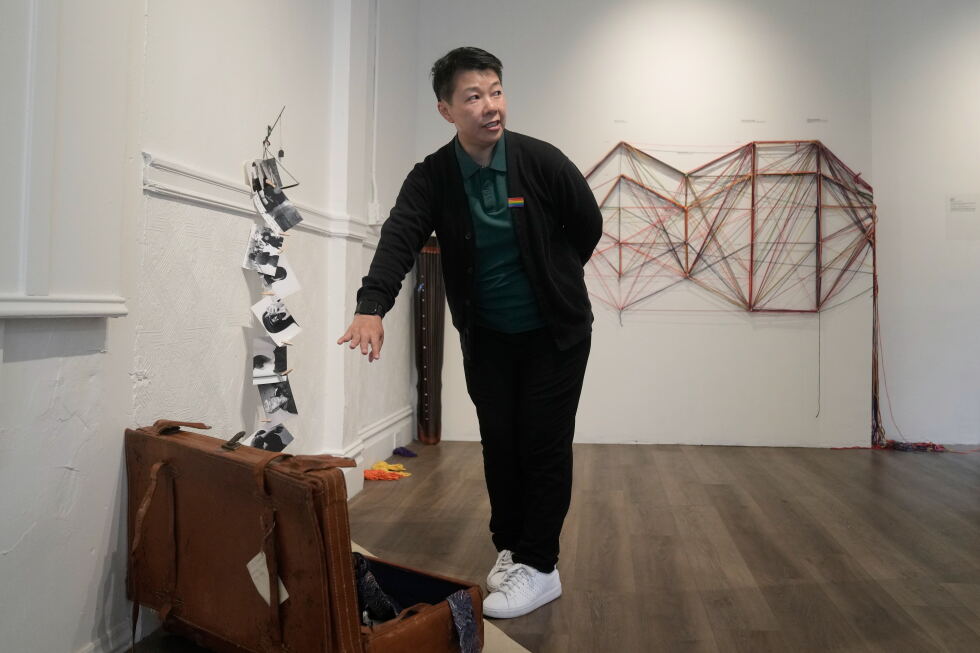
Against a backdrop of rising restrictions on LGBTQ+ rights across parts of the United States and systematic constraints on queer advocacy in China, a groundbreaking new cultural institution has opened its doors in one of the nation’s oldest Chinatowns, carving out a permanent public space for Chinese and Chinese diaspora LGBTQ+ artists to share their unfiltered stories.
The brainchild of Chinese artist and longtime LGBTQ+ activist Xiangqi Chen, the OUT Museum celebrated its opening with a rainbow ribbon-cutting ceremony at the end of May 2025, timed intentionally to fall between Asian American Pacific Islander Heritage Month and Pride Month. Located directly across from the Chinese Historical Society of America Museum in San Francisco’s iconic Chinatown, the bilingual facility fills a long-standing gap in cultural representation for a community that has historically been sidelined and erased in both mainstream Chinese and Western queer spaces.
For Chen, the museum’s launch in San Francisco is the culmination of a years-long journey that began when she first began organizing for LGBTQ+ communities in her native China. More than six years ago, while still based in Shanghai, Chen launched a Kickstarter crowdfunding campaign for what would eventually become the OUT Museum, drawing more than 2,000 individual donors. Even then, however, she knew the project could never come to fruition in her home country, where explicit public LGBTQ+ advocacy and expression face growing government restrictions. Chen, who ran a grassroots community center for lesbians in Shanghai for years, ultimately left China in 2022 after a widespread crackdown on queer organizing spaces during the COVID-19 pandemic. She arrived in the U.S. on a J-1 visiting scholar visa at Georgetown University, and by 2024, her work caught the attention of San Francisco’s arts community following a high-profile exhibition at the city’s Asian Art Museum. That opportunity led to a residency with the Chinese Culture Center of San Francisco, which agreed to serve as an incubator for the new museum.
Though the museum’s initial iteration is modest—housed in a single room, open only on Saturdays, and featuring fewer than a dozen works by creators from China and the global Chinese diaspora—its impact is already resonating deeply across local and national queer Asian communities. The debut exhibition showcases a diverse range of mediums, from fine art photography and self-published zines to interactive multimedia installations. One interactive piece invites visitors to use colored thread to trace their own personal journeys of gender and sexual self-discovery, turning passive viewing into collective connection. For Hong Kong-born artist Dixon Ngai, who contributed a hand-painted Chinese porcelain wine pot inspired by the classic Cantonese opera *Di Nü Hua (The Flower Princess)*, the OUT Museum fills a critical void that no generic queer art exhibition has addressed before. Unlike broader LGBTQ+ shows that often marginalize Asian voices, Ngai explained, the OUT Museum centers the specific, intersectional experiences of Chinese queer people, allowing their perspectives to finally receive the visibility they deserve.
In the weeks since opening, Chen says she has been profoundly moved by feedback from an unexpected group: long-time Chinese immigrants to California, both queer and cisgender straight. Visitors have shared deeply personal stories, from a 60-year-old transgender man who immigrated to the U.S. in the 1970s specifically to access gender-affirming care that was unavailable in his home country, to a straight mother seeking resources to better connect with her adult gay son, who later emailed Chen to thank the museum for creating a space that helped her embrace her child’s identity.
Helen Zia, a celebrated author, queer activist, and member of the OUT Museum’s advisory board, notes that these reactions confirm the institution’s core mission: elevating the visibility of Chinese, Chinese American, and Asian American LGBTQ+ people and affirming their place in both Asian American and broader queer history. Zia, who has organized for queer rights in San Francisco Chinatowns for decades, points to how dramatically community attitudes have shifted just in the last 20 years. When she distributed pro-marriage quality flyers in Oakland’s Chinatown in 2008, she faced regular harassment, including yelling and spitting from opponents, with thousands of protestors from Asian churches gathering weekly to condemn same-sex relationships. Later that same year, after the California Supreme Court struck down the state’s same-sex marriage ban, Zia was among the first same-sex couples to legally wed in the state. Even today, amid growing backlash against LGBTQ+ rights across the U.S., Zia says the museum’s existence sends a vital message: “See our humanity. Here’s the beautiful art that we create and imagine and contribute to the world.”
For Chen, the contrast between the ability to create a public queer museum in San Francisco and the constraints on queer expression in China is stark. While the Chinese Psychiatric Association declassified homosexuality as a mental disorder in 2001, same-sex couples still lack legal access to marriage and adoption, and public queer advocacy remains heavily restricted. Chen explains that while subtle queer art exhibitions could occasionally be held in China as recently as the 2010s, shifting policy has eliminated even that limited space today; explicit identification as queer or open discussion of LGBTQ+ themes in public art is no longer permitted.
Even in the U.S., LGBTQ+ rights face growing threats, from state-level bans on gender-affirming care to recent political attacks on Pride-related initiatives. Just weeks before the OUT Museum opened, San Francisco’s MLB team the Giants faced national controversy after players added anti-LGBTQ+ Bible verses to their official Pride Night caps, highlighting that even in traditionally progressive California, shifts in attitude are creating new tensions. Still, for the Chinese creators behind the OUT Museum, the social and political landscape of the Bay Area represents a transformative shift from the constraints they faced in China. Ngai summed up the community’s perspective: “Here in San Francisco, in California, we enjoy the air of freedom, there is equal human rights, there is security. So, we are very proud to be ourselves.”
Chen is set to make her first appearance at the San Francisco Pride Parade this year, dressed as a warrior from Cantonese opera to promote the museum. For her, the opening of the OUT Museum is just the beginning, not the end of the project. Organizers plan to expand the exhibition roster and add more operating days in the coming months, with a long-term goal of growing the institution into a permanent, larger hub for Chinese queer art and activism. “We still have a long way to go,” Chen says.