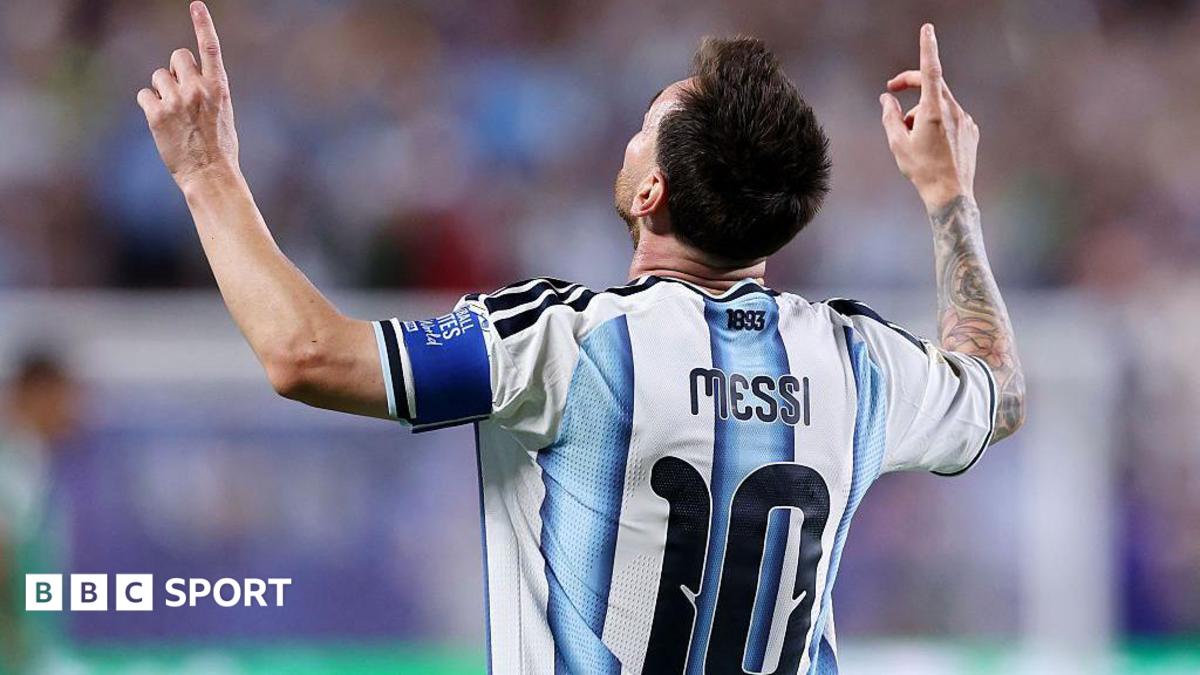
At the 2026 FIFA World Cup, 38-year-old Lionel Messi delivered another legendary performance that cemented his status as one of the greatest players to ever step onto a football pitch. During Argentina’s second group stage match against Austria, the Argentine captain bagged a brace that secured a 2-0 win for the defending champions, booked their spot in the tournament’s last 32, and broke a record that has stood for more than a decade.
Messi’s opening goal of the match – a signature left-footed curler into the top corner – was his 17th World Cup goal, moving him one ahead of former German striker Miroslav Klose’s previous all-time record of 16. He would add an 18th from a tight angle, slipping past two defenders to finish clinically. This incredible run of form sees the Inter Miami forward enter uncharted territory: he has now scored in six consecutive World Cup matches, a feat matched only by Just Fontaine (1958, France) and Jairzinho (1970, Brazil) – no player in history has ever scored in seven straight World Cup fixtures.
The 38-year-old’s scintillating start to the tournament also puts him in pole position for the Golden Boot, the only major individual World Cup prize he has never claimed. He already notched a hat-trick in Argentina’s opening match, and with one final group game against Jordan still to play, he has ample opportunity to extend his lead. Beyond scoring, Messi also continues to rewrite World Cup playmaking records: according to Opta statistics, he is just one assist away from breaking the all-time assist record that dates back to 1966, currently shared with his compatriot and idol Diego Maradona.
The question on every football fan’s mind is: how does a player of Messi’s age, who has already won every possible trophy in the sport, and has played in Major League Soccer for three years heading into this tournament, continue to deliver dominant performances on the game’s biggest stage?
Messi’s late-career dominance is not without precedent. Back in 2018, a 31-year-old Messi and Argentina were knocked out of the World Cup by eventual champions France in a iconic seven-goal thriller, leading many to assume his World Cup story was drawing to a close. Four years later, he silenced the doubters by captaining Argentina to a third World Cup title in Qatar, scoring seven times along the way. Now, another four years on, he continues to break new ground.
French veteran Olivier Giroud, who won the 2018 World Cup alongside the team that knocked out Argentina and is still playing top-flight Ligue 1 football at 39, said Messi’s longevity comes from his internal drive rather than a need to outperform younger stars. “It’s clear just how passionate Messi still is for football and you can tell it’s in his DNA to always be a competitor, to try and outdo himself more than anyone else,” Giroud explained. “Playing at a high level at our age, you have to pay close attention to your life hygiene – how you sleep, your diet, and taking care of your body, because that’s the thing you rely on for work. The key thing is still having the desire, the motivation, the passion, to keep going.”
Messi is far from the only elite sports star to maintain elite form into his late 30s – men’s tennis great Novak Djokovic is one of the most prominent recent examples. But sports psychologist Michael Caulfield, who has worked in professional football for more than 20 years, says this level of longevity relies on a rare combination of cutting-edge physical preparation and unmatched mental discipline.
“Players know themselves inside out by that age, so there’s not a lot left to teach them about how to manage as they get older,” Caulfield explained. “From a physical point of view, they take advantage of every breakthrough in sports science. But mentally, it’s about whether they have the capacity in their minds to deal with the daily grind. They have to be willing to spend the whole year working hard on the same things, and if you’ve been doing that for 25 years, that takes huge self-discipline. They have to maintain the sheer will to go through the rehab process after injuries when they know they’ve already won everything. All the top athletes I’ve ever known, they’re all willing to try and go back one more time, because they love doing what they do. It’s the same reason you still see Bruce Springsteen or Madonna touring – it is completely intrinsic to who these stars are.”
Former England and Manchester United striker Wayne Rooney, who faced Messi in two Champions League finals that the Argentine won, says Messi’s unrivaled technical ability has allowed him to offset any natural age-related decline in athleticism. “Coming into this World Cup, I pretty much wrote Argentina’s chances off because I didn’t think he could carry on [at that level] for another one,” Rooney admitted. “The one thing age can never take away from players is their ability with the ball. You put him around the penalty box and he has the ability to do things others can’t. It’ll be interesting to see whether it can last the rest of the tournament. [If it does] then it wouldn’t surprise me if we see him in the next World Cup for Argentina as well.”
While Messi is generally known as a reserved and humble figure off the pitch, his former Barcelona teammate Cesc Fabregas says that competitiveness comes to the fore the second he steps onto the pitch. “When he crosses the white line, he is a very different person,” Fabregas said in the BBC iPlayer documentary *Rivals: Messi vs Ronaldo*. “He wants to win at any cost.”
That relentless competitiveness, paired with a childlike love for the game, is what keeps him going even after he has achieved every possible honor in football. “Athletes always think there’s something left to achieve,” Caulfield says. “They’re wondering if there is something they haven’t quite mastered yet. But more than anything they want to keep feeling that childlike joy of doing what they love. You see Messi still doing keepy-ups or a rondo, and he still loves football like a little boy.”
Messi’s record-breaking performance also draws an interesting contrast with his long-time rival Cristiano Ronaldo, who is making his sixth World Cup appearance with Portugal at 41. The veteran made little impact in Portugal’s opening draw with DR Congo, and Rooney says Messi’s historic display will not have escaped Ronaldo’s attention. “Ronaldo will have been fuming,” Rooney said. “Even at 41 he will still be expecting to be top goalscorer. But that attitude is part of his own greatness. The two of them have spurred each other on. They have this self-belief and arrogance, in a good way, where they know what they have done, have nothing to prove, and it’s up to the likes of Mbappe and Haaland to prove they can take over.”
As the tournament progresses, all eyes will remain on Messi as he chases more history, both with Argentina and in the individual record books.