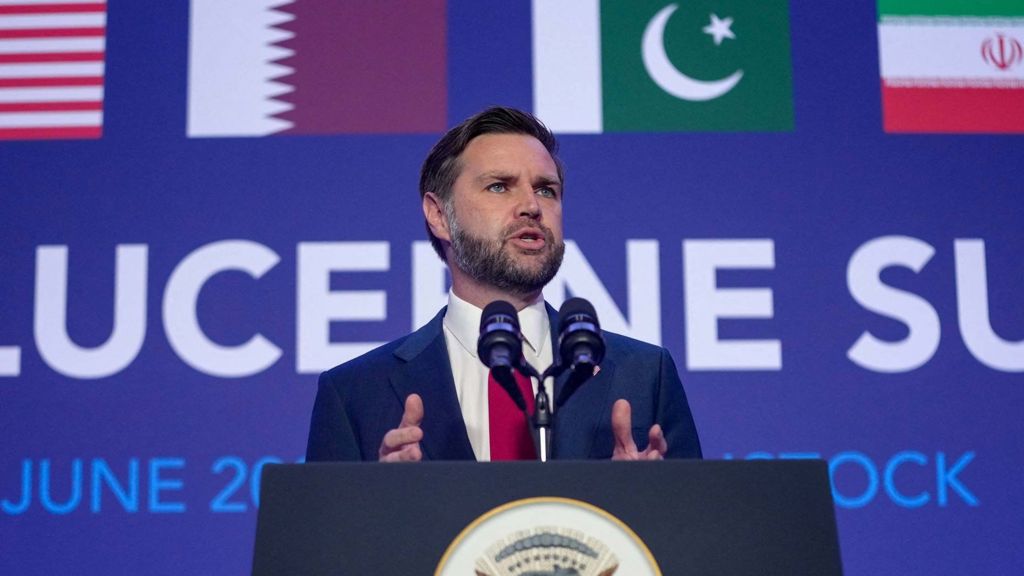
Fresh off the opening round of landmark negotiations between the United States and Iran, U.S. Vice President JD Vance has announced a breakthrough that checks one of the international community’s top boxes: Tehran has agreed to allow United Nations nuclear inspectors from the International Atomic Energy Agency (IAEA) to return to the country, with initial discussions potentially launching as early as the same day he spoke.
Vance, speaking from Switzerland on Monday morning, confirmed that substantial progress has already been made since the first round of talks aimed at forging a final comprehensive agreement to end the recent regional conflict. The vice president’s remarks aligned with earlier statements from Qatar and Pakistan, the two nations mediating the diplomatic process. Beyond the nuclear file, Vance added, negotiating teams have also covered two other critical priorities: the full reopening of the strategically vital Strait of Hormuz and the establishment of de-confliction mechanisms to support a regional ceasefire.
The framework for these talks was laid out in a 14-point memorandum of understanding (MOU) signed last week by U.S. President Donald Trump and Iranian President Masoud Pezeshkian. That initial agreement formalized Tehran’s commitment to reopen the Strait of Hormuz and end active hostilities on all regional fronts, including Lebanon. In their joint statement released earlier Monday, mediators Qatar and Pakistan confirmed that the two parties have agreed to a binding roadmap to reach a final, full agreement within a 60-day window. Vance praised the opening round of discussions, saying it had laid a “very good foundation” for ongoing negotiations toward a lasting settlement.
For the U.S. side, Vance emphasized that progress on the nuclear issue stands as the most significant milestone for the American public. “This is a major milestone for the American people and a first step in permanently ending a nuclear weapons programme in Iran,” he told reporters. When asked for a timeline for IAEA inspectors’ return, Vance said he expected the process to get underway no later than this week, with initial technical conversations between Iran and the nuclear watchdog possibly starting as early as the day of his announcement.
The MOU signed by Trump and Pezeshkian specifically references the IAEA’s role in addressing ongoing concerns over Iran’s stockpile of enriched nuclear material. Tehran has repeatedly maintained that its entire nuclear program is focused solely on civilian energy and medical purposes, but global powers and the IAEA have long questioned those claims, citing a lack of full transparency over the past years.
This diplomatic push comes nearly a decade after the original 2015 Joint Comprehensive Plan of Action (JCPOA), an agreement between Iran and six world powers — the U.S., China, France, Russia, Germany, and the U.K. The JCPOA placed strict limits on Iran’s nuclear activities in exchange for sanctions relief, and granted the IAEA unfettered access to all nuclear facilities and suspect sites across the country. But during his first presidential term in 2018, Trump withdrew the U.S. from the agreement, calling it a fatally flawed “bad deal” that failed to permanently curb Iran’s nuclear ambitions or address the country’s ballistic missile program and regional military activities.
The most recent rift over inspections opened after the 12-day regional war between Iran and Israel in June 2025. Following the conflict, Iran suspended IAEA access to sites hit by Israeli and U.S. airstrikes, and by the following month, the watchdog had withdrawn all of its remaining inspectors from Iranian territory.
Iranian state media reported that the country’s lead negotiating team departed the Bürgenstock resort talks venue in Switzerland on Monday, though low-level technical discussions between U.S. and Iranian teams are set to continue in the coming days.
Beyond the nuclear file, the mediators’ joint statement outlined progress on regional security. Negotiators have established a dedicated communication line designed to prevent accidental clashes and miscommunication, with the core goal of guaranteeing safe passage for commercial shipping through the Strait of Hormuz, a chokepoint through which roughly 20% of the world’s global oil supplies pass daily.
The two sides also agreed to create a tripartite de-confliction cell involving the U.S., Iran, and Lebanon, with logistical and diplomatic support from the mediating countries, to coordinate an end to ongoing military operations in Lebanon. Iranian Foreign Minister Seyed Abbas Araghchi noted that the successful operation of this de-confliction cell will serve as the first “real test” of the agreement’s viability. While the MOU calls for an immediate ceasefire on all fronts, violence has continued in the days since it was signed: Israeli airstrikes in Lebanon have killed at least 67 people, while cross-border attacks from the Iranian-backed armed group Hezbollah have claimed the lives of five Israeli soldiers.