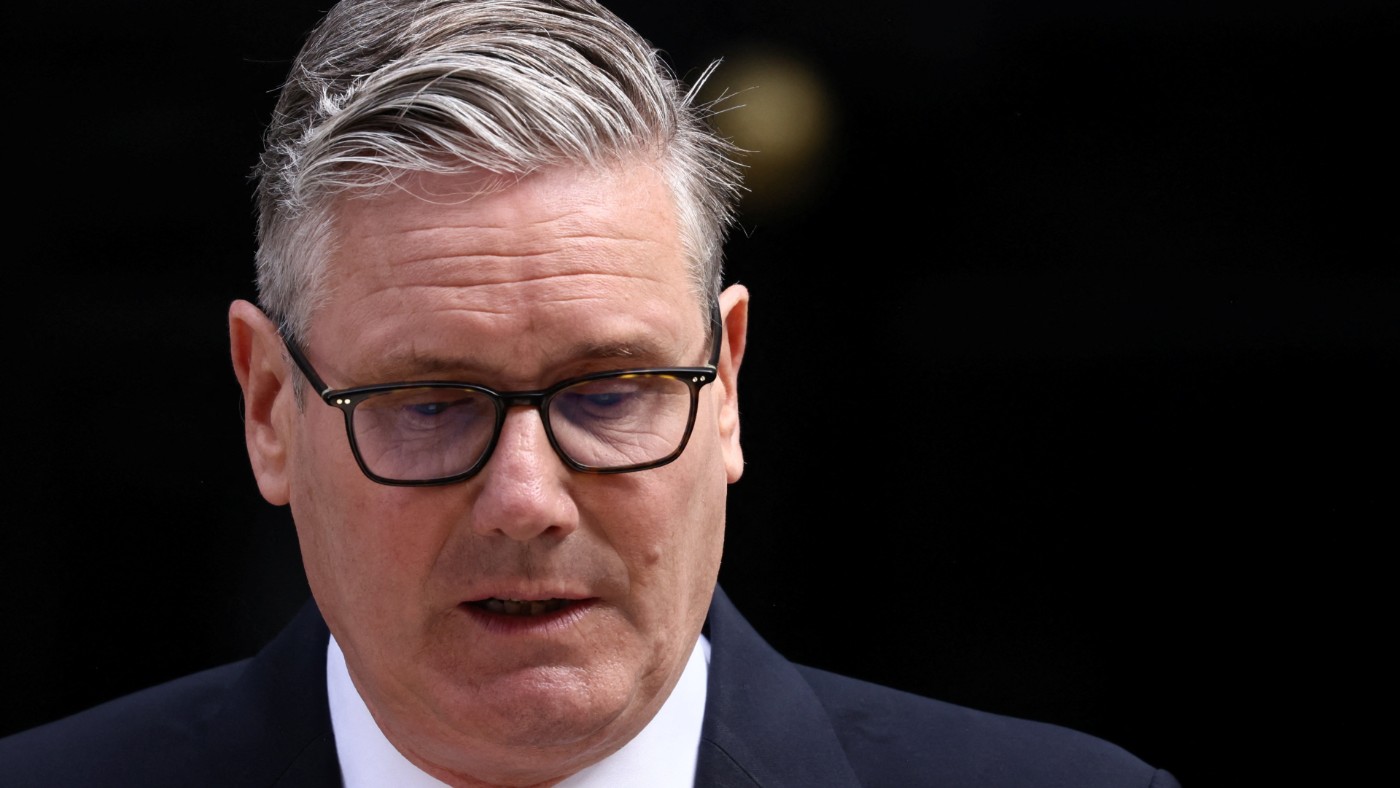
When Keir Starmer first launched his bid for the UK Labour Party leadership, his core pitch to party voters was straightforward: retain the bulk of Jeremy Corbyn’s left-wing policy platform, but package it in the polished, establishment-friendly image of a suited, buttoned-up professional. Long before Labour’s crushing 2019 general election defeat at the hands of Boris Johnson that forced Corbyn out of the leadership, Starmer’s inner campaign circle had already identified him as the perfect candidate to pull off this rebranding.
Backed by a bloc of Labour right-wing figures including Morgan McSweeney, Peter Mandelson and Roger Liddle, Starmer secured the leadership after making 10 explicit left-wing pledges to the Labour members who voted him into office. Within months, every single one of those commitments had been either fully abandoned or quietly watered down. For his entire tenure, first as opposition leader and later as prime minister, Starmer clung to that carefully crafted image of competent, managerial professionalism, while systematically discarding the policies he had promised to carry over from Corbyn — the man he once publicly called a friend. To the party’s left-wing members, who he publicly disparaged as antisemites, he sent a clear message: “The door is open, and you can leave.”
But according to multiple insiders — serving and former civil servants, Starmer’s former legal colleagues, and senior Labour Party sources who spoke on condition of anonymity to Middle East Eye — the now-resigned Starmer, who leaves office as the most unpopular British prime minister in decades, also failed to deliver on his core promise of being a competent, results-focused grown-up in office. This failure, they say, rippled through every area of his governance, most glaringly in the UK’s approach to Israel’s military campaign in Gaza, where long-held international legal norms were cast aside.
People who have interacted with Starmer in personal settings — including regular football teammates near his north London home in Kentish Town — describe him as a man defined almost entirely by raw ambition and ruthless competitiveness. He hates losing, they say, but once he climbed to the highest office in the UK, he had no clear plan for what to do with power. In less than two years, he lost it entirely.
“He was rubbish on all metrics, apart from the fact that he isn’t a liar or a cheat – but really that should be an entry requirement,” one senior civil servant who worked closely with both Starmer and his former chief of staff McSweeney told MEE. “Height, voice, inspiration, achieving anything: he was rubbish on all fronts.”
That same official noted that McSweeney, the veteran Labour strategist widely credited with engineering Starmer’s rise to power and a close ally of Peter Mandelson, had no clear roadmap for governing once he controlled the levers of power. “He was a campaigner,” a second civil servant explained of McSweeney. “And he just stayed in that mode once he was in government. He didn’t look to get things done.”
Labour MP Clive Lewis framed the core failure of Starmer’s leadership in three clear terms. “Leadership at this moment needs three things: vision, a clear sense of where we are taking the country and why,” Lewis told MEE. “It needs empathy, a real grasp of how people are living and what they are up against. And it needs a plan equal to the scale of what we face. Keir had none of these.”
Lewis added: “Even so he would not be the first PM to be guilty of such failings. But these are not normal times. Facing us is the spectre of the far right and such failings become catastrophic as opposed to just electorally problematic. That could not be allowed. Hence his early departure.”
McSweeney’s pro-Starmer group Labour Together, which raised more than £700,000 in undisclosed donations — a portion of which came from prominent pro-Israel business figures such as Trevor Chinn — successfully seized back control of the Labour Party for the right wing, with Starmer serving as its public face. A source who has known McSweeney since his childhood in County Cork, Ireland, told MEE that McSweeney’s political project was driven first and foremost by a visceral hatred of Corbyn and the Labour left, a conflict that dates back to his early days as a grassroots organiser across London.
While McSweeney is often publicly described as economically left-of-centre but socially conservative, the source called him an unapologetic neoliberal. “He joined the Labour Party because he knew he had a chance of doing well there… The contempt he and his wife [Imogen Walker, who became a Labour MP in 2024] have for Corbyn, is visceral,” the source said.
That contempt was front and centre even in Starmer’s final resignation speech. The outgoing prime minister claimed he had inherited a Labour Party “that was politically, financially and morally bankrupt” and that he had rooted out “the poison of antisemitism, restoring trust on the economy, defence, and national security.”
Jeremy Corbyn’s spokesperson hit back with a scathing rebuke: “Keir Starmer ends as he started: with lies. Corbyn turned Labour into the largest party in Europe, built and funded by half a million people who believed in social justice and peace. Starmer swapped political principles for corporate donors – and leaves behind a legacy of broken pledges, grotesque inequality and complicity in genocide. If that isn’t moral bankruptcy, then what is?”
On the same day of Starmer’s resignation, Corbyn announced he would formally reintroduce his private member’s bill calling for an independent public inquiry into the British government’s complicity in Israel’s military actions in Gaza.
Madeleine Rees, a prominent British human rights lawyer who worked closely with Starmer in the 1990s, pointed to his stance on Gaza as his defining moral and political failure. “He capitulated on things he really shouldn’t have. The biggest of these was Gaza,” Rees said. Another former legal colleague from Starmer’s days as a liberal barrister at Doughty Street Chambers noted that very few of his former professional associates would still publicly defend his record as prime minister.
“I didn’t think his reign would be so short. It shows how important principle and optimism are,” Rees told MEE. “He capitulated on things he really shouldn’t have. The biggest of these was Gaza. Abetting a genocide. He could have taken a legal stand and called it a crime. I feel sorry for him because he is a decent man, despite all this, and this will be super hard for him,” she added.
Beyond Gaza, foreign policy observers also painted a picture of directionless, unprincipled governance. Asked about Starmer’s approach to key global regions, an Indian foreign policy adviser and analyst who participated in UK-India Free Trade Agreement negotiations told MEE: “Have you an inkling of what UK policy on Afghanistan, Pakistan, southeast Asia, Hong Kong and India is? I have no clue what the UK stands for anymore.”
The adviser argued that the negotiated UK-India FTA would only “make rich UK wallahs richer. What is the UK but land around the City of London?” He added: “Starmer’s foreign policy was foreign to the UK’s interests. The development aid is gone. The BBC has no support from them. British universities in India are all shops, with no research and development angle.”
Andy Burnham, the popular Labour mayor of Greater Manchester commonly known as the “King of the North,” is now widely expected to replace Starmer as party leader and prime minister. But one left-wing Labour activist warned that Burnham could simply be “Starmer 2.0.”
Josh Simons, who replaced McSweeney as head of Labour Together before winning election as the MP for Makerfield in 2024, recently vacated his seat to clear the path for Burnham’s leadership bid and was a prominent fixture in the by-election campaign. Wes Streeting, the favoured candidate of Labour’s right wing who resigned as health secretary last month, has already thrown his support behind Burnham; if Burnham wins and keeps Streeting in a top cabinet role, Labour’s left wing faces an uphill battle to retain any influence in the new administration.
John McDonnell, who served as shadow chancellor under Corbyn, has called on the party to return to its historic “broad church” model. That model, he said, is one “in which the views of the full range of traditions, left, right and centre, are respected and engaged with.” Asked whether that inclusive model is likely to be re-established after Starmer’s departure, McDonnell told MEE: “We’ll see, but if the broad church is not re-established, any administration will fail.”