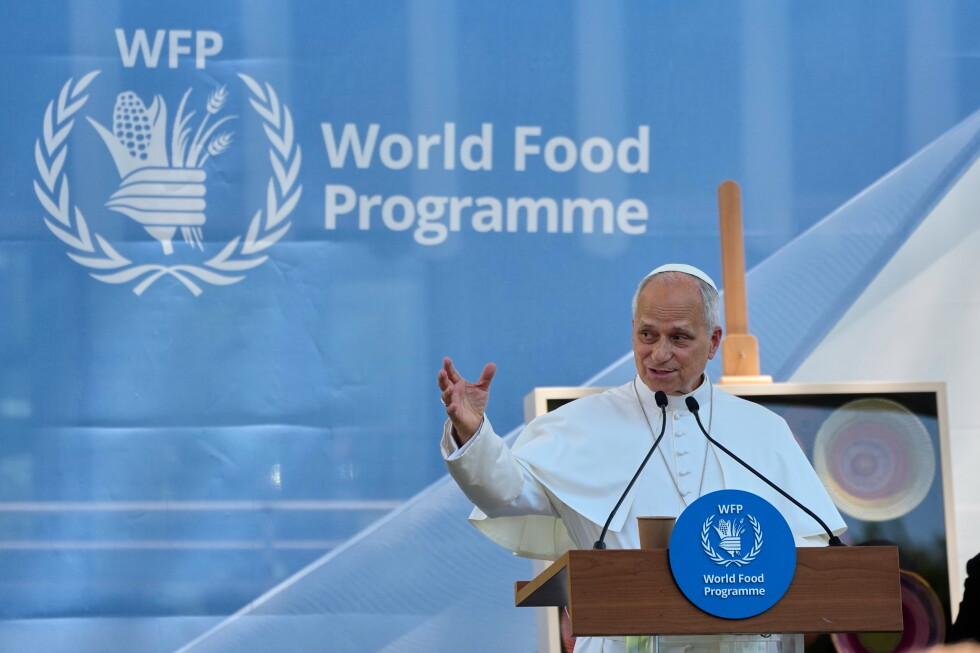
ROME — In a stark rebuke of broken global priorities, Pope Leo XIV delivered a urgent address Monday to the governing body of the United Nations World Food Program (WFP) in Rome, calling out the lopsided reality that enables war to be funded far more easily than vulnerable communities can be fed. His appeal comes as the global food assistance system grapples with crippling funding gaps even as humanitarian needs surge to unprecedented levels across the globe.
Pope Leo echoed a warning first issued by his predecessor, the late Pope Francis, during a visit to the WFP a decade ago, criticizing the systemic political and administrative barriers that slow or block life-saving aid from reaching hungry populations, while military spending and weapons flows to conflict zones continue without interruption. “Whereas forms of aid and development projects are obstructed by involved and incomprehensible political decisions, skewed ideological visions and impenetrable customs barriers, weaponry is not,” the pope told the assembly. “In effect, conflicts are ‘fed’ more readily than people are nourished.”
His intervention comes on the heels of a recent WFP report that lays bare the scale of the funding crisis: global contributions for food assistance have plummeted roughly 59% since 2022, even as the number of people facing acute food insecurity has risen sharply. While there was a small bright spot last week, when the United States announced an $800 million pledge to the WFP that the agency says will support more than 38 million vulnerable people across at least 37 countries, the organization’s broader $10 billion funding appeal for 2026 remains drastically underfunded.
The current funding shortfall follows years of shifting U.S. commitments to global humanitarian aid. For decades, the U.S. Agency for International Development served as the backbone of global relief efforts, but the Trump administration abolished the agency last year, slashing $60 billion in overall global assistance. A partial reset in December restored limited funding to the WFP and included a $218 million contribution to UNICEF, but it has not come close to closing the gap left by earlier cuts.
Pope Leo warned that today’s interconnected crises — from ongoing armed conflicts to climate disruption and global economic inequality — have evolved from temporary emergencies into persistent, structural realities. He argued that the existing global order is not simply failing to address hunger, but actively reproducing the conditions that push millions into food insecurity. Describing a fractured international system marked by deep mistrust between nations, the pope noted that countries increasingly prioritize narrow national interests over collective global cooperation, even as widespread hunger acts as a core driver of further instability, irregular migration and new conflict.
Framing the issue as a matter of fundamental human dignity rather than just a humanitarian challenge, Pope Leo urged global leaders to reframe their policy priorities to center the inherent worth of every person. “Every human person possesses an inherent and inalienable dignity that remains intact regardless of circumstance, condition or social status,” he said. He called on governments to cut bureaucratic red tape, dismantle barriers that block aid delivery, and reallocate global resources away from endless military spending to end the global hunger crisis.