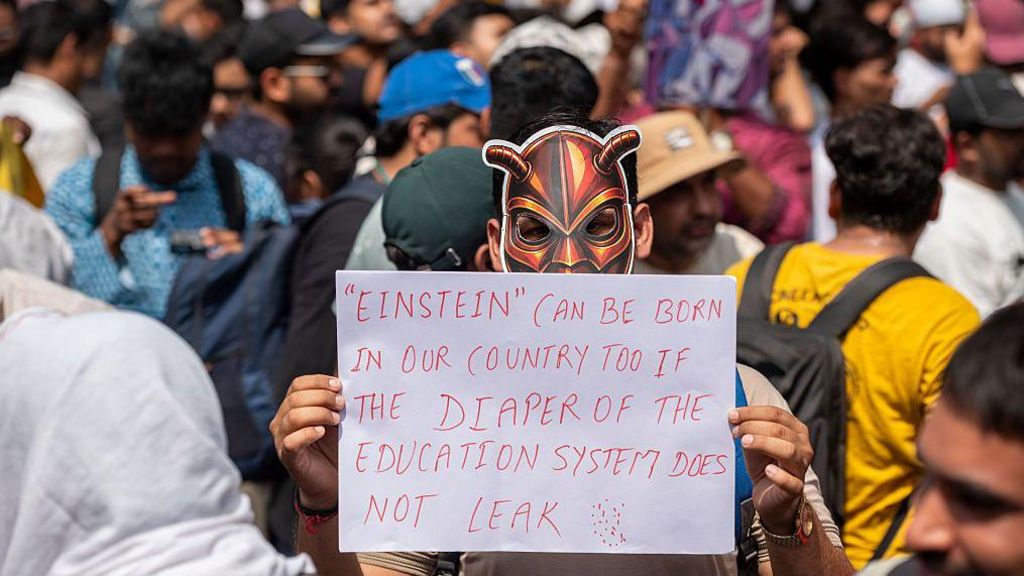
Three consecutive days of sustained protests have unfolded in India’s capital New Delhi, as hundreds of students, young working professionals and job-seeking candidates rally to call for the resignation of Education Minister Dharmendra Pradhan. The unrest follows a major paper leak scandal that has upended one of India’s most high-stakes competitive medical entrance examinations.
Organizing the demonstration at Delhi’s iconic protest venue Jantar Mantar is the Cockroach Janata Party (CJP), a grassroots political collective that has rapidly gained viral online traction for its sharp, satirical commentary on mainstream Indian politics. Taking aim at Prime Minister Narendra Modi’s ruling Bharatiya Janata Party (BJP) through its name, the group, which uses a cockroach as its official mascot, has centered its activism on pushing for greater transparency and accountability across India’s education system.
The current wave of protests is rooted in the NEET-UG controversy. The entrance exam for undergraduate medical programs was thrown into chaos earlier this year after widespread allegations of a question paper leak, triggering massive public anger from thousands of aspirants and their families. In response to the outrage, Indian authorities annulled the original exam results and ordered a full re-examination for millions of candidates.
On Sunday, those millions of candidates returned to testing centers across the country to sit for the new exam, held under stringent enhanced security protocols including mandatory biometric identity verification. The National Testing Agency (NTA), the government body tasked with administering NEET-UG, released a statement shortly after the re-test concluded claiming the exam had proceeded without major incident and that no new allegations of paper leaks had been received.
Yet for protesters gathered in central Delhi, the re-examination has done little to resolve the deeper issues at the heart of the controversy. Many demonstrators argue that the scandal is not an isolated incident, but evidence of systemic failure that has let down millions of young students across the country, and that top officials must be held accountable for the breakdown.
“We are here for accountability,” CJP founder Abhijeet Dipke told assembled supporters at the protest site on Sunday, issuing a call for more people across India to join the movement. Dipke, a student at Boston University currently based in India, launched the CJP’s first protest at Jantar Mantar earlier this month before traveling to other Indian cities to expand the movement. Since its launch, the collective has seen steadily growing online engagement and has organized coordinated demonstrations in multiple regions across the country.
The sit-in protest at Jantar Mantar officially began on June 19, after Delhi Police granted a permit for the demonstration that expired at 5:00 PM local time on June 20. When the permit expired, hundreds of protesters refused to vacate the site, vowing to continue their demonstration until Pradhan steps down from his post.
Over the weekend, demonstrators camped out on sidewalks on mattresses, blocked local roads, and endured rising Delhi temperatures as they sang protest songs, debated the need for broad education reform, and received food and water from volunteer supporters. Organizers have accused Delhi Police of deliberately cutting power to the site and restricting access to clean water and public restrooms after the protest permit expired, though they later confirmed basic services had been restored. Delhi Police has not yet issued any public response to these allegations.
The protest has drawn widespread support from members of the public who have no direct connection to the NEET-UG exam, reflecting broader frustration over systemic issues in India’s education and employment sectors. “I came because I believe they are doing the right thing,” said Jyoti Thakur, a 23-year-old storekeeper based in Delhi. “The path to a better society is through a better education system.”
Gaurav Jain, a 39-year-old lawyer who spent one night at the protest camp, echoed that sentiment, saying he joined the movement over his own concerns about systemic lack of accountability, and is calling for a far more transparent and responsible education governance structure.
To date, neither India’s Education Ministry nor the ruling BJP has issued a public response to the demands for Pradhan’s resignation. The BBC has reached out to both institutions for comment, and has not yet received a reply.
The CJP itself emerged just last month, born from a public backlash against comments made by India’s Chief Justice Surya Kant that went viral online. During a recent court hearing, Kant compared some unemployed young people in India to “cockroaches” and “parasites”, remarks that critics condemned as dehumanizing to an entire generation of young people grappling with widespread youth unemployment.
While the Chief Justice later clarified that his comments were directed at people who use fake educational degrees to secure work, not unemployed young people as a whole, the damage had already been done, and the backlash quickly spread across Indian social media. Within days, Dipke launched an online movement around the hashtag #MainBhiCockroach, which translates to “I too am a cockroach”. The movement quickly gained traction, drawing tens of thousands of direct supporters, earning backing from opposition political figures, and amassing more than 22 million followers on Instagram alone.