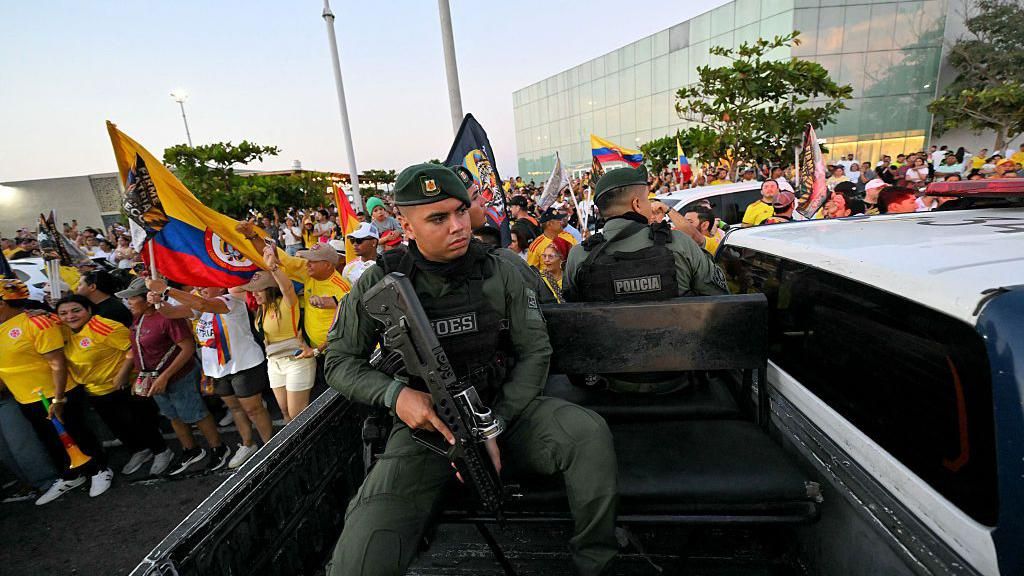
As Colombia prepares for its decisive presidential runoff election on Sunday, spiraling violence and widespread insecurity have emerged as the defining issue splitting voters and overshadowing the entire campaign. For countless Colombians displaced by criminal conflict, the stakes of this election are not just political — they are a matter of survival.
Edilma Martinez Flores, now staying at a support center for internally displaced people in Bogotá, knows this reality all too well. After armed criminal groups distributed leaflets ordering residents to abandon their homes on the outskirts of Cali or face deadly retaliation, she lost her brother to assassination when he refused to pay extortion fees — killed in front of his own children. “We had no choice but to leave our things behind. They started placing bombs along the routes people travel,” she explains. She is one of tens of thousands of Colombians forced from their homes by escalating clashes between illegal armed factions that have seized control of vast swathes of rural territory.
Colombia’s history of armed conflict stretching back 60 years has already claimed hundreds of thousands of lives. What makes the current crisis unprecedented is the rapid expansion of illegal groups over the past half-decade: their membership has roughly doubled since 2021, with FARC dissident factions, the National Liberation Army (ELN), and the Clan del Golfo criminal network fighting for control of land critical to drug trafficking and illegal mining. A 2025 brutal offensive between ELN and FARC dissidents near the Colombia-Venezuela border alone displaced tens of thousands of people. Official data confirms the scale of the crisis: forced displacement surged 300% between 2024 and 2025, a level not seen in 20 years.
Isabelita Mercado Pineda, a Bogotá-based government advisor focused on peace, victim support and reconciliation, attributes the crisis to multiple overlapping factors. Growing cocaine production has created massive profit incentives for armed groups, while the Colombian military failed to fill territorial vacuums left after the 2016 peace deal demobilized most FARC fighters. Mercado Pineda also criticizes the outgoing government’s peace strategy, arguing it offers only incentives to criminal groups without sufficient enforcement to curb their expansion. Support centers across the capital bear witness to this human cost: Erin Gamboa, from the violence-plagued Pacific Chocó region, still has no news of his half-brother, abducted by FARC fighters amid constant battles for control of illegal mining and cocaine routes. Another anonymous couple running a small food delivery business told of extortionists claiming ties to the FARC demanding 5 million pesos (roughly $1,500) from their children, leaving them too afraid to leave their home in peace.
This election offers voters two starkly contrasting visions to address the crisis, put forward by candidates who finished neck-and-neck in the first round of voting, with conservative outsider Abelardo de la Espriella holding a narrow lead over left-wing senator Iván Cepeda. The campaign has already been marred by violence, including the assassination of a lower-tier presidential candidate, widespread homicides, kidnappings, and bomb attacks across the country.
Cepeda, a key architect of outgoing President Gustavo Petro’s flagship “total peace” strategy and a central figure in the 2016 FARC peace accord, prioritizes negotiated settlements with armed groups over all-out military confrontation. Critics argue the current peace approach has failed, allowing criminal factions to exploit ceasefires to expand their territory and power. But supporters argue negotiation prevents the mass loss of life that comes with full-scale conflict. Cepeda has pledged to pursue urgent social transformations to address the roots of violence, while committing to review and adjust the existing peace strategy to fix its shortcomings. Among young Colombians, the candidate has built strong support by framing his approach as a break from failed hardline security policies of the past. “Cepeda’s proposal for security not only contemplates the coercive forces of the state to stop crime, but also takes into account the structural roots of insecurity — the lack of state presence, poverty, inequality, that push many young people into joining criminal groups,” explains student Catalina La Grande, a Cepeda supporter. “We don’t want to repeat security models from previous governments that have left thousands of victims and not solved the problems. We believe in negotiated security: combining repression of armed groups with social programmes.”
His challenger, de la Espriella — a right-wing businessman and lawyer who goes by the nickname “El Tigre” (The Tiger) and holds dual US-Colombian citizenship — has taken a hardline stance, promising to end all negotiations with armed groups and crush criminal networks through military force. A high-profile endorsement from former US President Donald Trump has amplified his outsider campaign, though the left has decried the endorsement as unacceptable foreign interference, amid a growing interventionist US stance on Latin American criminal networks. Trump has framed the election as critical to US-Colombia relations, saying “if Abelardo wins…[Colombia] will have the total support and strength of the United States behind him,” while labeling Cepeda a “radical left Marxist.”
De la Espriella’s signature policy proposal is the construction of 10 mega-prisons to hold incarcerated gang members, and he has pledged that any criminal who refuses to surrender will be killed. Raised on Colombia’s Caribbean coast, where he retains strong regional support, his backers frame his tough tone as exactly what the country needs after years of rising violence. “He has achieved everything he has set out in life, he is a man with very strong convictions. He has that character, courage, it’s what we need for Colombia, a person who is tough on drug-trafficking, tough on guerillas,” says Maria Luisa Sanchez, a childhood neighbour and family friend. Sandra Caballero, a supporter from a village outside Barranquilla, adds: “He will work with the United States to fight drug trafficking and doesn’t plan to speak with criminals — which has not given results in four years. He wants to change taxes to help companies generate more jobs and invest in security and health.”
As Colombians gathered last week to celebrate their national football team’s 2-1 opening win over Uzbekistan at the World Cup, the streets of Bogotá briefly rang with unified celebration. But the coming election will lay the country’s deep divides bare: with two candidates offering fundamentally different paths to address the country’s decades-long violence, Sunday’s vote will shape the future of security and peace for millions of Colombians for years to come.