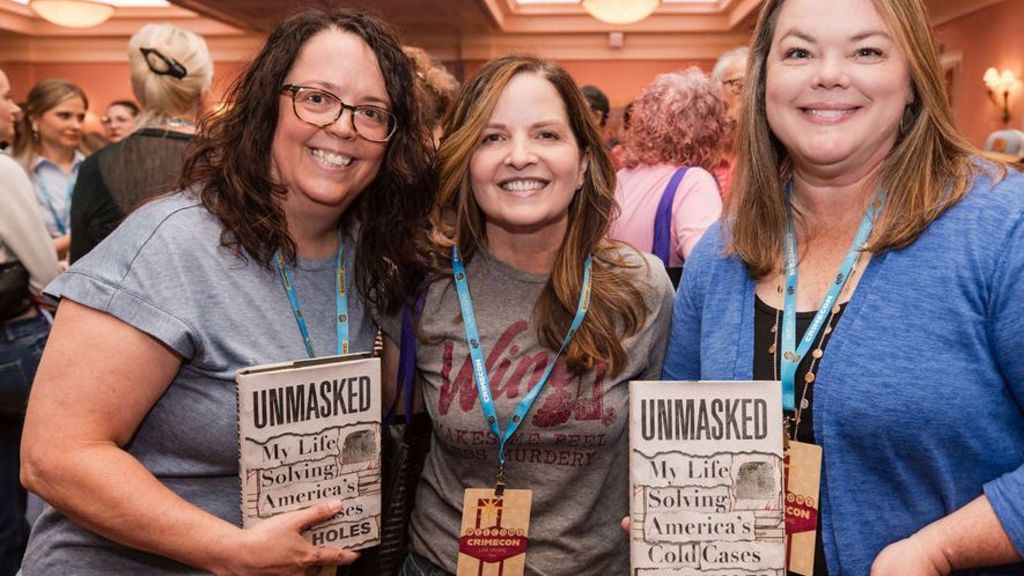
Beneath the hum of thousands of conversations inside a sprawling Las Vegas convention center, CrimeCon 2026 brings together a one-of-a-kind crowd: true-crime podcasters rubbing elbows with veteran prosecutors, casual fans in playful themed apparel, and grieving family members who have traveled thousands of miles to keep their loved ones’ cases in the public eye. Attendees wander the exhibit floor carrying branded conference bags printed with the provocative slogan “unsolved crime is a choice,” many wearing custom T-shirts that range from tongue-in-cheek quips like “True Crime And Wine” and “I’m Only Here For An Alibi” to solemn tributes to missing and murdered loved ones. The annual gathering, now owned by Fox News following its 2025 acquisition of organizer Red Seat Ventures, has grown dramatically alongside America’s decade-long obsession with true-crime media, but it continues to navigate a tense, fine line between commercial popularity and respectful advocacy for victims.
For many participants, attendance is far more than a recreational outing—it is a deeply personal mission to keep cold cases from fading into obscurity. Dr. Maggie Zingman, a trauma psychologist whose daughter Brittany Phillips was murdered in an unsolved 2004 killing, has spent years crisscrossing the country in a pink-and-purple wrapped vehicle to draw attention to her daughter’s case, and CrimeCon has become a key stop on her advocacy journey. Standing stoically behind a booth lined with photos of Brittany, Zingman acknowledges the inherent contradictions of a for-profit event built around real-life tragedy. “It’s a balance,” she says. “I wouldn’t get 8,000 people learning about my story if it wasn’t here.”
The rise of CrimeCon tracks directly with the explosion of mainstream true-crime culture that transformed the genre from a niche interest to a global pop-culture phenomenon. Industry observers trace the current craze to groundbreaking early hits: 2014’s breakout podcast *Serial*, followed by 2015’s hit docuseries *The Jinx* and *Making a Murderer*, which turned true crime into a watercooler topic and mainstream entertainment. Since its 2017 debut, which drew just 800 attendees, CrimeCon has expanded exponentially: attendance jumped to 2,400 in 2018, and this year’s Las Vegas iteration drew 6,500 guests, with some paying upwards of $1,600 for premium VIP access.
As the genre has grown, so has criticism that many true-crime platforms center perpetrators over victims, profiting from the pain and loss of grieving families. But long-time participants and event organizers argue CrimeCon has intentionally shaped its space to center victims and advocacy. Numerous victim-rights and missing-person organizations operate booths on the exhibit floor, including the foundation founded by the parents of Gabby Petito, the young travel blogger whose 2021 murder by her boyfriend sparked a national manhunt. Wearing T-shirts that read “Victim exploitation does not equal victim advocacy,” Joe and Nichole Petito have attended since 2023, and Joe notes the event has evolved steadily to prioritize advocacy over sensationalism. The convention hosts major national groups including the National Center for Missing and Exploited Children and the Black and Missing Foundation, giving them space to connect with audiences and raise awareness for their work. “It does a really good job of toeing the line… for pushing the advocacy side and not the exploitative side of victims and their families and loved ones,” Joe Petito says.
Event co-founder Kevin Balfe explains that organizers have intentionally curated the event to weed out visitors drawn only by sensationalized fascination with serial killers. “Over the years, we’ve had people who show up expecting this to be serial-killer this and that, and they just realise quickly this event’s not for them,” he says. “And we ultimately have curated an audience of people who, I think, really care.”
That said, the unmistakeable energy of a pop-culture convention permeates the space. Steps from an entry arch welcoming guests to CrimeCon 2026, a wall is covered in missing-person posters and a guide to “8 Simple Rules for Being an ETHICAL True Crime Fanatic,” but just five minutes away, a branded merchandise store sells everything from CrimeCon shot glasses to $80 event sweatshirts, with staff roaming the hallways promoting next year’s event and the premium CrimeCon Cruise experience. Some attendees fully embrace the playful side of the theme: one guest wears form-fitting leggings printed with crime-scene tape, while two best friends show off homemade handbags lined with blood-spatter fabric. The crowd is overwhelmingly female, with many fans lining up for selfies with high-profile true-crime personalities like Nancy Grace, who is presenting new theories on the unsolved disappearance of Nancy Guthrie, and for meet-and-greets with Steve and Kristi Goncalves, parents of University of Idaho murder victim Kaylee Goncalves. This year’s annual Clue Awards, which honor outstanding true-crime content, named three Jeffrey Epstein survivors and their non-profit as Crimefighters of the Year.
For many repeat attendees, the draw goes far beyond curiosity about unsolved mysteries. Ruth-Ann Labrecque, 52, traveled from Maine for her sixth CrimeCon alongside her 67-year-old aunt Roberta Randall, and each has spent roughly $3,000 on the trip. Brandi Barrett Elkins, a 53-year-old from Idaho who first developed an interest in true crime as a child, says many fans are drawn to the genre out of a desire to learn how to stay safe. “You want to learn what happened so you’ll know how to recognize it,” she explains. “I know for a fact if somebody came up to me with a broken arm and asked me to help them load a sailboat, aka Ted Bundy, I would be like: ‘Mmmm, sorry dude.’” Amy Dixon, an Illinois teacher and mother of three who created a CSI summer camp for her students, agrees, noting that learning about crime helps people prepare for unexpected danger. “It can happen anywhere,” she says. This is Dixon’s third CrimeCon, and she has upgraded her ticket each year, purchasing a $1,200 platinum badge for this year’s event.
Even the small number of male attendees often find themselves won over by the event’s mission. Jim McConnell, 71, a Texan who accompanied his wife Susan, a youth pastor, to the convention, says he never expected to enjoy the experience but has been impressed by the community’s commitment to advocacy. Susan McConnell has wanted to attend CrimeCon for years, and came hoping to connect with podcasters to raise awareness for the local unsolved 2021 murder of Missy Bevers, who was killed in a Texas church near her home. A photo of Bevers is printed on her T-shirt, and she says just getting the case more exposure makes the trip worthwhile.
For first-time attendee Greg Wallace, an Indiana father whose 23-year-old daughter disappeared nearly eight years ago, the convention is both emotionally exhausting and deeply hopeful. Struggling with PTSD from his daughter’s disappearance, the large crowd and loud noise pushed him to his emotional limits on the first day, but he says the opportunity to share his daughter’s story with a global audience makes the discomfort worth it. “But I’m really glad I did it, because, you know, I’ve got her name out there globally now, and that just gives me more hope,” he says.
Zingman, who has attended multiple CrimeCons, acknowledges the event still has growing pains, and has experienced firsthand the hierarchy that places more attention on families of high-profile victims. During a 2018 Nashville event, she says she felt uncomfortable watching attendees pass her booth to reach families of more well-known victims, overhearing visitors whisper “Who is that?” as they walked by. “And I was like: I don’t know if I can handle this, because it is very commercial,” she recalls. Over time, however, she has learned to separate the commercial aspects of the event from the valuable platform it provides, and says she has watched CrimeCon evolve to prioritize victims and their families far more than it did in its early years.
The Goncalves, attending their first CrimeCon this year, have been overwhelmed by the support they have received from attendees, and are already planning to return next year with a booth for their Murder Has a Name foundation, which raises funds for DNA testing in cold cases. “You can’t beat the people that are here,” Kristi Goncalves says. “The media people that are here, the citizens that are here, the true crime families.”
Nicole Earnest-Payte, a first-time attendee, sexual assault survivor and speaker who waited 27 years for justice after being attacked by the NorCal rapist, says CrimeCon often gets an unfair reputation because of its name’s similarity to the pop-culture convention Comic Con. “They think, ‘Oh, this is just a bunch of people that are obsessed with murder that come there,’” the 56-year-old Californian says. “And I don’t think that’s what this is.” Instead, she sees the event as a space for education and connection, where attendees can leave with a better understanding of criminal behavior and investigative work. “It’s really important for fans to understand that these are real human beings, real lives, real parents, real children, real spouses whose lives have been completely destroyed,” she says. That understanding, she argues, is the key to keeping the event focused on respect, not exploitation.