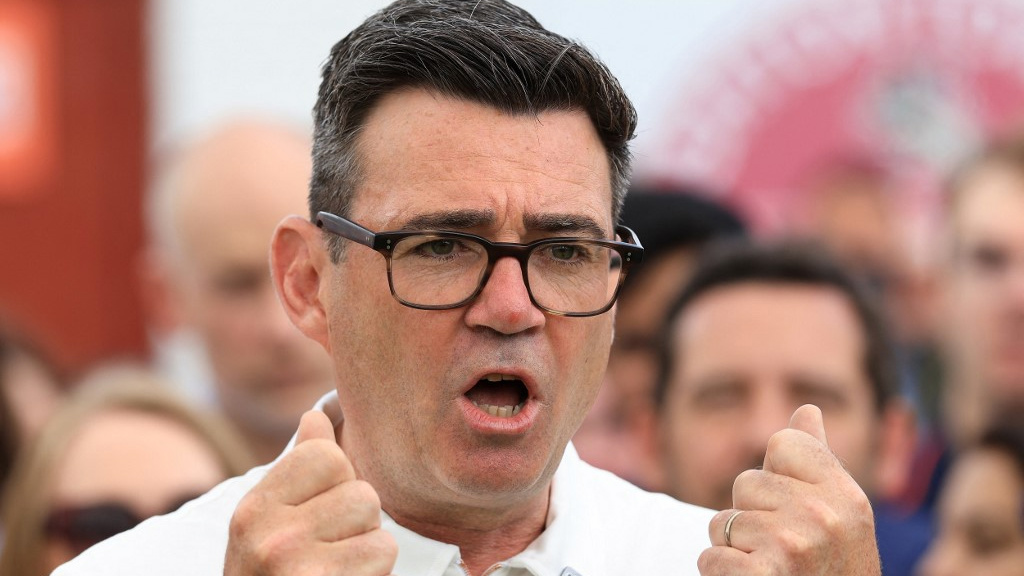
In a political earthquake that has upended Britain’s domestic political landscape, former Greater Manchester Mayor Andy Burnham has secured a landslide victory in the Makerfield constituency by-election, catapulting him directly into position as the clear frontrunner to become the United Kingdom’s next prime minister.
Burnham’s stunning win in the early hours of Friday defied every recent political trend in the northern, working-class dominated seat. Just one month prior, Nigel Farage’s right-wing Reform UK had delivered a crushing blow to Labour in Makerfield during local elections, opening a 20-point lead over the incumbent party. Against all polling expectations, however, Burnham captured 55% of the by-election vote to Reform’s 35%, handing the insurgent right-wing party its second high-profile by-election defeat of 2025, following a second-place finish behind the Greens in the Gorton and Denton contest in February.
This double defeat seriously undermines Reform’s core narrative that a Farage-led government is an inevitable outcome of the next general election. Political analysts now agree that Burnham’s victory has shifted the entire trajectory of British party politics.
Within the Parliamentary Labour Party, Burnham already commands widespread popularity, with dozens of MPs now viewing him as Labour’s best chance to secure a stable majority in the next election. Polling on his impact is split: some analysts predict his leadership would boost Labour’s national support by multiple percentage points, while others argue the shift would be more modest, and leave Labour still neck-and-neck with Reform.
The path to Downing Street for Burnham is already laid out in Labour Party rulebook. To trigger a leadership challenge against incumbent Prime Minister Keir Starmer, he only needs the public backing of 81 Labour MPs, plus support from 5% of local Labour party branches or three party-affiliated groups, including at least two major trade unions. A challenge would then proceed to a membership-wide vote. If Starmer chooses to resign voluntarily, Burnham could even secure an uncontested “coronation” to the leadership.
Notably, Burnham’s inner circle has actively discouraged junior ministers from resigning en masse to force Starmer out, a dramatic escalation that would risk splitting the party. Instead, the frontrunner prefers to give Starmer space to announce a voluntary timetable for stepping down. A senior anonymous campaign source quoted by The Guardian noted: “If they’re trying to force Keir’s hand with a kamikaze approach it will ultimately be counterproductive.”
If Starmer steps aside, Burnham could be sworn in as prime minister within a matter of weeks. But multiple Westminster sources confirm the incumbent prime minister remains determined to hold onto his position, and is prepared to fight any leadership challenge head-on. Still, few political insiders in Westminster believe Starmer can survive the current momentum behind Burnham, with many already describing him as a “dead man walking.”
A shortened, accelerated leadership contest lasting only a few weeks is also a likely outcome, which could see Burnham face off against Starmer and former Health Secretary Wes Streeting. While Streeting’s allies claim he has already secured the required 81 MP nominations to get on the ballot, polling consistently shows he is far less popular with rank-and-file Labour members than even Starmer, let alone Burnham.
Politically, Burnham is positioned on the soft left of the Labour Party, and is often described as a pragmatic politician who has adjusted his policy stances over his decades in public life. During his tenure as Greater Manchester mayor, he and his allies developed a distinct economic philosophy dubbed “Manchesterism,” which he now proposes to roll out nationally. The framework calls for a far more interventionist approach to the UK economy than Starmer’s cautious platform: it is not full socialism, but represents a clear break from four decades of privatization and centralized political control. In Burnham’s own words, Manchesterism is a “modern and functional response to the high-inequality, low-growth trap that came from the 1980s drive to privatise economic power and overcentralise political power in the Treasury.” He has already publicly committed to bringing water and energy utilities back into public ownership if he takes office.
Still, open questions remain about what version of Burnham would govern as prime minister. During the by-election campaign, he signaled he would retain key planks of Starmer’s policy agenda, most notably the current government’s aggressive push to cut net immigration levels. This pivot is widely interpreted as an attempt to win over working-class voters who have drifted to Reform in recent years, but it has already become a key point of attack for the Green Party, which has seen a major surge in national support under Starmer’s leadership.
While the Greens captured just 0.7% of the vote in Makerfield, political analysts note the party has never prioritized the constituency, focusing its resources instead on the upcoming Manchester mayoral race, where they believe they have a credible shot at victory. In last month’s local elections, the Greens actually inflicted more damage on Labour’s vote share across the country than Reform did, a fact Burnham and his team are acutely aware of. Some of Burnham’s left-leaning economic policies could help win back disaffected Green-leaning voters, but foreign policy and immigration remain major flashpoints.
Green Party co-deputy leader Mothin Ali publicly criticized Burnham on Friday over his immigration stance and his refusal during the campaign to label Israeli military actions in Gaza as genocide. Burnham largely avoided discussing foreign policy during the by-election, with internal Labour sources confirming he and his team believed the issue would not help him win over Makerfield voters. But if he wants to win over the Labour membership, which overwhelmingly supports stronger action to address the crisis in Gaza, he will be forced to take a clearer stance on the issue. A shift toward a stronger condemnation of Israeli military actions would also help him undercut the Greens and win back left-wing voters who have abandoned Labour in recent years.
Political events are expected to move rapidly over the coming week, and many outcomes remain uncertain at this stage. It remains unclear whether Burnham will move quickly to claim the premiership, whether a prolonged public leadership contest will unfold, or whether Starmer will ultimately concede that his time as leader has come to an end. What is certain, however, is that the United Kingdom’s political landscape will be fundamentally reshaped by the outcome of the Makerfield by-election, regardless of what comes next.