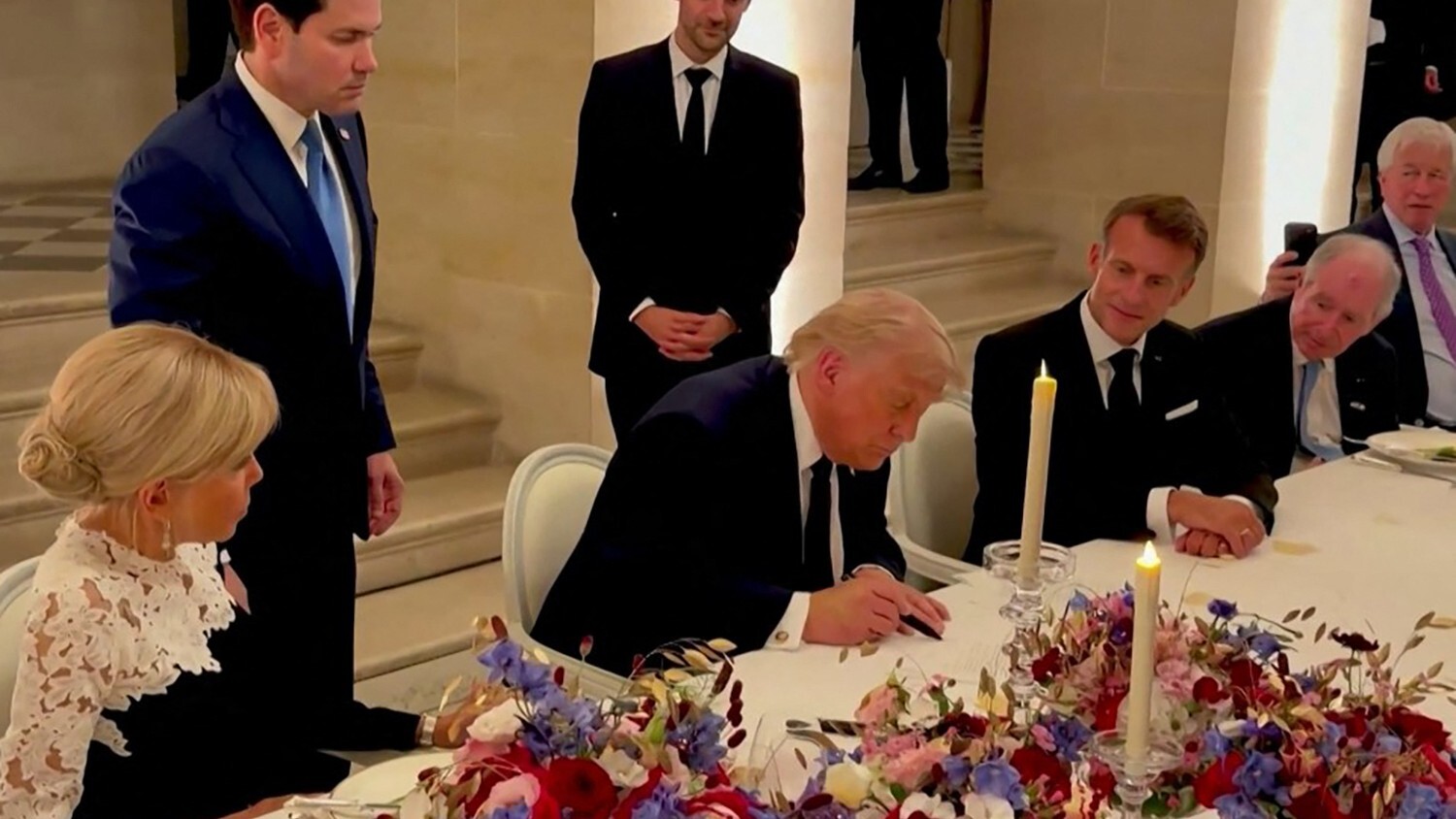
Parallels between the 1919 Treaty of Versailles, which ended World War I on humiliating terms for Imperial Germany, and a new 2025 ceasefire agreement between the United States and Iran have emerged after U.S. President Donald Trump signed the deal at the same French palace that hosted the historic post-WWI conference.
The agreement, dubbed the Islamabad Memorandum of Understanding (MoU), opens a 60-day window for permanent negotiations to end the full-scale war launched by the U.S. and Israel against Iran earlier this year. Even across the U.S. political spectrum, the deal is widely labeled a strategic debacle for Washington, even among factions that support ending the conflict on its current terms.
When Trump first launched military strikes on Iran in June 2025, he laid out a sweeping set of non-negotiable war aims: he claimed the attack was justified to eliminate Iran’s nuclear program, initially floated plans to overthrow the Islamic Republic by backing Kurdish militants and domestic opposition, vowed to destroy Iran’s conventional military and ballistic missile program, and repeatedly demanded Iran’s unconditional surrender. None of these core objectives have been achieved, according to current and former U.S. officials, independent analysts, and political commentators from across the ideological spectrum.
“War opponents can be glad the war is over and also point out that this insane deal is a final proof point that the whole war…was a total calamity,” Democratic Senator Chris Murphy wrote on social media platform X. Conservative commentator Brandon Weichert echoed that criticism, blaming interventionist neoconservative Republicans for dragging the U.S. into a conflict it could not win. “We are only in this terrible position because of the ‘Neocons’ who pushed [us] into an unwinnable war. Again. This is what happens when you lose a war,” Weichert wrote.
Aaron David Miller, a former Middle East negotiator who has served both Republican and Democratic administrations, summed up the widespread assessment of the U.S. position in comments to Middle East Eye. “The US deployed its power foolishly and recklessly,” Miller said. “We have lost, vis-a-vis Iran, a lot of power and influence. Deterrence is gone. Iran has survived the largest deployment of American air, naval and missile assets since the Second Iraq War.”
On paper, the MoU only includes a loose Iranian pledge to refrain from developing nuclear weapons – a commitment that is already codified in a fatwa issued by former Iranian Supreme Leader Ali Khamenei, who was assassinated early in the conflict. The agreement leaves the door open for Iran to continue enriching uranium for civilian purposes as part of a final permanent deal, and experts note the U.S.-led bombing campaign has already set Iran’s nuclear program back by years, meaning any temporary enrichment moratorium would be largely symbolic. “Iran’s nuclear programme is already years damaged. So if they propose a moratorium they aren’t really offering anything,” explained David Schenker, a former senior U.S. official now based at the Washington Institute for Near East Policy.
Critics of the deal have focused heavily on the sweeping economic concessions granted to Tehran. The MoU lifts all U.S. sanctions on Iranian oil exports, ends the American blockade of Iranian ports, and outlines a process to unfreeze more than $100 billion in Iranian assets held abroad, with many of these funds expected to be released during the 60-day negotiation window. Alan Pino, a former CIA and National Intelligence Council officer now at the Atlantic Council, noted that the MoU ties few of these economic benefits to concrete Iranian concessions on Washington’s original policy goals. “Iran clearly gets a lot of economic benefits from the MoU. What is not clear is how many of these benefits are tied to implementation of a final agreement,” Pino said. “It seems like these frozen funds might start flowing to Iran during the 60-day period. Either way, with the sanctions waiver, it sounds like Iran is going to get its hands on a lot of money without fully complying with the US’s goals and objectives.”
Analysts say the final outcome of the conflict was shaped by Iran’s successful asymmetric pressure campaign that wore down U.S. resolve long before Tehran’s own position weakened. Though Iran never launched direct attacks on the U.S. homeland, its missile and drone strikes depleted American stocks of air defense interceptors to critically low levels, while its blockade of the Strait of Hormuz – the chokepoint through which 20% of global oil supplies flow – pushed U.S. strategic petroleum reserves to a 40-year low and created widespread fears of a global energy crisis. By mid-April, two weeks after the war launched, multiple outlets including Middle East Eye warned the U.S. was facing a “Suez moment,” a parallel to the 1956 failed Suez Crisis that marked the end of British and French dominance over the Middle East. Trump continued the conflict for another month, however, with a shaky ceasefire repeatedly broken by flare-ups in fighting and empty threats to target Iranian civilian infrastructure.
Experts say Trump entered the war largely on the urging of Israeli lobbyists who claimed that toppling the Iranian government would be quick and low-cost. When the initial invasion plan failed, Trump doubled down on a blockade and threats of further escalation, betting that the Iranian government would collapse under pressure. Instead, Iran outlasted the U.S., as growing global fears of an energy crisis and pressure from U.S.-allied Gulf states forced Washington to compromise.
William Usher, a former CIA analyst and Middle East expert, explained the timeline that led to the MoU. “The US and Iran both had clocks that were winding down for several weeks,” Usher said. Oil executives warned that a prolonged closure of the Strait of Hormuz would trigger a global supply shock by summer, and Iran responded to U.S. threats with warnings of new attacks on oil-rich Gulf U.S. allies – states that hold major investments in the U.S. economy and have extensive personal business ties to the Trump family. “The US clock wound down first because concerns about rising energy prices hit a fever pitch. Iran had a little bit more sand in the hourglass and is reaping the benefit of strategic patience,” Usher added. “Iran basically got paid to reopen the strait.”
While the war has inflicted massive damage on Iran – Trump has claimed U.S. and Israeli strikes caused up to $2 trillion in damages to Iranian military, civilian, and energy infrastructure – Tehran is already moving to recoup its losses. The MoU outlines a $300 billion reconstruction fund for Iran in a final peace deal. While Trump has ruled out using U.S. taxpayer money for the fund, he has not objected to contributions from Gulf Arab states. Diplomatic sources say Qatar and the United Arab Emirates are already in informal talks to contribute to the fund, a sharp shift from the start of the war, when most Gulf states opened their military bases to the U.S. and joined the coalition attacking Iran.
That shift underscores the new regional reality created by the war: Gulf states now recognize that U.S. deterrence against Iran has been weakened, and are moving to strike their own conciliatory deals with Tehran to avoid future conflict. “The Gulf states know we [the US] lost and that we can’t protect them from Iran. They are paying Iran for safety, and it appears to be part of a US arrangement,” a former senior U.S. official told Middle East Eye. Schenker summarized the dynamic: “The US has given its blessing for hedging.”
This war, Usher noted, fits a decades-long pattern of U.S. military interventions in the Middle East that have ultimately strengthened Iran’s strategic position. After the U.S. toppled Saddam Hussein’s regime in Iraq in 2003, Iran filled the power vacuum and built deep influence with Iraq’s Shia majority government. “Like the Iraq war, the US has left Iran in a strategically better position,” Usher said.
While parallels to the 1919 Versailles Treaty have been drawn, experts note there are key differences between the two outcomes. The Versailles Treaty led to the collapse of Imperial Germany and the rise of the fragile Weimar Republic, but the war with Iran was never an existential threat to the United States, which remains the dominant military power in the Middle East. Miller argued that despite the strategic defeat, no external power is positioned to displace U.S. influence in the region. “Is American power and influence in the Gulf fundamentally eroded as a result of this strategic defeat?” Miller asked. “Well, where are the Russians, the Chinese and the Europeans? This was an unprecedented crisis dominated by three countries: the US, Israel and Iran. The US is still the only game in town.”