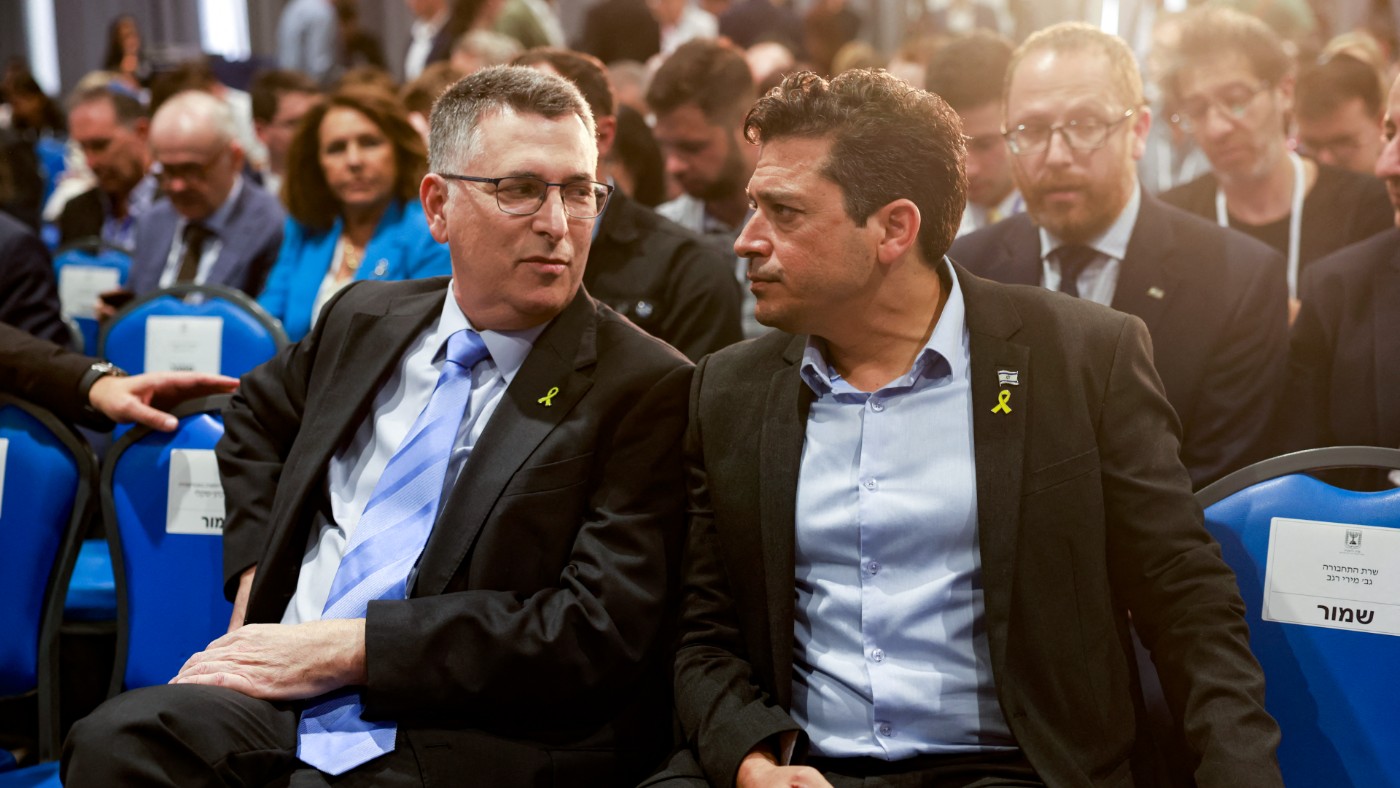
A senior far-right Israeli cabinet member from Prime Minister Benjamin Netanyahu’s ruling Likud party has stoked regional tensions this week with explosive comments forecasting that Israel will ultimately go to war with Syria, and outlining a sweeping new anti-Israel alliance he claims is taking shape across the Muslim world.
Amichai Chikli, Israel’s Minister of Diaspora Affairs, laid out his controversial assessment in a series of radio interviews conducted across Wednesday and Thursday, framing the emerging bloc as a far greater threat to Israeli national security than Iran and its recently finalized ceasefire agreement with the United States.
Chikli centered his criticism on the new government led by Syrian President Ahmed al-Sharaa, claiming its jihadist ideological roots tied to the Islamic State and al-Qaeda, paired with its stated goal of securing the unification of Jerusalem, make peaceful coexistence with Israel impossible. From that foundation, he argued that a full military confrontation between Israel and Syria is inevitable. “There is no way that a jihadist regime rooted in Isis and al-Qaeda, whose aspiration is the unification of Jerusalem, can live in peace alongside the State of Israel,” Chikli stated.
The minister went on to identify a three-country coalition he calls the “radical Sunni axis of evil”, made up of Pakistan, Turkey, and Qatar. In remarks to Israel’s Army Radio, he emphasized that this unreported new alliance poses a far more acute danger to Israel than Tehran, even as he acknowledged that Iran has secured major strategic gains through its U.S.-brokered ceasefire. “What is far more troubling is the new axis emerging in the Middle East,” Chikli explained.
He argued Pakistan and Turkey earned their place in the bloc through their outsized influence during U.S.-Iran negotiations, while he dismissed Qatar as the global public relations mouthpiece for jihadist movements during an interview with Kol Barama Radio. Chikli reserved his sharpest criticism for Ankara, describing Turkish President Recep Tayyip Erdogan’s regional ambitions as “an extremely dangerous combination” for Israel. He claimed Turkey has effectively installed a protectorate over much of Syria, and doubled down on his assessment by saying “Turkey and Syria are ten thousand times more concerning than Iran.”
Chikli’s comments come amid a sharp upward trajectory in bilateral tensions between Ankara and Jerusalem. Erdogan earlier this month declared that Israel’s ongoing military strikes in Syria and Lebanon constitute a direct threat to Turkish national security, stating that “Israel must be stopped, this is the duty of humanity.” Just weeks prior, Turkish Interior Minister Mustafa Ciftci publicly called for the “liberation” of Jerusalem, further ramping up rhetorical hostility between the two countries.
Chikli is not an outlier in his hardline stance toward Turkey among senior Israeli political figures. Last week, fellow Likud lawmaker Ariel Kellner officially labeled Turkey an “enemy state,” while Israeli Culture and Sports Minister Miki Zohar argued last month that Israel must reclassify Turkey as an enemy state, warning that Ankara would face devastating consequences in any future conflict with Israel. Even former Israeli Prime Minister and opposition figure Naftali Bennett backed that framing back in February, declaring that “Turkey is the new Iran.”
Outside of his regional security assessments, Chikli used his recent media appearances to defend a high-profile far-right British political agitator. After UK police detained Tommy Robinson, whose legal name is Stephen Yaxley-Lennon, and seized his electronic devices upon his return from a trip to Russia, Chikla called the action an attack on free speech. “One of Britain’s clearest voices against real Islamic terrorism is now being hunted under anti-terrorism laws. At this rate Britain will become the second Islamic Republic in Europe,” he claimed.
Chikli also pushed back against the idea that the region is set for a long period of peace after two and a half years of continuous conflict. When asked if Israelis could expect an extended period of calm, he said he hoped for that outcome but did not expect it to hold. He argued that Turkey has open regional ambitions that directly undermine Israeli interests, though he was careful to clarify that Israel has no intention of capturing the Turkish capital of Ankara, and would welcome lasting peace with both Syria and Turkey. He closed by referencing the October 7, 2023, Hamas-led attack on Israel as a lesson: “When the enemy says something, I listen.”
For years, Chikli has worked to build close working relationships with far-right political figures and governments across the globe, aligning with their anti-Islam and anti-immigration policy platforms.