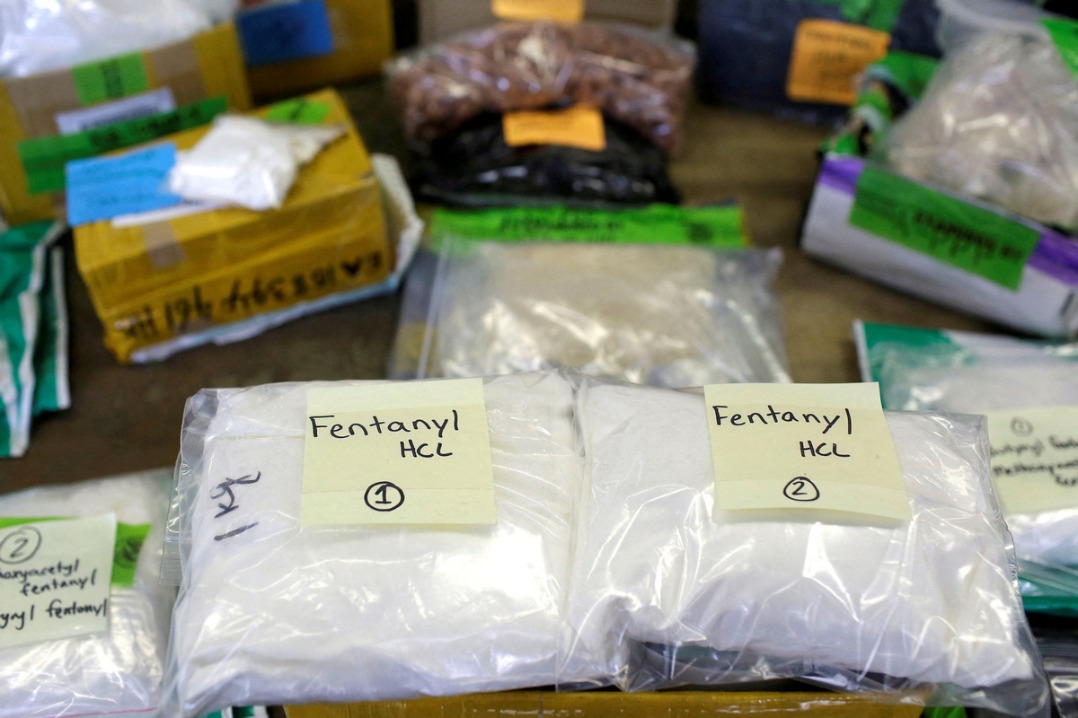
China and the United States have continued to make consistent, steady progress in cross-border anti-narcotics cooperation, expanding practical collaboration across multiple high-priority areas, a senior Chinese narcotics control official announced Wednesday. The announcement came as China rolls out new strengthened measures for domestic drug governance and chemical regulation, adding 16 extra non-medical narcotic and psychotropic substances to its official controlled substances roster.
Wei Xiaojun, executive deputy director of the Office of China National Narcotics Control Commission and director of the Ministry of Public Security’s narcotics control bureau, outlined that bilateral cooperation between the two countries has deepened across a wide range of critical domains: substance scheduling regulation, precursor chemical control, intelligence sharing, transnational joint investigations, illegal online drug content cleanup, repatriation of drug-related fugitives, anti-money laundering initiatives, and advances in drug testing technology.
Wei confirmed that China has maintained regular, structured communication with relevant U.S. government agencies, including the White House Office of National Drug Control Policy, to share updates on ongoing operations and align collective strategic priorities. Chinese law enforcement bodies have also partnered on joint casework and fugitive repatriation with multiple U.S. law enforcement agencies, including the Drug Enforcement Administration, the Federal Bureau of Investigation, and U.S. Immigration and Customs Enforcement, he added.
A recent example of this cooperative work was highlighted: In February 2026, Tianjin police apprehended a drug suspect surnamed Gong using intelligence provided by U.S. law enforcement. Prior to the Chinese arrest, U.S. authorities in Georgia had already taken into custody a U.S. citizen linked to the same transnational drug ring.
Addressing the principles of global anti-drug collaboration, Wei emphasized that cross-border narcotics control is a shared global responsibility that must be rooted in mutual respect and mutual trust between nations. “As long as China and the United States work in tandem, we can effectively tackle shared drug-related challenges, an outcome that will bring tangible benefits to both of our peoples and the entire global community,” he stated. He added that China remains fully committed to preserving the positive, hard-won momentum of Sino-U.S. anti-drug cooperation, which requires continuous, coordinated joint efforts from both sides to sustain.
Wei also noted that China has proactively addressed the growing global threat of unregulated nonscheduled chemicals being diverted into illegal drug manufacturing networks, particularly the diversion routes that feed illicit production in North America.
Coinciding with Wednesday’s announcement, China’s national drug regulatory body confirmed that starting July 1, 2026, the 16 newly added substances will be formally integrated into the country’s official catalogue of controlled nonmedical narcotic and psychotropic substances. Once the update takes effect, China will have regulatory control over 412 types of non-medicinal narcotic and psychotropic substances, along with full category-based controls for all fentanyl-related substances, synthetic cannabinoids, and nitazene-related compounds.
To proactively mitigate emerging regulatory risks ahead of the policy update, China issued two official public compliance warnings in November 2025 and May 2026, urging all industry actors to abide by existing national drug control laws. Chinese customs and postal inspection authorities have also already strengthened export oversight, upgraded risk analysis frameworks, and expanded inspection protocols for high-risk chemical shipments.
Nationwide, Chinese authorities have carried out large-scale crackdowns targeting illegal trafficking of precursor chemicals and new psychoactive substances, while also pushing for stronger industry self-regulation across chemical manufacturing and distribution sectors. Wei noted that strict upstream chemical regulation remains a core, foundational pillar of China’s national anti-drug strategy. In 2025 alone, Chinese law enforcement seized 550.6 metric tons of illicit drug-related precursor chemicals. The country has also published a landmark white paper focused specifically on fentanyl control and has continuously expanded its national regulatory system to close emerging gaps.
While Wei confirmed that China’s overall domestic drug situation remains stable, he warned that evolving trafficking patterns have created new regulatory challenges: modern drug networks are increasingly organized, available substances are more diversified, and the average age of drug users continues to fall. Unregulated gray-area compounds and exploitation of regulatory loopholes, alongside the constant emergence of new addictive synthetic substances, have added significant complexity to national control efforts.
The 2025 China Drug Situation Report, which was also released Wednesday, provided a full overview of last year’s anti-drug work. The data showed that Chinese authorities solved 27,000 drug-related criminal cases and arrested 34,000 suspects in 2025, representing year-on-year drops of 27.6 percent and 33 percent respectively. Total drug seizures reached 33.5 tons, a 25.4 percent increase from 2024, while authorities processed 134,000 drug users for treatment and supervision, a 30.3 percent year-on-year decrease.
The report also highlighted a key emerging trend: a sharp rise in abuse of unregulated nonscheduled addictive substances. In 2025, authorities seized nearly 1.27 million liters of nitrous oxide, an 84 percent year-on-year increase, and 9.3 tons of other unregulated addictive substances, which marked a more than 17-fold increase compared to 2024 figures.