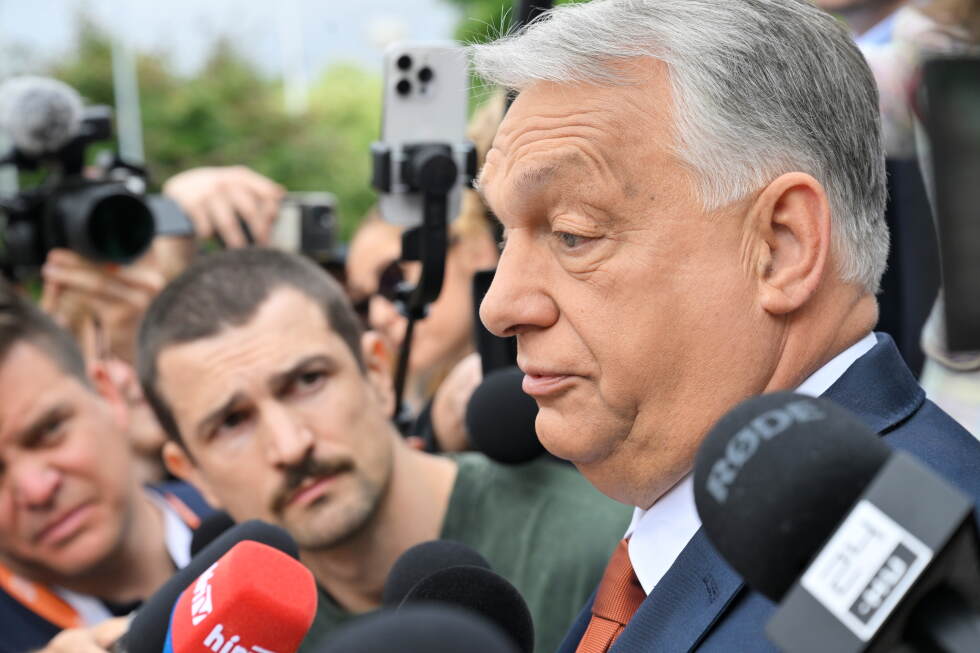
BRUSSELS — For the first time in 16 years, one of European politics’ most polarizing figures was absent from the room when European Union heads of state gathered for their flagship summit in Brussels on Thursday. Over nearly two decades, through countless rotations of national leadership across the bloc, Hungarian nationalist Viktor Orbán stood as an unshakable fixture in Brussels’ corridors of power. His political brand of illiberal nationalist populism not only shifted Europe’s ideological center sharply to the right but also became a template for far-right movements across the continent, even earning admiration from America’s Make America Great Again wing.
Orbán’s exit from the top table of EU summits comes after he lost Hungary’s national parliamentary election in April, which pushed his Fidesz party into the country’s main opposition bloc. For years, Orbán built his political brand around open confrontation with EU institutions: he repeatedly vilified bloc leaders, violated EU regulations, and systematically eroded checks and balances on executive power within Hungary. He also emerged as the most consistent and high-profile barrier to the EU’s core geopolitical priority of integrating Ukraine into the bloc, leveraging his position as Hungarian prime minister to repeatedly veto EU progress on Kyiv’s accession bid.
Now, with Orbán on the political sidelines for the first time in a generation, his successor as Hungary’s leader, Prime Minister Péter Magyar, is taking his seat at the summit alongside EU heavyweights including French President Emmanuel Macron, Spanish Prime Minister Pedro Sánchez and German Chancellor Friedrich Merz — advancing policy priorities that directly contradict Orbán’s long-held agenda. While Orbán was locked out of the main EU summit focused on expanding military and political support for Ukraine, he remained in Brussels to lead a gathering of his new far-right political alliance, Patriots for Europe. The coalition, which unites Euroskeptic and nationalist parties from across the bloc, holds the third-largest number of seats in the European Parliament, giving it significant leverage to shape EU legislation.
Despite his bruising election defeat — a result widely greeted with relief by EU leaders, who saw it as a popular rejection of Orbán’s hostile stance toward the bloc and his close ties to the Kremlin — the former prime minister shows no sign of abandoning his ideological project. Speaking to reporters on Wednesday ahead of the Patriots for Europe summit, Orbán framed his April loss as a temporary setback, arguing it would do nothing to slow the rise of nationalist forces across the continent. “No one election loss can stop this historical process,” he said. “Anti-migration and sovereigntist political forces in Europe will continue to grow stronger in the coming months and years.”
Orbán has positioned Patriots for Europe as the vehicle to reshape the EU in his illiberal image. Key policy goals for the alliance include rolling back EU oversight of national rule of law and democratic standards, implementing a harsh zero-tolerance policy on irregular migration, and forging deeper strategic ties with Russia and China. But a major shift is already underway under Hungary’s new leadership: just last week, Magyar’s government lifted Orbán’s long-held veto on the formal opening of Ukraine’s EU accession negotiations, following weeks of bilateral talks with Kyiv that resolved longstanding disputes over minority rights for ethnic Hungarians in western Ukraine.
The removal of Orbán’s veto clears the biggest single barrier to accelerating Ukraine’s accession path, a process set to pick up speed when Ireland takes over the EU’s rotating six-month presidency in July. “Hungary obviously had issues that they were able to resolve to allow this to happen this week,” said Thomas Byrne, Ireland’s Minister for European Affairs.
Orbán’s confidence in a far-right breakthrough is not entirely unfounded. The movement has notched notable electoral gains across the bloc in recent months: Marine Le Pen’s National Rally party picked up significant ground in French municipal elections earlier this year, while Germany’s far-right Alternative for Germany (AfD) has climbed steadily in national opinion polls. Andrej Babiš, a Czech populist and close Orbán ally, returned to the office of prime minister last year, making him the only leader from the Patriots for Europe alliance to currently hold the reins of government in an EU member state.
Most recently, the far-right secured a major policy win last week, when a joint voting bloc of Patriots for Europe and the center-right European People’s Party passed sweeping EU migration reform. The legislation, which has been fiercely condemned by human rights groups, expands bloc-wide surveillance powers, increases deportation targets for irregular migrants, and establishes offshore migrant detention centers labeled “return hubs” outside EU borders. When the reform passed the European Parliament in Strasbourg, far-right and center-right lawmakers celebrated with chants of “Send them back.”
Still, the European far-right is not without internal rifts. Fractures have emerged in recent months over key geopolitical issues, including conflicting stances on the Israel-Hamas conflict and reactions to former U.S. President Donald Trump’s repeated threats to annex Greenland, an autonomous territory belonging to EU member Denmark. For the EU and Ukraine, however, one major barrier has already been removed: with Orbán no longer holding the Hungarian prime ministership, he can no longer use veto power over EU policy to block Kyiv’s accession path, opening a new chapter in the bloc’s expansion and geopolitical direction.