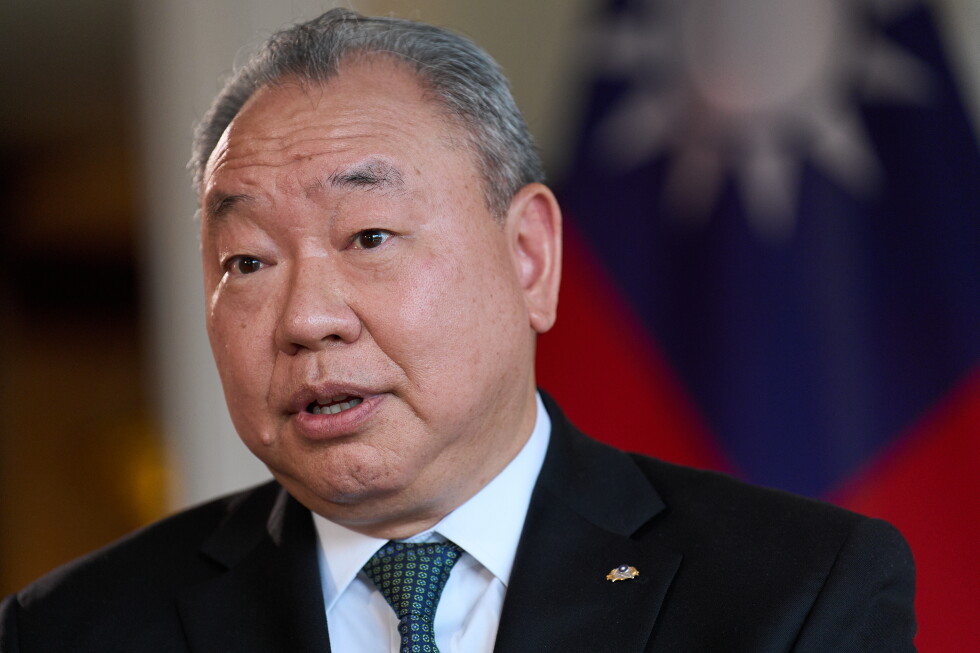
WASHINGTON — Amid intensifying military pressure from Beijing on the self-governing island of Taiwan, the island’s highest-ranking diplomatic representative in the United States has emphasized that Taipei urgently needs to procure U.S.-manufactured weaponry to bolster its self-defense capabilities. Alexander Yui Tah-ray, who leads the Taipei Economic and Cultural Representative Office — Washington’s de facto embassy for Taiwan, which the U.S. does not formally recognize as a sovereign state — also confirmed he has detected no shift in longstanding U.S. policy toward the island, which China claims as an inalienable part of its territory.
The $14 billion arms package, which won approval from senior U.S. congressional leaders earlier this year, has remained in gridlock ever since President Donald Trump returned from a state visit to Beijing in May, where he discussed the proposed sale at length with Chinese President Xi Jinping. The delay has stoked widespread anxiety across Taiwan and drawn sharp concern from members of Congress on Capitol Hill.
In an exclusive interview with the Associated Press in Washington on Wednesday, Yui made clear the necessity of the requested arms for defensive ends. “We need those arms for defensive purposes. We’re trying to increase our defense expenditure. We try to increase our ability to defend ourselves better and survive times of crisis,” he said.
Unlike many global powers, the U.S. does not maintain official diplomatic recognition of Taiwan, in line with Beijing’s requirement that all nations with formal ties to China cut off official relations with Taipei. Even so, Washington has remained the island’s most powerful informal ally and its largest supplier of defensive military hardware. Under longstanding U.S. domestic law, the U.S. is required to provide Taiwan with enough military equipment to deter any potential aggressive action from Beijing, which has repeatedly vowed to take control of the island by force if necessary to achieve unification. Beijing has consistently opposed all U.S. arms sales to Taiwan, which has operated outside of Chinese Communist Party control since 1949.
Yui, who holds the de facto role of Taiwan’s ambassador to Washington, stressed that Taiwan does not plan to rely solely on U.S. military intervention in the event of a crisis. “This is our responsibility, so we will not wait and depend for the U.S. cavalry to come and save us,” he said. “That’s why we’re willing to acquire, to buy U.S. equipment and arms to make ourselves stronger.”
The envoy added that the scale of the requested arms sale must match the severity of the threat Taiwan faces from mainland China, a threat he described as “actually pretty high.” He pushed back against Beijing’s framing of cross-strait tensions, noting, “First and foremost, we’re not the aggressors. It is the People’s Republic of China who is sending all the planes and ships. They’re the ones huffing and puffing. They are the ones who’s trying to annihilate our freedom and democracy in Taiwan.”
In recent years, the People’s Liberation Army has deployed warships and military aircraft near Taiwan on an almost daily basis, and has carried out multiple large-scale military exercises in the waters and airspace surrounding the island. Beijing views control of Taiwan as a non-negotiable core interest, and blames pro-independence forces on the island and their international supporters for rising instability across the Taiwan Strait.
Reaffirming his assessment of U.S. policy, Yui said he had seen no adjustments to Washington’s longstanding position on Taiwan, and added that the Taipei government is willing to respect the timeline the second Trump administration chooses to move forward with the announcement.
The proposed arms sale enjoys broad bipartisan support in Congress, and lawmakers raised their concerns over the delay to Secretary of State Marco Rubio during a public hearing earlier this month. Rubio confirmed that U.S. policy toward Taiwan remains unchanged, and stated that Washington does not negotiate or consult with Beijing on U.S. arms sales to the island. “We’re aware of their position. They talk about it all the time. They are not negotiated, and they are not consulted,” Rubio said.
Rubio clarified that the proposal has not been intentionally held up, but is still undergoing interagency review, with multiple factors being weighed by the administration. “It includes the availability of the stocks in the short term,” he said, referencing U.S. military stockpiles that have been significantly depleted amid ongoing operations in the Iran war. “We have to balance that with our own procurement process.”
The Trump administration did greenlight a separate $11 billion arms package for Taiwan back in December, which included advanced High Mobility Artillery Rocket Systems (HIMARS) and conventional howitzers. Speaking to reporters on Thursday, Taiwanese President Lai Ching-te said his administration maintains close, regular contact with U.S. officials, and added, “We hope the arms purchase from the U.S. can be approved as soon as possible.”
In response to the push from Taipei, Chinese Foreign Ministry spokesperson Lin Jian reiterated Beijing’s longstanding opposition, stating that any attempt by the Taiwanese government to seek independence through reliance on U.S. support and military buildup is “a dead end.” “China’s opposition to American arms sales to Taiwan is consistent and clear,” he said.
Yui, who took up his post in Washington in late 2023 during the final months of the Joe Biden administration, is now navigating a second Trump presidency marked by shifting tones toward Beijing. Biden repeatedly stated during his time in office that he would deploy U.S. troops to defend Taiwan if China launched an attack. By contrast, the second Trump administration has taken a more conciliatory approach to Beijing after a first term defined by an intense tit-for-tat trade war.
Trump has raised concerns among observers by appearing to break with a longstanding Reagan-era pledge not to hold prior consultations with Beijing on arms sales to Taiwan, but he has also broken decades of protocol by suggesting he could directly call Taiwanese President Lai, a step no sitting U.S. president has ever taken.
In its 2025 National Defense Strategy published in January, the Pentagon outlined its approach to countering China, stating that it seeks to deter Beijing through military strength rather than open confrontation. The strategy document notes that the U.S. will “build, posture, and sustain a strong denial defense” along a chain of strategic Pacific islands that includes Taiwan, to block Chinese expansion into the broader Pacific Ocean.
Yui attributed the administration’s seemingly mixed signals to Trump’s unconventional, outside-the-box governing style, and expressed long-term confidence in the U.S.-Taiwan partnership. “It’s important to look at the actions, what is happening, not just the rhetoric,” he said. “The big stick is still there.”
Associated Press writer Simina Mistreanu contributed reporting from Taipei, Taiwan.