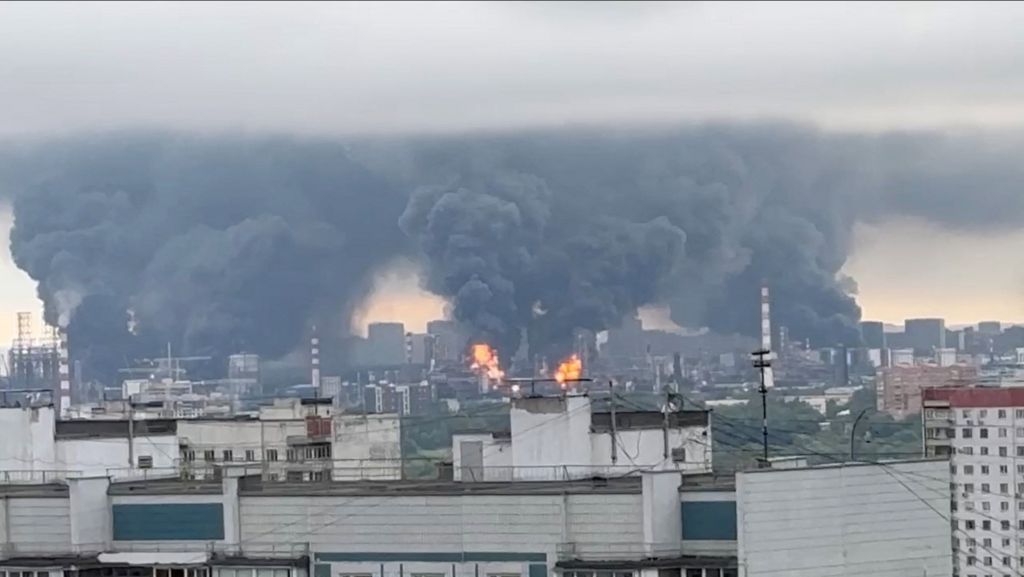
Nearly four and a half years after Russia launched its full-scale invasion of Ukraine, the largest recorded Ukrainian drone assault on the Russian capital has sent thick plumes of smoke billowing over Moscow’s skyline, marking a dramatic escalation of Kyiv’s long-range strike campaign against targets deep inside Russian territory. Close to 200 unmanned aerial vehicles targeted sites across the Moscow region in the coordinated attack, which Ukrainian officials have framed as a direct retaliation for a recent Russian strike that destroyed a major religious landmark in Kyiv.\n\nLocal Moscow region governor Andrei Vorobyov confirmed that 17 civilians sustained injuries in the assault. The Kapotnya oil refinery in southeast Moscow, a key energy infrastructure site, was hit for the third time in just one month and the second time this week, triggering large-scale fires that turned the sky black with toxic smoke. Footage circulating widely on social media — despite Russian government bans on publishing imagery of drone strike aftermath — captured an oil storage tank lid blown dozens of meters into the air by the force of the explosion. Falling drone debris also sparked a fire at a nearby shopping mall and forced evacuation of multiple residential high-rise buildings. All four of Moscow’s major commercial airports suspended operations for several hours, disrupting more than 500 incoming and outgoing flights that were either canceled or delayed.\n\nBeyond the Moscow region, the assault extended across other parts of Russia. An oil depot in the southern Rostov region was struck, killing one civilian, according to preliminary official reports. Russia’s Ministry of Defense claimed that its air defense systems intercepted and destroyed nearly 1,000 drones and four Ukrainian cruise missiles across the entire country over a 24-hour period surrounding the attack. These numbers have not been independently verified, and Ukraine has not confirmed the total volume of munitions launched in the operation.\n\nUkrainian President Volodymyr Zelenskyy openly claimed responsibility for the strike, referring to the assault on the Moscow region as “long-range sanctions,” Kyiv’s standard euphemism for long-distance strikes on Russian territory. He emphasized that the large-scale attack was a direct response to last week’s Russian bombardment of Kyiv that left a prominent religious landmark engulfed in flames. “We don’t want this war and have never wanted it,” Zelenskyy said in remarks following the assault. “But if Ukraine burns, your Moscow will burn too.” He added that a diplomatic end to the conflict remains Kyiv’s goal, urging Russia to take necessary steps toward negotiated peace.\n\nThe mass drone strike marks a clear milestone in the evolution of Kyiv’s long-range strike capabilities. Strikes on Moscow, located roughly 310 miles from the Ukrainian border, were rare just two years ago: Ukraine’s first successful drone attacks on the capital only began in spring 2023, and early strikes were sporadic, usually involving fewer than five drones. As Ukraine has expanded its domestic drone production and improved its long-range technology, attacks on Russian core territory have grown steadily more frequent and larger in scale. While Russia has constructed layered air defense networks around Moscow in response to the growing threat, the sheer number of drones deployed in this latest assault allowed multiple weapons to penetrate the defensive shield and hit intended targets.\n\nThe strike campaign against Moscow and other major Russian cities aligns with Zelenskyy’s stated strategy of “bringing the war home” to ordinary Russian citizens, who have largely been shielded from direct impacts of the conflict that their country launched. While the grinding war of attrition continues along the hundreds of kilometers of front line in eastern and southern Ukraine, most Russians have experienced little direct disruption to daily life — a reality that Kyiv is seeking to change with deep strikes on infrastructure and population centers.\n\nIn a tit-for-tat escalation, Kyiv confirmed that Russia launched its own large-scale overnight assault following the Moscow attack, deploying more than 200 drones and multiple ballistic missiles across Ukrainian territory. No immediate casualty figures for this retaliatory strike were released as of the latest reports.\n\nRussian President Vladimir Putin has not issued any public statement on the large-scale attack on the capital. At the time of the assault, Putin was hosting a summit of Southeast Asian leaders in the central Russian city of Kazan, hundreds of kilometers east of Moscow.\n\nUkrainian Foreign Minister Andriy Sybiha amplified Kyiv’s messaging in a post on the social platform X, directly addressing residents of Moscow. “One of the most popular questions asked by Muscovites this morning is ‘What is going on?’” Sybiha wrote. “I can answer. Your country started a war of aggression against ours. For years, it has been killing our people. Now that you know what’s going on, ask Putin when he is planning to end it.”