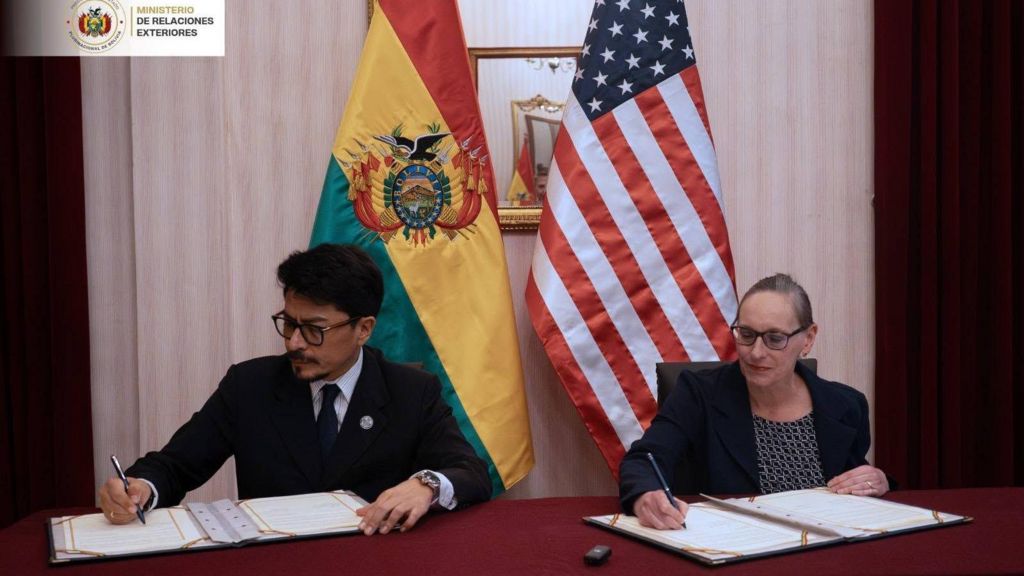
Nearly two decades after Bolivia expelled the U.S. Drug Enforcement Administration (DEA) from its territory under former President Evo Morales, the Andean nation has marked a sharp reversal of course by inking a new bilateral counter-narcotics cooperation agreement with the United States. The landmark deal, signed in Bolivia’s administrative capital La Paz, will see Washington provide up to $20 million (£15 million) to train and equip local Bolivian security forces for the joint campaign against transnational drug smuggling, Bolivia’s foreign ministry confirmed.
As the world’s third-largest producer of coca, the base raw material for cocaine, Bolivia holds significant strategic importance in global counter-narcotics efforts. This new agreement is the clearest signal yet of warming relations between the two countries following the election of centrist President Rodrigo Paz. Since taking office, Paz has moved Bolivia back into alignment with U.S. security priorities in the Western Hemisphere, most recently joining the Shield of the Americas, a regional security initiative spearheaded by the United States.
The signing comes less than two weeks after Paz appointed Ernesto Justiniano, the country’s recently named “drug czar,” as Bolivia’s new defense minister. In March of this year, Paz joined 12 other regional leaders at the inaugural Shield of the Americas summit hosted by U.S. President Donald Trump in Florida. In recent weeks, alliance member states have thrown their public support behind Paz amid a growing wave of anti-government protests and road blockades targeting his administration. In a joint statement released May 21, the coalition reaffirmed that it “stands with the government of Bolivia” and voiced deep concern over protests aimed at subverting constitutional order and destabilizing the democratically elected government.
While counter-narcotics collaboration is the core of the new Bolivia-U.S. deal, the broader Shield of the Americas initiative is framed by its creators as a campaign to combat what it labels “narco-terrorism.” As part of his stated pledge to block illicit drugs from reaching U.S. consumers, President Trump has also authorized U.S. military forces to target watercraft suspected of smuggling controlled substances across international waters. Since early September, these strikes have killed more than 200 people in Caribbean and Pacific waters, a tactic that has drawn sharp criticism from legal experts who argue the operations violate fundamental norms of international law.
In the most recent of these strikes, confirmed by U.S. Southern Command (Southcom) on Tuesday, one person aboard the targeted vessel was killed and two others survived. Southcom claims intelligence confirmed the vessel was involved in active drug trafficking operations, but has not released any public evidence to back this assertion. The U.S. embassy in Bolivia has confirmed to Agence France-Presse that Washington will “work closely with the Bolivian government to provide training, equipment, and other forms of support” under the new agreement. The BBC has also reached out to the embassy for additional comment, and Bolivia’s foreign ministry says the overarching goal of the pact is to strengthen domestic institutions responsible for public security, criminal investigation, and countering transnational organized crime.