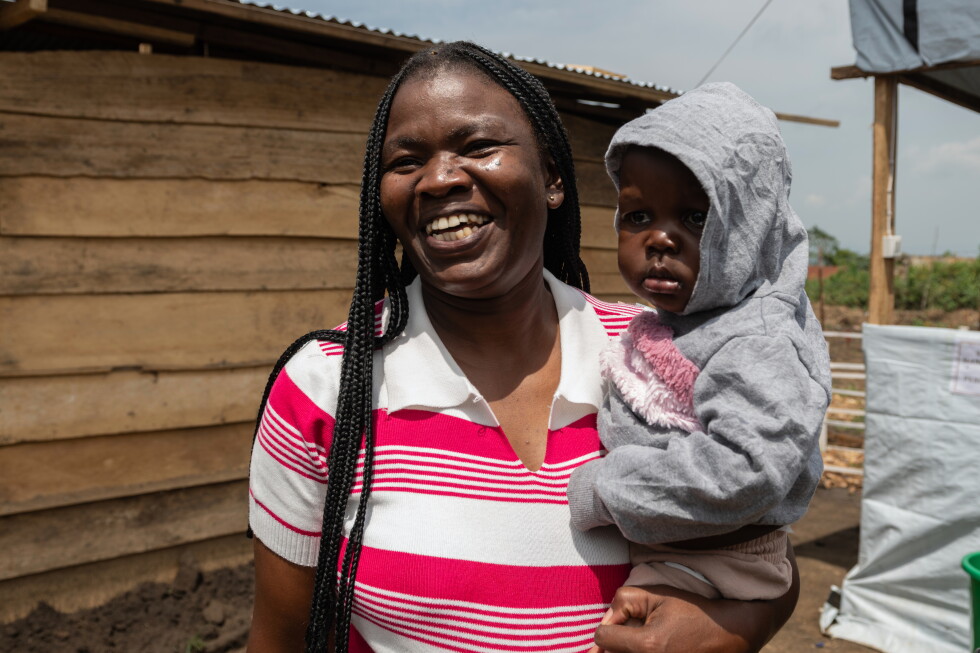
In the conflict-stricken eastern Democratic Republic of the Congo, a glimmer of hope has emerged amid a rapidly spreading Ebola crisis: a 16-month-old infant and his mother have successfully overcome the deadly virus and been discharged from a local treatment center. The pair left the Rwampara Treatment Center near Bunia, the capital of Ituri province — the current epicenter of the outbreak — on Tuesday, alongside five other patients who also achieved full recovery from Ebola.
For Kahindo Mireille Pierrette, the mother of the recovering infant, the relief and joy of her child’s survival are overwhelming. “The joy is immense given the state he was in at first,” she shared. “If you had seen him before, you wouldn’t believe he could have this strength now.” Pierrette explained that she rushed her son to the treatment center in late May, after he developed frightening Ebola symptoms: uncontrollable bleeding from the mouth and nose, and extreme weakness that left him barely able to move. Dr. Modet Camara, a clinical lead at the treatment facility, confirmed that the infant received a positive Ebola result via PCR testing on his second day of admission, and was immediately placed on targeted supportive care including antibiotics to manage secondary infections.
As of Tuesday, Congo’s Ministry of Health has confirmed 837 Ebola cases and 196 confirmed deaths since the outbreak was formally declared on May 15. However, public health officials warn the true case count is almost certainly higher, because the virus began spreading undetected for weeks before official confirmation was announced. To date, only 49 patients across the affected region have recovered from the virus, according to government data.
What makes this outbreak particularly challenging for response teams is that it is driven by the rare Bundibugyo Ebola strain, a variant for which no approved vaccines or specific antiviral treatments currently exist. This marks a departure from Congo’s 16 previous Ebola outbreaks, which were overwhelmingly caused by the more common Zaire strain — a variant for which an effective, approved vaccine is already available.
More than 90% of all current cases are concentrated in Ituri province, though infections have also been documented in neighboring North Kivu and South Kivu provinces, and the virus has already crossed the international border into Uganda. Speaking during a virtual meeting of African heads of state on Tuesday, Africa Centres for Disease Control and Prevention Director-General Jean Kaseya issued a stark warning about the outbreak’s trajectory: if spread is not rapidly contained, it could surpass the 2014–2016 West African outbreak to become the deadliest Ebola event on record. Kaseya highlighted that tens of thousands of close contacts of confirmed Ebola patients have not yet been traced and monitored, creating a large pool for potential further transmission.
The 2014 West African outbreak remains the worst Ebola event in recorded history, with more than 28,000 confirmed cases and over 11,000 reported deaths across Guinea, Liberia, and Sierra Leone.
Multiple structural challenges are hampering containment efforts in eastern Congo. The United Nations Office for the Coordination of Humanitarian Affairs estimates that years of ongoing armed conflict have displaced nearly one million people across Ituri province. As communities flee persistent attacks and move frequently through the region’s vast, dense forest landscape, which is crisscrossed by poor roads and dotted with remote villages that can take days to reach, contact tracing teams struggle to track exposed individuals and limit new transmissions. Additional complications come from the region’s large population of artisanal miners, who regularly move between remote mining sites in the mineral-rich province, making consistent monitoring of potential exposures nearly impossible. Local cultural preferences for traditional healers over formal hospital care have also slowed response efforts, as many infected people delay seeking treatment and continue to interact with their communities while contagious.