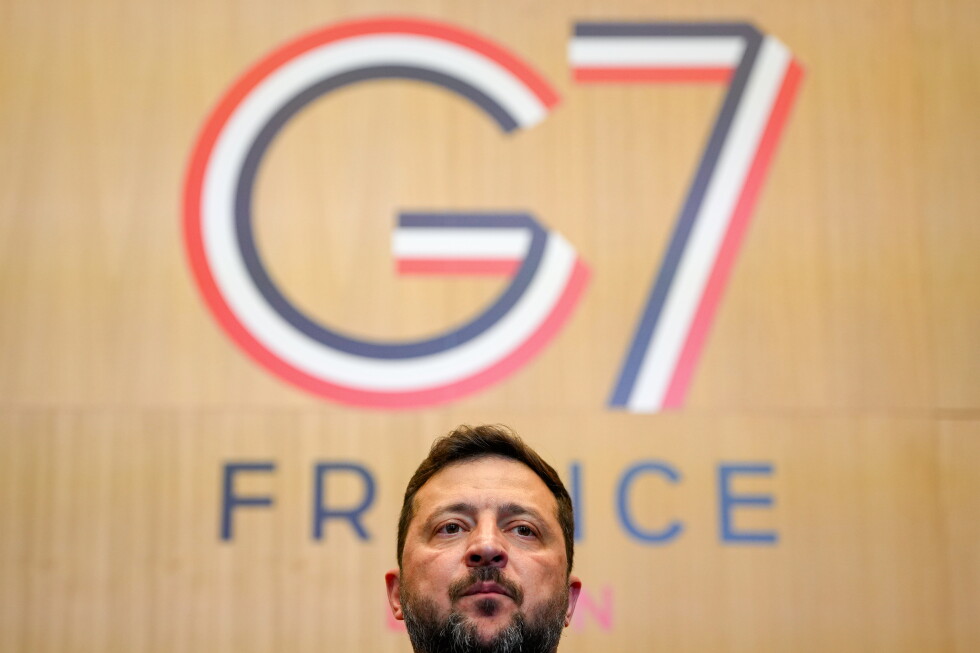
As Ukraine’s full-scale defensive war against Russia’s invasion enters its third year with no diplomatic or military resolution in sight, President Volodymyr Zelenskyy announced Wednesday that the country has secured new, binding commitments of additional backing from G7 leaders gathered for the group’s annual summit in France.
The leaders of the Group of Seven — the world’s seven largest advanced industrial economies — have pledged to reinforce Ukraine’s critical air defense systems, shore up the country’s energy infrastructure ahead of future Russian attacks targeting power grids, and ramp up coordinated international economic sanctions to increase pressure on Moscow, Zelenskyy confirmed in a post on X, the social media platform formerly known as Twitter. The Ukrainian president attended the summit in person to push for renewed global backing for his country’s war effort.
“The G7 Summit in France delivered important results for Ukraine. Most importantly, we agreed on additional strengthening of Ukraine’s air defense,” Zelenskyy wrote. “Our partners will ensure support for our defense and energy resilience,” he added, noting that new restrictive measures targeting Russia would also be implemented.
Since Russia launched its full-scale invasion in February 2022, Zelenskyy has made global diplomatic outreach a core priority, working steadily to secure military and humanitarian aid from Western allies while isolating Putin and his regime on the international stage. Fresh off the G7 gathering, Zelenskyy was scheduled to travel to Brussels Thursday for a European Union summit, coming just days after Ukraine formally launched accession negotiations with the bloc Monday. The membership process is expected to take years of political and economic reforms, even as the country continues to defend its territory against Russian occupation.
In a joint official statement released after the summit, all G7 members — Japan, the United Kingdom, France, Germany, Italy, Canada, and the United States — formally endorsed Ukraine’s resistance, praising Kyiv’s recent advances on the front lines. “We commend Ukraine for its resilience and progress on the battlefield in recent months and emphasize there is now a new momentum” in Kyiv’s resistance, the statement read.
Western political and military analysts have confirmed that Ukraine’s battlefield capabilities have improved notably in recent months, driven in large part by the effective use of advanced domestic drone technology. Ukrainian drones have successfully pinned Russian frontline troops in occupied territories, choked off critical Russian supply lines, and carried out strikes disrupting oil production deep inside Russian territory — a key source of revenue for the Kremlin’s war machine. These strikes have also brought the reality of the conflict, which Putin labels a “special military operation”, directly to Russian civilians, growing domestic pressure on the Russian president, according to analysts.
Despite these gains, Ukraine still faces critical gaps in its defensive capabilities: the country is currently facing a shortage of U.S.-made Patriot air defense missiles, a shortfall partially driven by depleted U.S. stockpiles that have been drawn down to support U.S. efforts in the ongoing Iran conflict. The shortage leaves Ukraine vulnerable to Russia’s regular strategic ballistic missile bombardment campaign targeting civilian and energy infrastructure. The G7 joint statement committed to delivering additional air defense assets to Ukraine but did not specify what types of weapons or what volume of supplies would be provided. Leaders also added that they are considering approving license agreements to allow Ukraine to manufacture Western-designed weapons domestically, a longstanding request from Kyiv that includes domestic production of Patriot missiles.
The G7 summit meeting also came as ongoing conflicts in the Middle East have shifted Washington’s focus away from Ukraine, after more than a year of diplomatic efforts to end the war have failed to produce a breakthrough. On the sidelines of the G7, Zelenskyy held talks with U.S. President Donald Trump alongside key European leaders, as part of his push to sustain U.S. backing for Kyiv. Putin has for his part attempted to bypass both Europe and Kyiv to negotiate directly with Washington over the future of Ukraine.
On Wednesday, separate reports of cross-border attacks continued: a Ukrainian regional official confirmed that a Russian drone strike hit a children’s equestrian school in the northeastern Sumy region, striking the facility’s stable and killing multiple horses. Preliminary reports indicate no civilian staff were injured in the overnight attack, according to Sumy regional military administration head Oleh Hryhorov. On the Russian side, the country’s Defense Ministry claimed that its air defense systems intercepted and downed 157 Ukrainian drones between late Tuesday and early Wednesday.
This reporting featured contributions from AP correspondents Illia Novikov based in Kyiv, Ukraine, and Barry Hatton based in Lisbon, Portugal.