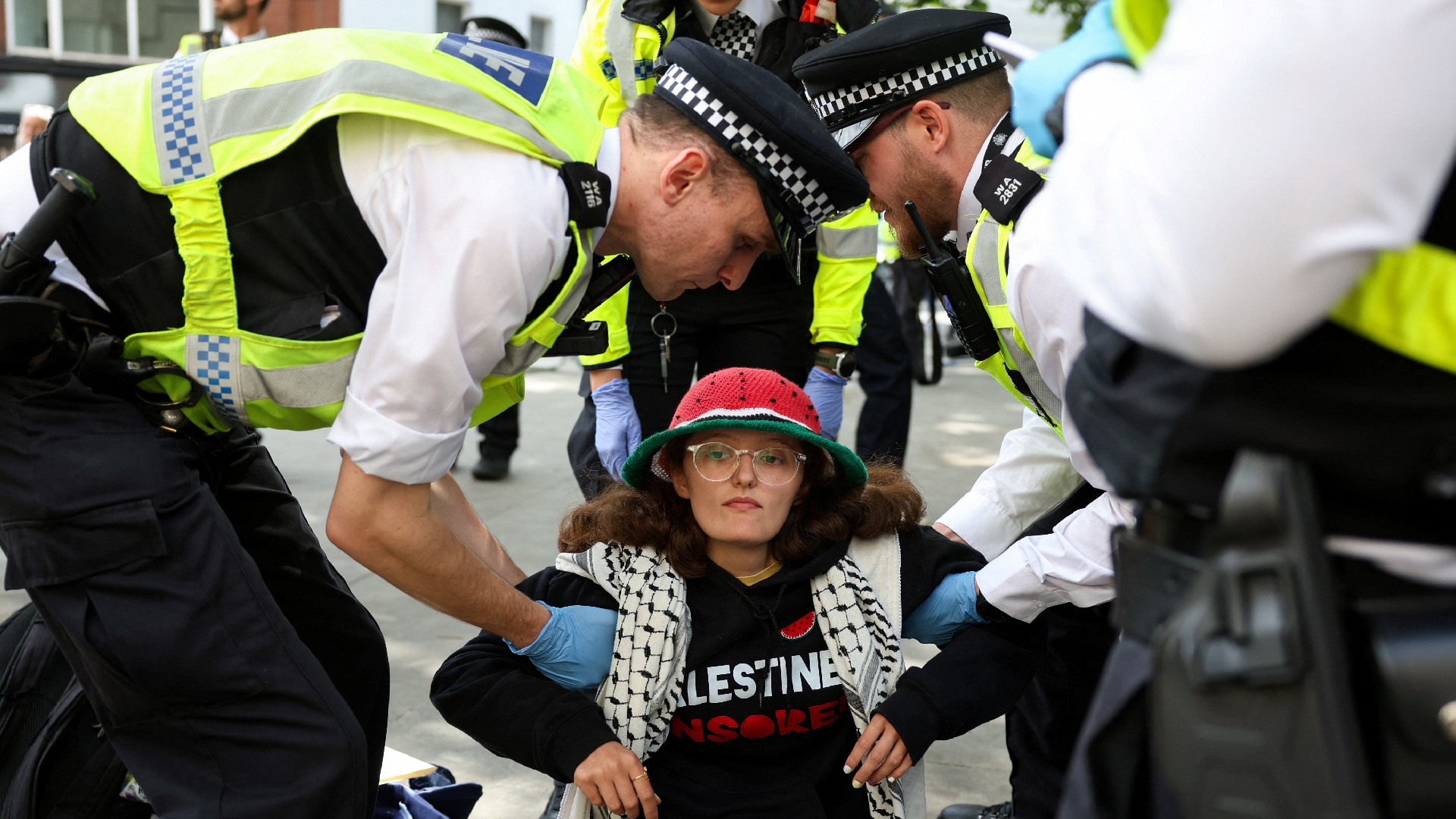
In a high-stakes legal ruling delivered on Monday, five senior judges at the UK Court of Appeal overturned a prior High Court decision that had deemed the UK government’s ban on direct action group Palestine Action unlawful. The appeal judgment, led by Lady Chief Justice Sue Carr, drew sharp lines to distinguish Palestine Action from historic movements that deployed civil disobedience, claiming the organization operates not as an open civil disobedience network aligned with the legacy of suffragettes, but rather as a covert entity organized into secret cells. This structure, the court argued, is intentionally designed to shield members who use violence to damage third-party property, with the group’s activities having already resulted in both physical injury and widespread property destruction, per the ruling.
The court’s comparison between Palestine Action and the early 20th century suffragette movement, however, has sparked fierce pushback from legal experts and historians, who accuse judges of deliberately whitewashing suffragette history to fit their narrative. Critics note the Court of Appeal’s characterization of the suffragettes as exclusively non-violent, transparent activists is a widely debunked myth that erases the movement’s well-documented turn to militancy.
Former government lawyer Tim Crosland, who has advised multiple climate direct action groups, described the court’s framing as a propagated historical fantasy. “The whitewashing of that history, making out that they broke at half time to have cucumber sandwiches with the police is quite alarming,” he told independent outlet Middle East Eye.
Historical records confirm this critique: the Women’s Social and Political Union (WSPU), the militant core of the British suffrage movement, began as an open campaign but escalated its tactics after 1912 following repeated government repression. The movement shifted to covert operations, organized into secret cells to carry out arson and bombing attacks targeting public infrastructure, political venues, and the homes of anti-suffrage politicians. One specialized cell, the Young Hot Bloods, was explicitly formed to conduct high-risk militant actions, with members pledging to accept “danger duty.” While the majority of attacks targeted property, they still left a trail of harm: crude homemade bombs were placed in occupied train carriages, and phosphorus parcels mailed to officials left multiple postmen with severe burns. Contemporary authorities at the time labeled the campaign a “reign of terror,” with national headlines branding the actions “Suffragette Terrorism.” Emmeline Pankhurst, the movement’s iconic leader, defended the shift to militancy in her pamphlet *Why We Are Militant*, arguing that violence and property damage are only justified when all peaceful avenues to secure justice have already been exhausted.
Palestine Action co-founder Huda Ammori has outright rejected the Court of Appeal’s description of her group as a covert, secretive organization. She emphasized that the vast majority of the group’s actions are open and accountable, with activists deliberately accepting arrest as part of their protest strategy. Actions such as factory blockades, roof occupations, and site takeovers are all carried out with the full knowledge that participants will face legal consequences, she explained.
Addressing the court’s reference to an “underground manual” that the ruling claims advocates for property destruction and evasion of detection, Ammori pushed back on the sinister framing. She described the document as simply a compiled collection of public resources for volunteers across different regions, most of which are already freely available on other activist group websites. Even open, accountable direct action requires basic digital security planning to protect participants, she added, noting that such precautions are a necessary requirement for any sustained social movement.
Crosland echoed this point, arguing that covert operational planning is a universal feature of all direct action groups, not a unique mark of extremism. “Otherwise, you’ll be stopped when you leave the house,” he explained, arguing that it is deliberately disingenuous to use this standard to isolate Palestine Action from other historic and contemporary protest movements. He added that the distorted historical framing is a deliberate tactic to justify authoritarian action against the group, by erasing the precedent of militancy in past accepted movements.
The Court of Appeal’s ruling also went further, claiming that Palestine Action has little to no common ground with other historic protest movements, including anti-apartheid campaigners and groups opposing the 2003 Iraq War. This claim has also been debunked by historical context: the African National Congress (ANC), the group that led the fight against apartheid in South Africa, initially relied on peaceful civil disobedience before shifting to armed sabotage of state infrastructure after the 1960 Sharpeville Massacre, when police killed 69 unarmed protesters. Outlawed by the apartheid government, the ANC was forced to operate entirely underground, with its leader Nelson Mandela defending the turn to militancy during his 1964 sabotage trial. Mandela argued that violence became inevitable only after all peaceful channels of protest were closed off by the state, a position mirroring Pankhurst’s justification a half century earlier.
The Court of Appeal explicitly referenced a landmark 2006 ruling in *R v Jones*, a case involving anti-war activists who broke into a UK Royal Air Force base to damage fuel tanks and bomb trailers, in a bid to stop US aircraft from participating in the 2003 invasion of Iraq. In that ruling, Lord Hoffmann affirmed the long, honorable tradition of civil disobedience in democratic societies, noting that activists who break the law to protest unjust government policy are often vindicated by history – and he explicitly named the suffragettes as a core example of this legacy. Hoffmann established what became known as “Hoffmann’s bargain,” which held that protesters who act with a sense of proportionality can reasonably expect the state to respond with proportionate restraint. The activists in that case received only conditional discharges and curfew orders, rather than harsh prison sentences or blanket bans.
In the current ruling, however, the Court of Appeal argued that Palestine Action is the complete antithesis of the honorable civil disobedience movement outlined by Hoffmann. Crosland rejects this framing, arguing it amounts to deliberate historical misrepresentation designed to justify a harsh, disproportionate crackdown on Palestine Action.
The original reporting was published by Middle East Eye, an independent outlet covering the Middle East, North Africa and global affairs.