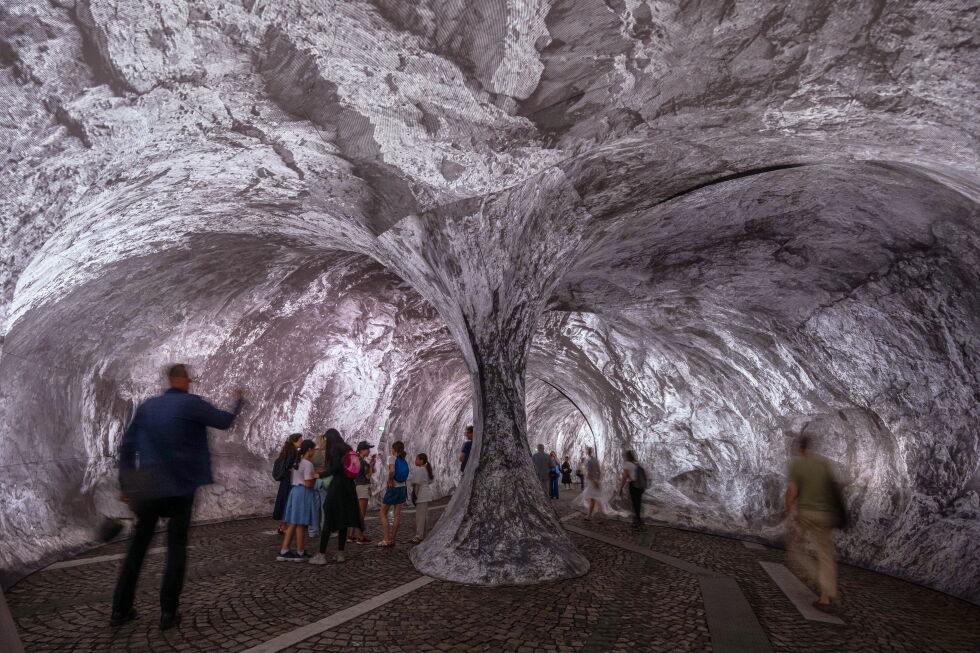
For weeks, an imposing black artificial mountain stood in the place of Paris’ iconic Pont Neuf, drawing curiosity from locals and tourists alike. On a Monday evening, that structure finally opened its doors to visitors, welcoming members of the public into a one-of-a-kind multisensory art experience that reimagines one of the French capital’s most historic landmarks.
Dubbed the Pont Neuf Cavern, this large-scale installation is the work of celebrated French street artist JR, often referred to as France’s answer to Banksy. Free and open to the public 24 hours a day through June 28, the temporary work transforms the 17th-century bridge into a man-made cave that rises 59 feet above the surface of the Seine. Constructed primarily from printed fabric and inflated to hold its shape, the installation invites guests to step away from the sunlit riverbank and into a dim, atmospheric passage that reframes how visitors interact with the centuries-old crossing.
As visitors walk along the original undulating cobblestones of the Pont Neuf, their senses are immediately engaged by the space. The walls are lined with glowing photographic prints of natural cave formations, while a low, rhythmic electronic hum hums through the structure, setting a meditative, ancient tone. The most striking element of the illusion, however, is its custom scent design, crafted to make visitors feel they have stepped into a deep, natural underground space.
Olfactory specialist Sarah Bouasse developed two evolving scent profiles for the installation, centered on geosmin and isoborneol — the natural chemical compounds that create the signature smell of rain hitting dry earth. The aroma shifts gradually as visitors cross the bridge, starting with crisp notes of damp soil and mineral-rich stone before transitioning into warmer, smokier, faintly earthy tones that deepen the immersive illusion. For many regular visitors to the bridge, the experience is transformative. “Usually I cross here without looking up once,” shared Michel Dupré, a 67-year-old Parisian retiree, after stepping back out into daylight. “Today I felt the stones under my feet. And smelled them too. It makes you walk like a child again.” Léa Martin, a 22-year-old art student visiting from Lyon, echoed that sense of disconnection from the familiar city. “It feels like the city has disappeared,” she said. “You know the river is right outside, but for a moment you’re somewhere ancient.”
Complementing the scent and visual design is a custom sound installation created by Thomas Bangalter, former member of legendary French electronic music duo Daft Punk. His score fills the cavern with soft rumbles, echoing vibrations and steady rhythmic pulses that amplify the feeling of being deep within a natural cave.
Beyond its immersive design, the installation carries intentional artistic and historical context. Despite its name meaning “New Bridge”, Pont Neuf, completed in 1607, is the oldest standing bridge in Paris, with a history stretching back decades before the French Revolution. JR’s work also pays homage to the iconic late artist duo Christo and Jeanne-Claude, who wrapped the entire bridge in shimmering pale golden fabric for a landmark 1985 installation that drew an estimated 3 million visitors. Where Christo and Jeanne-Claude bathed the bridge in light, JR has chosen to envelop it in darkness, leaning into the metaphor of the cave. The artist draws direct links between his work and Plato’s famous Allegory of the Cave, in which trapped prisoners mistake shadows cast on a cave wall for real reality. JR argues that in the modern era, the “cave walls” that shape our perception are the digital screens and algorithmic feeds that frame most people’s daily experiences.
For visitors who want a digital layer to their experience, JR has partnered with tech company Snap to add an optional augmented reality component: guests can activate the feature with their smartphones to see digital light-trailing bats, ghostly afterimages of passing visitors and a materializing digital dancer within the cave space. Even without the AR add-on, however, visitors say the installation has a powerful effect. Nadia Benali, a 34-year-old visitor, noted that Paris is often defined by its constant rush, making the installation a much-needed pause. “It’s completely strange,” she said, smiling beside the artificial cliff walls. “Paris needs things that make people stop.”
When the installation closes on June 28, all of its fabric components will be reused or recycled, aligning with sustainable temporary art practices. The artificial mountain will be disassembled, regular traffic will return to the bridge, and the centuries-old Pont Neuf will once again stand fully exposed to the Paris light — leaving behind a new shared memory of a familiar landmark seen through entirely new senses.