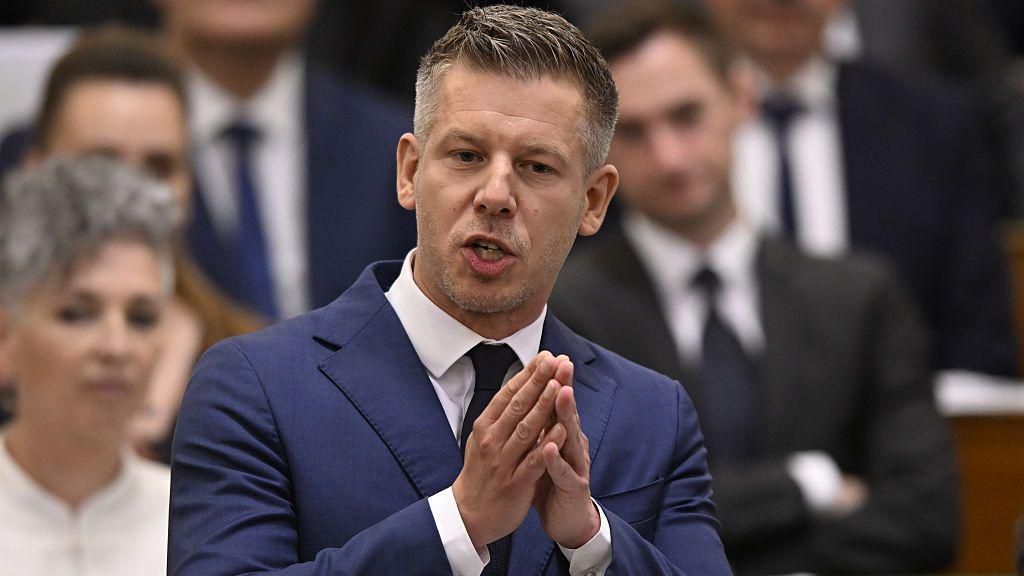
Hungary’s newly elected national legislature has approved a landmark constitutional amendment that caps a prime minister’s cumulative time in office at eight years, a long-promised reform from Prime Minister Péter Magyar’s Tisza Party that explicitly bars former long-serving leader Viktor Orbán from returning to the top executive post.
Orbán, who led Hungary without interruption for 16 years, was unseated in a landslide April election that handed Tisza a two-thirds supermajority in parliament — enough voting power to unilaterally amend the country’s constitution. The new rule applies retroactively to all prime ministers who have held office since 1990, counting non-consecutive terms toward the two-term limit. The amendment also inherently restricts Magyar’s own tenure, capping his time in office at 2034 if he wins re-election.
The amendment passed by a lopsided 135-50 vote, with Orbán’s greatly reduced Fidesz party uniformly opposing the measure. Orbán, who was just re-elected as Fidesz leader over the weekend, lashed out at the new government in a Facebook post following the vote, framing the reform as a partisan power grab.
“The Orban law has just been voted through. That was the most pressing issue. If I’m needed, I’ll be here,” Orbán wrote, adding that it was irresponsible for the Tisza administration — which had only been in power for one month when the amendment was approved — to lock in term limits nearly a decade into the future.
Balázs Orbán, Viktor Orbán’s former political director and a senior Fidesz lawmaker, doubled down on the criticism, accusing Magyar of abusing his parliamentary supermajority to eliminate a political rival from democratic competition. The accusation sparked a heated parliamentary clash between Balázs Orbán and the prime minister during the legislative session.
Beyond the term limit provision, the constitutional amendment scraps a controversial requirement to maintain an independent agency tasked with protecting Hungary’s “constitutional identity” — effectively dissolving Orbán’s Sovereignty Protection Office, a body created in 2023 to monitor purported “undue foreign interference” in Hungarian politics. The reform also opens the door to restructuring the so-called Kekva public trust foundations, which were established by the Fidesz government to transfer state assets, including major corporations and higher education institutions, to Fidesz-aligned entities.
One prominent target of the restructuring is the Mathias Corvinus Collegium, a prominent vocational education institution whose board of trustees is led by Balázs Orbán and maintains close ties to Fidesz. The Tisza government plans to either return transferred assets to state control or cut public funding for aligned institutions like MCC.
Magyar took office last month on a platform of dismantling the centralized, controversial state apparatus built by Fidesz during 16 years of rule. For four consecutive years, Transparency International has ranked Hungary as the European Union’s most corrupt member state, and the EU froze more than €16 billion in cohesion funds over widespread concerns about democratic backsliding, rule of law violations, and public corruption. Just last month, the European Commission agreed to unfreeze the €16.4 billion package, contingent on the Hungarian parliament passing a series of anti-corruption and governance reforms.
On the day after the constitutional amendment vote, parliament turned its attention to the next slate of reforms required to unlock the frozen EU funds, including measures to strengthen the mandate and independence of Hungary’s anti-corruption watchdog, the Integrity Authority. Tuesday’s session also included a formal commemoration of the 70th anniversary of the execution of 1956 Hungarian Revolution leaders, who were executed by Soviet-aligned authorities after the uprising was crushed. Magyar individually honored each of the six executed leaders, including former Prime Minister Imre Nagy, and lawmakers marked the anniversary of their 1989 reburial.
In remarks during the commemoration, Magyar framed the recent election and reform push as a new chapter for Hungary’s place in the free world, noting that Hungarians will mark the 70th anniversary of the 1956 uprising this October against a backdrop of renewed democratic change. Balázs Orbán meanwhile criticized the government’s reform agenda, claiming it has left thousands of Hungarian students facing uncertain futures as institutional restructuring moves forward.